Ultrashort metal–metal contacts are favoured when the valence configuration fills strongly metal–metal-bonding orbitals while leaving their antibonding partners empty. Early or middle transition metals in low oxidation states can retain enough d electrons for multiple bonding without the unavoidable antibonding occupation of a more filled d shell. Good radial and angular overlap, a compatible metal–metal axis, and low competing ligand-field stabilization all matter; a short contact should be interpreted together with an orbital/electron-counting model, not automatically called a high-order bond.
Ligands should support a geometry in which the relevant d orbitals can overlap and protect the low-valent pair from oligomerization or oxidative attack. Bulky aryl-substituted bridging amidinates can provide this protection while maintaining an appropriate small coordination number. Strongly coordinating axial ligands or inappropriate pi interactions can compete with metal–metal bonding, especially its weaker delta components. For quadruple or quintuple bonds, retaining two appropriately oriented delta-capable orbitals is particularly important; a geometry optimized only for metal–ligand bonding can remove that advantage.
Ligand bridges need not literally squeeze two otherwise unbound metals together. Comparing bond lengths across oxidation states and across related ligands helps distinguish electronic multiple bonding from enforced steric compression. The lantern-type dichromium experiment in (ii) is informative because reduction changes the electron occupation within essentially the same three-bridge supporting framework.[ref]
Remarkably Short Metal-Metal Bonds: A Lantern-Type Quintuply Bonded Dichromium(I) Complex by Yi-Chou Tsai and others. 2008, printed pp. 7250–7253: mixed-valent precursor, reduced anion, orbital analysis and discussion of ligand constraints
chromium is the characteristic assignment, giving Cr(I)–Cr(I) with a formal quintuple bond. Each formamidinate is monoanionic, so gives . chromium(I) is and the pair supplies ten d electrons. Relative to a metal–metal axis, the idealized bonding combinations are sigma, pi and delta:End-on sigma overlap gives the largest splitting, pi overlap a smaller splitting, and delta overlap the weakest. A useful qualitative ordering places bonding sigma lowest, then the two pi combinations, then the two delta combinations; all are occupied. Their antibonding partners are empty, with the weakly split delta-star levels nearest their bonding counterparts. The actual three-bridge ligand field can mix and split symmetry-compatible levels, so the diagram is a bond-axis model rather than five perfectly degenerate metal d levels in the molecular complex.
The identified lantern-type anion has an experimentally determined Cr–Cr distance near Å; reduction of its nine-bonding-electron precursor supplies the tenth electron. This corroborates the model more specifically than citing “short bonds” in an unrelated framework.[ref]
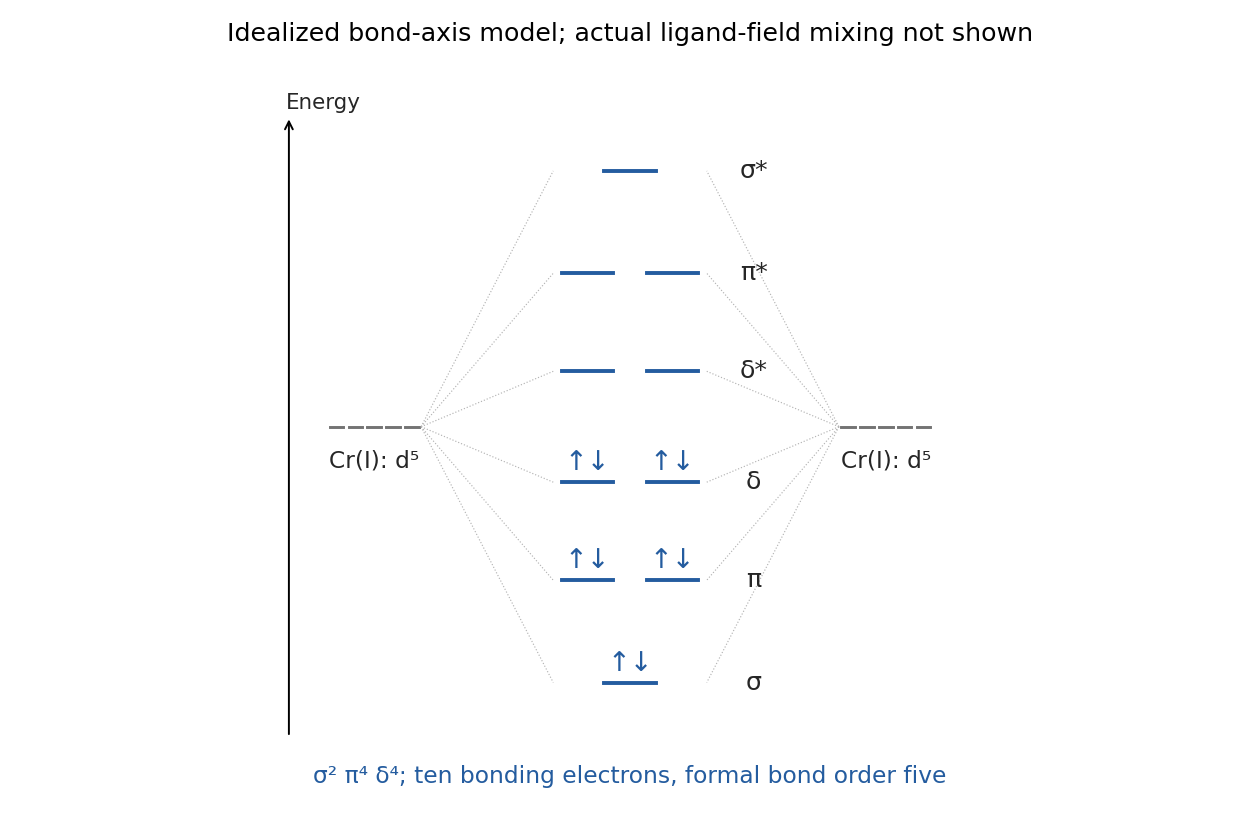
Original idealized d-orbital combinations and ten-electron occupancy for a sigma-two-pi-two-delta quintuple bond
. Details. 
Articles by others on the same topic
There are currently no matching articles.