Use the balanced aqueous-acid reactionA Hess cycle first atomizes the metal, then ionizes its gas-phase atoms, then hydrates the triply charged gas ions:Close the reference leg by combining the three electrons with to make . Calling that element-independent contribution givesA single-ion standard enthalpy of formation uses the conventional hydrogen-ion reference; it must not be treated as a balanced creation of net charge from neutral metal without an electron/reference term. The constant hydrogen leg does not affect comparisons along the lanthanide series.
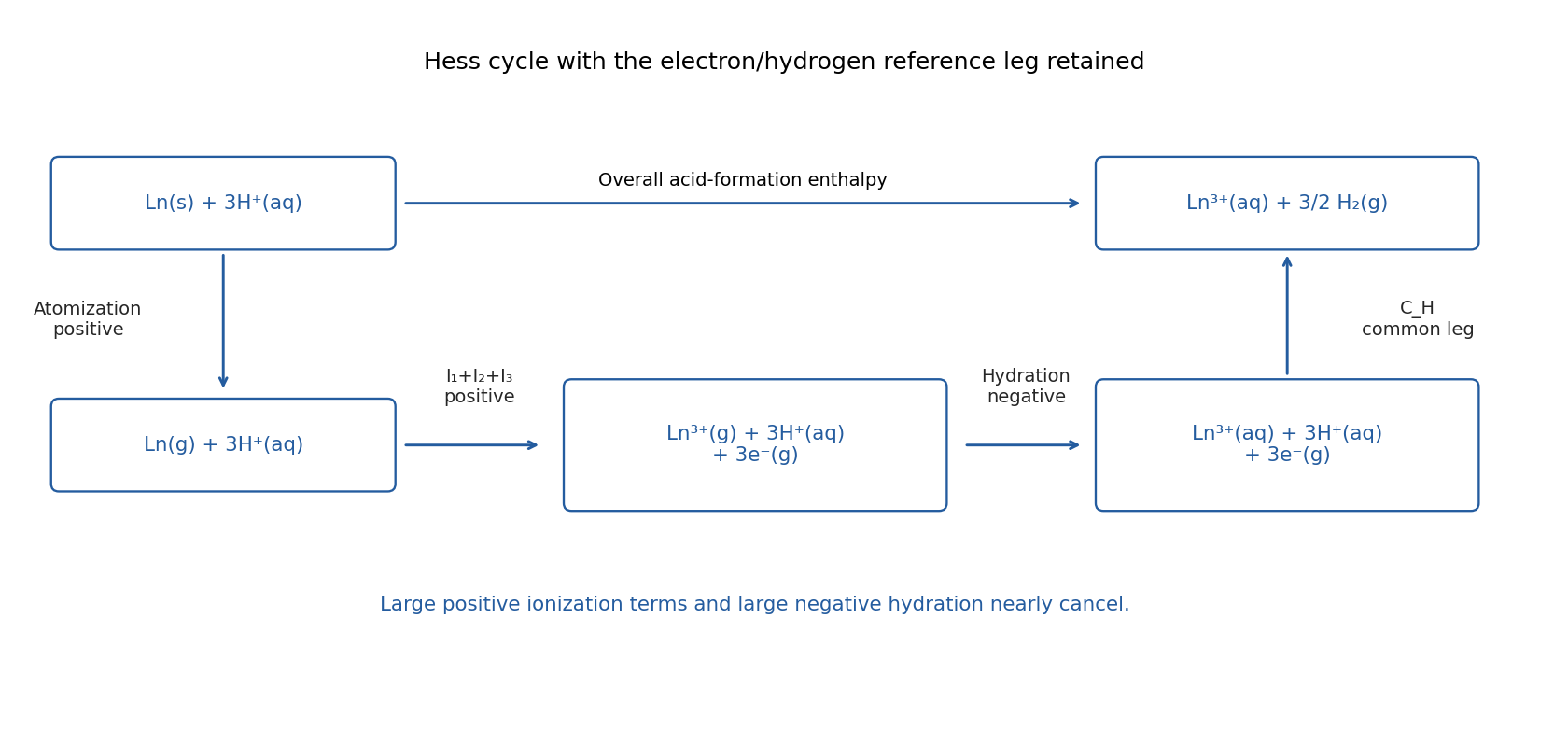
Original Hess cycle separating atomization, three ionizations, hydration and the common aqueous hydrogen reference leg
. Details. 
The large positive sum of ionization energies and large negative hydration enthalpy dominate, with a smaller but significant positive atomization term. Ionization depends on effective nuclear attraction, orbital energies and the stability of successive gas-ion electron configurations; removing the third electron may require disruption of a particularly stable divalent f configuration. Atomization depends on the metal's cohesive bonding and valence participation, and need not vary perfectly smoothly.
Hydration becomes more favourable for higher charge density. All the compared ions have charge , so smaller effective ionic radius generally gives more negative hydration enthalpy. Incomplete shielding by the 4f shell produces the lanthanide contraction and strengthens ion–water attraction along the series. A Born-type electrostatic estimate has a stabilization scale proportional to , but hydration-shell structure, water polarization and temperature dependence prevent treating that crude scale as an exact enthalpy formula. The hydration trend is smoother than the sharp configuration-dependent ionization anomalies. The measured formation enthalpy reflects cancellation of large terms, so comparison of just one term can give a misleading prediction.
The unusually stable divalent configurations Eu(II) and Yb(II) make their third ionization particularly costly. Forming Eu(III), , or Yb(III), removes an electron from a half-filled or filled f shell. The positive ionization-energy contribution therefore increases relative to the smoother background across the series.
Their trivalent ionic radii and hydration enthalpies do not supply a matching abrupt extra stabilization. Differences in atomization and the divalent character of elemental Eu and Yb partly compensate the ionization anomaly but do not erase the net less favourable trivalent aqueous formation enthalpy. This explanation concerns formation of the aqueous ions, not a claim that or is intrinsically the most stable isolated f configuration.
Articles by others on the same topic
There are currently no matching articles.