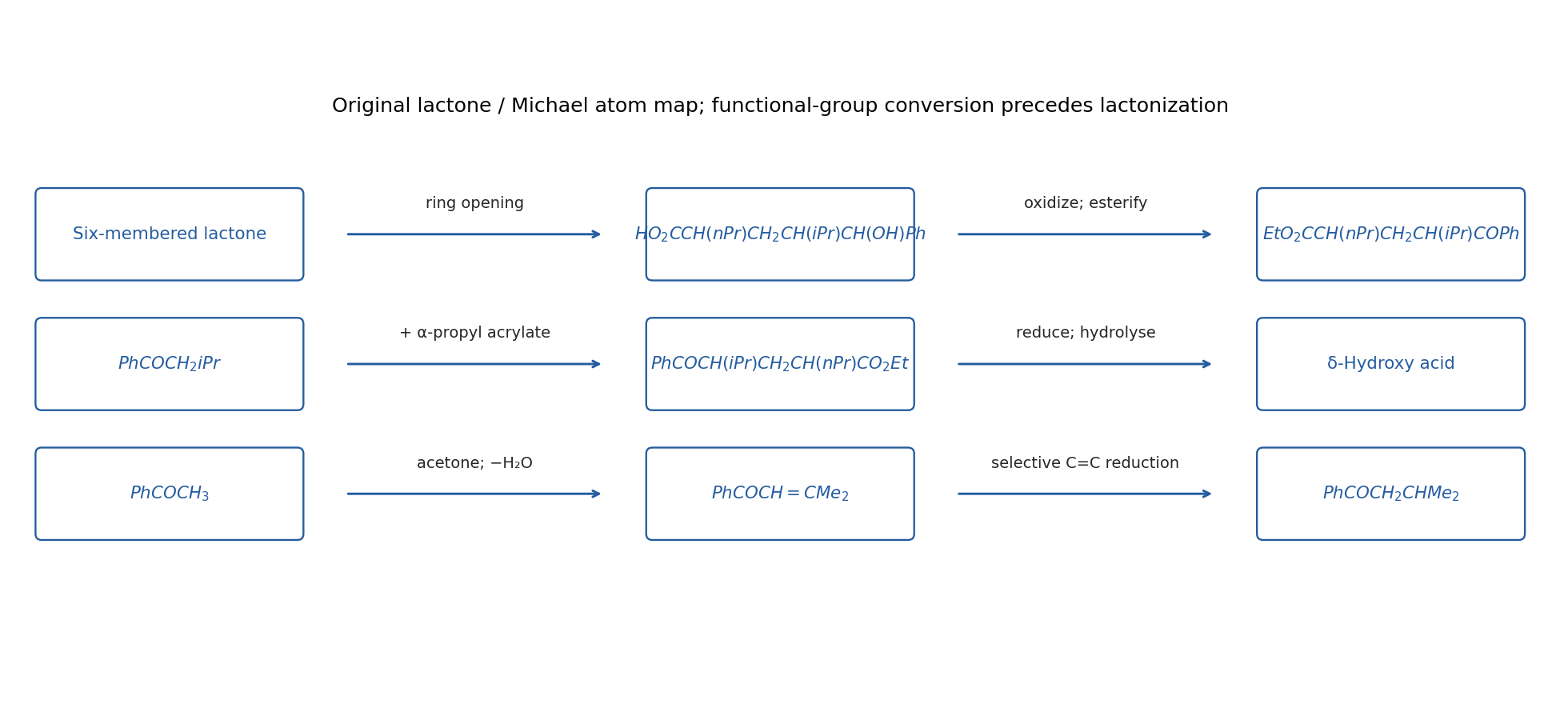
Open the cyclic ester at its acyl–oxygen bond. The resulting delta-hydroxy acid isOxidation-state reversal at the benzylic alcohol gives . This identifies the key Michael disconnection between the central and groups:The nucleophile is the enolate or enamine of the phenyl ketone. The electrophile's propyl substituent must be alpha to its ester carbonyl; using a beta-propyl acrylate would move the substituent to the wrong ring position.
Disconnect further to the indicated acetophenone. Crossed aldol addition to acetone followed by dehydration gives ; selective conjugate reduction or controlled alkene hydrogenation then gives . This avoids requiring an efficient SN2 alkylation with a secondary isopropyl halide. The alpha-propyl acrylate can be obtained by alpha-hydroxymethylation/dehydration of ethyl pentanoate, , using formaldehyde.
In the forward direction, perform the Michael coupling, reduce the phenyl ketone selectively with sodium borohydride while retaining the ordinary ester, hydrolyse the ester, and cyclize the delta-hydroxy acid by controlled acid-catalysed lactonization or an activated-acid coupling. The six-membered ring then has the order carbonyl–––––O. This atom order checks all three substituent positions. No relative configuration is specified, so the scheme does not imply a single diastereomer from the Michael addition or reduction.

Articles by others on the same topic
There are currently no matching articles.