Write . The alternating-vertex cubane A is ; replacing one or two methyl vertices gives and . Balanced redistributions areThe smaller aggregate has composition , since the conventional masses or match the supplied values. Thus is another balanced redistribution.
For the structures, place Li on one tetrahedral set of cube corners and Me/X on the complementary set, joining adjacent unlike vertices. A contains four Me vertices, B three Me and one X, and C two of each. D is a four-membered alternating Li-Me-Li-X ring. The quoted relative masses use conventional elemental masses; a fully Li-enriched D would be approximately two mass units lighter, without changing its composition.
Useful isotope-selection factors include spin and quadrupole moment, gyromagnetic ratio, natural abundance or enrichment, sensitivity at the available field, line widths and relaxation, chemical-shift dispersion and the couplings needed for structural assignment. Both lithium isotopes are quadrupolar, but Li has a much smaller quadrupole moment and often much narrower lines, allowing inequivalent sites and carbon-lithium couplings to be resolved. Enrichment compensates its low natural abundance and removes isotope-mixture complexity.
Fully enriched Li would generally be more sensitive but broader in these aggregates. Its chemical-shift pattern would remain chemically similar, although isotope shifts and dynamics can make small differences. Resolved H-Li couplings increase in frequency approximately with and have different multiplicities because changes from to : equivalent Li nuclei give lines. If such long-range proton couplings remain unresolved, the main visible difference can instead be broadened lines. One should not invent resolved multiplets absent from the printed spectra.
The nucleus-count ratios H:Li are A, ; B, ; C, ; D, . Enrichment changes which isotope is counted but not these stoichiometric ratios.
Quantitative lithium integration requires adequate excitation bandwidth, a suitable calibrated pulse, acquisition of the entire broad as well as narrow signal, correct baseline/phasing and no differential saturation. Recycle delays should be long relative to the slowest relevant longitudinal relaxation time, or saturation must be measured and corrected. Exchange and unresolved overlap must be handled in the integrated areas. Proton and lithium spectra also require a stated relative calibration before raw numbers can be compared across nuclei.
The zero-ppm signals E are plausibly solvated lithium halide, predominantly LiBr or LiI and their solution ion-pair/aggregate forms. Structural symmetry predicts one Li environment in A, two in B in a ratio, two in C in a ratio, and one in an ideal symmetric D.
The natural lithium assignment is therefore:
- Br mixture: A at approximately (43.4); B at approximately (16.2, three Li) and (5.4, one Li); D at (10.3, broad); E at (24.8).
- I mixture: A at approximately (59.9); B at approximately (8.4, three Li) and (2.8, one Li); C at approximately and (0.6 each); D at (2.3, broad); E at (3.0). The close C/D signals require care about overlap.
The major proton peak near is A. The next peak near to is naturally assigned to B; in the iodide mixture the smaller peaks near and distinguish C and D. Smaller D aggregates can exchange Li or ligands with free halide-containing species more rapidly, giving intermediate-exchange broadening at the two specifically identified broad lithium resonances.
There is a quantitative inconsistency in the printed integrations under these ideal single-species assignments. For example the Br lithium B integrals give molecular amount proportional to , while A gives . Their proton areas should consequently obey , whereas either small proton integral gives . No common proton-versus-lithium calibration removes that ratio discrepancy. Similarly the I B/A ratio predicted from Li is , compared with printed .
Thus the symmetry-based assignment above is useful, but an exact simultaneous quantitative assignment satisfying every printed reliable integral is not established by these data. It would require corrected integrals, an explicitly overlapped signal or an additional speciation model; the discrepancy should not be concealed by treating independently normalized spectra as automatically consistent.
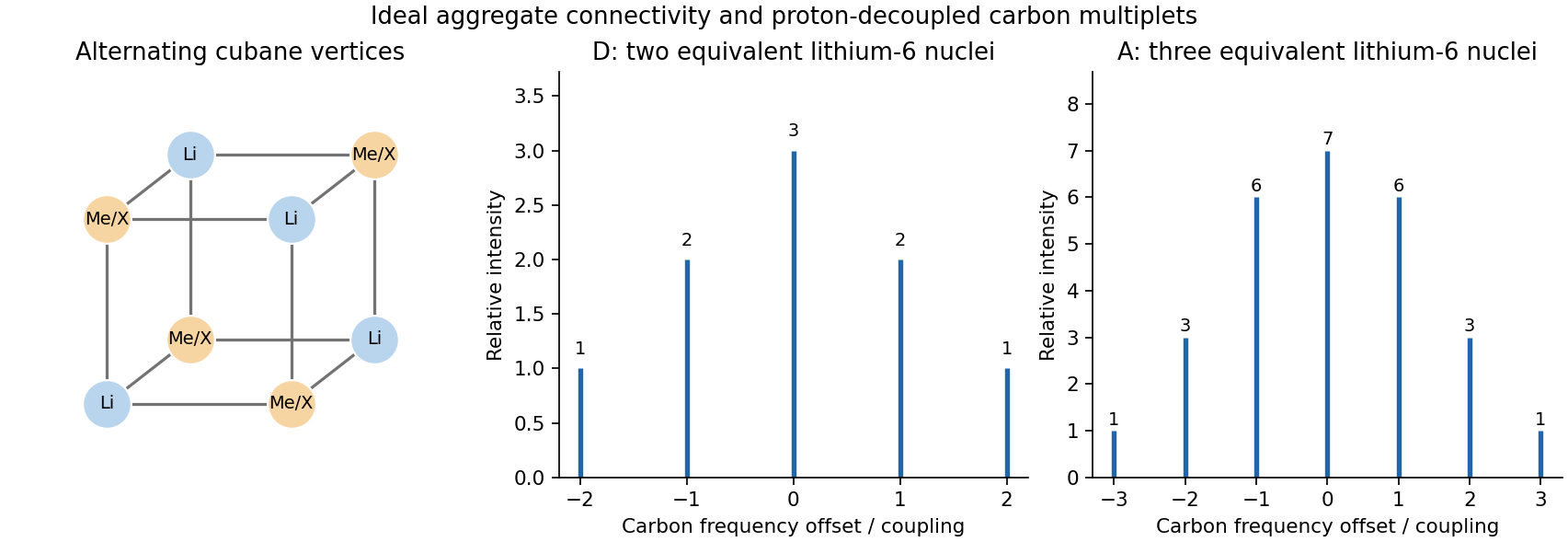
In the slowly exchanging cubane A each methyl carbon is bonded to three equivalent Li nuclei with . Its single carbon environment gives a septet, with first-order intensities .
In B the three methyl vertices remain equivalent by the ideal threefold symmetry, but each carbon sees two equivalent Li of one type and one Li of the other. The carbon resonance is therefore a quintet of triplets (15 first-order lines if both couplings are resolved and unequal): the equivalent pair gives , and the third Li gives . Accidental equality of couplings can collapse this to a septet.
D has one methyl-carbon environment coupled to two equivalent Li, giving a quintet . E has no methyl carbon. These patterns assume proton decoupling, resolved , ideal aggregate symmetry and slow exchange; without proton decoupling each methyl-carbon pattern is additionally split by its three attached protons.

Articles by others on the same topic
There are currently no matching articles.