Make heterogeneous electron transfer fast relative to delivery of reactant, usually by applying sufficient overpotential so that its surface concentration approaches zero. Use excess supporting electrolyte to suppress migration. For purely diffusional transient transport, suppress uncontrolled convection; for a rotating disk electrode, controlled convection supplies the bulk while diffusion across the thin interfacial boundary layer limits the current. A limiting current that no longer increases with driving potential is the characteristic test; a large current alone is not sufficient.
The midpoint potential characterizes the redox couple under specified solution conditions: it is the potential at which oxidized and reduced forms have equal activities, or equal concentrations in the corresponding formal-potential convention. For a reversible cyclic voltammogram it is estimated by . It approximates the formal redox potential when the usual reversibility and diffusion assumptions apply; it is not the potential halfway along a scan chosen arbitrarily.
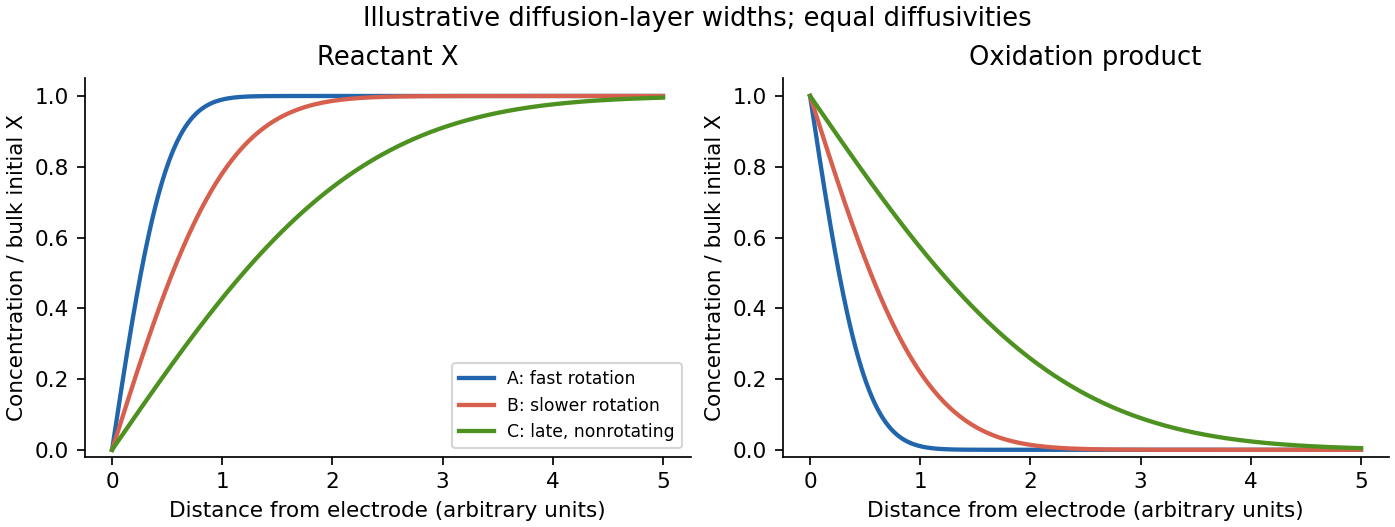
All three marked points are at strongly oxidizing potentials, where X is depleted at the electrode: . Assuming only X initially in bulk, and . Oxidation produces X at the interface.
- A: the largest steady limiting current corresponds to the fastest rotation and thinnest diffusion boundary layer. X rises steeply from zero to ; X falls steeply from its surface value to zero.
- B: slower rotation gives a thicker layer and shallower gradients, hence a smaller limiting current.
- C: the nonrotating electrode gives the peaked, subsequently decaying current. Its diffusion layer continues to broaden with time, approximately as , giving the broadest and shallowest profiles at the indicated late-scan point.
For equal diffusion coefficients, the two concentration profiles are complementary, . More generally equality of their interfacial molar fluxes requires , so the product surface concentration need not equal . A and B are approximately steady hydrodynamic profiles; C is a time-dependent diffusion profile.
Read the potential labels rather than the alphabetical order: b, the less negative event, is ; a, the more negative event, is . These are the first and second reductions respectively, with the reverse branches giving the corresponding oxidations. The second electron is harder to add to an already negatively charged species.
Event a probes electron transfer between the semiquinone and dianion. Benzoquinone's smaller framework localizes charge and undergoes a greater change in bonding and solvation on this reduction; a larger effective reorganization barrier can make its heterogeneous transfer insufficiently fast for Nernst equilibrium on the time scale. Anthraquinone's extended framework distributes the added charge and can support the more reversible response seen here.
This is a kinetic interpretation of quasi-reversibility, not a claim that benzoquinone cannot be reduced. Follow-up chemistry or adsorption can also distort peak separation and return-current ratios; scan-rate-dependent measurements would distinguish them from slow electron transfer. A single trace does not uniquely identify the cause.
A useful electrode-surface scheme for the proposed ECEC mechanism isElectron-transfer arrows occur at the electrode, whereas both capture steps occur in the adjacent solution layer. CO is attacked by an oxygen-centered nucleophilic component of the reduced quinone, forming an O-carbonate linkage rather than simply physically adsorbing on neutral AQ.
At potentials more negative than , direct second reduction of any unbound semiquinone is also accessible: , followed by carbonate formation. Thus the fully reduced unbound and mono-adduct species can feed the bis-adduct, and the drawing should include CO transport into the layer and adduct transport away. ECEC is the proposed sequence; competing EECC transfer/capture ordering is possible at such negative potentials.
Peak I is the cathodic reduction shifted positive of the unbound AQ/AQ event, consistent with reduction of the CO-bound semiquinone to mono-carbonate dianion. Peak II is the corresponding relatively negative-potential return oxidation of mono-carbonate dianion. Peak III, appearing farther positive on the faster return scan, is consistent with direct oxidation of the more strongly protected bis-carbonate dianion, followed by CO release.
This assignment is consistent with binding making the reduced species harder to oxidize. At slow scan, chemical interconversion and CO dissociation can feed the easier mono-carbonate oxidation pathway; at fast scan a larger fraction of kinetically retained bis-adduct survives to its direct oxidation potential. The two separated reductions also show that initial capture and its associated potential shift are not sufficient to make every ECEC step a single equilibrated two-electron wave.
These traces support coupled electron-transfer/binding chemistry but do not determine every microscopic rate constant or exclude EECC pathways. The peak assignments are species-family assignments within the stated mechanism, rather than proof of a unique elementary sequence from voltammetry alone.
Within the stated ECEC model and with CO genuinely in large excess, its concentration is effectively constant. Both capture steps are then pseudo-first-order in the quinone species, and at the same scan rate the faradaic current is linear in bulk AQ concentration.
The sketch therefore retains the peak potentials, sweep directions and relative features of the trace, including the positive-potential return feature III, but reduces the faradaic current scale by a factor of ten. Charging/background current need not scale with AQ concentration and should be shown separately. A changed normalized shape would indicate effects outside this simple scaling limit, such as CO depletion, adsorption or reactions between quinone species.
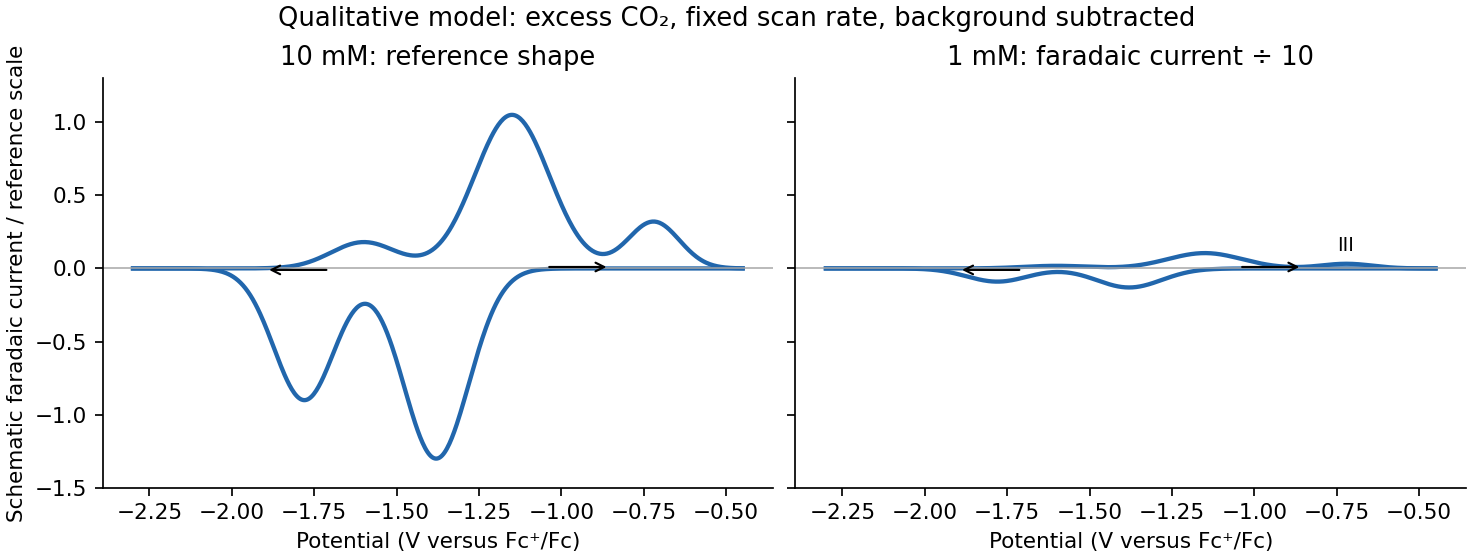
Qualitative tenfold faradaic-current scaling at fixed scan rate and excess carbon dioxide
. Details. The target dianion consumes two electrons per molecule, sogiving Faradaic yield. Of the passed electron equivalents, are not accounted for by the quantified bis-adduct.
They can reside in incompletely captured reduced quinones, other reduction products or parasitic solvent/proton/CO chemistry. The data do not identify one unique loss pathway. The starting solution contains BQ, so the target product represents only of that inventory; low bulk conversion alone does not explain a sub-unity Faradaic yield, because unreacted BQ has consumed no charge.
Write . The alternating-vertex cubane A is ; replacing one or two methyl vertices gives and . Balanced redistributions areThe smaller aggregate has composition , since the conventional masses or match the supplied values. Thus is another balanced redistribution.
For the structures, place Li on one tetrahedral set of cube corners and Me/X on the complementary set, joining adjacent unlike vertices. A contains four Me vertices, B three Me and one X, and C two of each. D is a four-membered alternating Li-Me-Li-X ring. The quoted relative masses use conventional elemental masses; a fully Li-enriched D would be approximately two mass units lighter, without changing its composition.
Useful isotope-selection factors include spin and quadrupole moment, gyromagnetic ratio, natural abundance or enrichment, sensitivity at the available field, line widths and relaxation, chemical-shift dispersion and the couplings needed for structural assignment. Both lithium isotopes are quadrupolar, but Li has a much smaller quadrupole moment and often much narrower lines, allowing inequivalent sites and carbon-lithium couplings to be resolved. Enrichment compensates its low natural abundance and removes isotope-mixture complexity.
Fully enriched Li would generally be more sensitive but broader in these aggregates. Its chemical-shift pattern would remain chemically similar, although isotope shifts and dynamics can make small differences. Resolved H-Li couplings increase in frequency approximately with and have different multiplicities because changes from to : equivalent Li nuclei give lines. If such long-range proton couplings remain unresolved, the main visible difference can instead be broadened lines. One should not invent resolved multiplets absent from the printed spectra.
The nucleus-count ratios H:Li are A, ; B, ; C, ; D, . Enrichment changes which isotope is counted but not these stoichiometric ratios.
Quantitative lithium integration requires adequate excitation bandwidth, a suitable calibrated pulse, acquisition of the entire broad as well as narrow signal, correct baseline/phasing and no differential saturation. Recycle delays should be long relative to the slowest relevant longitudinal relaxation time, or saturation must be measured and corrected. Exchange and unresolved overlap must be handled in the integrated areas. Proton and lithium spectra also require a stated relative calibration before raw numbers can be compared across nuclei.
The zero-ppm signals E are plausibly solvated lithium halide, predominantly LiBr or LiI and their solution ion-pair/aggregate forms. Structural symmetry predicts one Li environment in A, two in B in a ratio, two in C in a ratio, and one in an ideal symmetric D.
The natural lithium assignment is therefore:
- Br mixture: A at approximately (43.4); B at approximately (16.2, three Li) and (5.4, one Li); D at (10.3, broad); E at (24.8).
- I mixture: A at approximately (59.9); B at approximately (8.4, three Li) and (2.8, one Li); C at approximately and (0.6 each); D at (2.3, broad); E at (3.0). The close C/D signals require care about overlap.
The major proton peak near is A. The next peak near to is naturally assigned to B; in the iodide mixture the smaller peaks near and distinguish C and D. Smaller D aggregates can exchange Li or ligands with free halide-containing species more rapidly, giving intermediate-exchange broadening at the two specifically identified broad lithium resonances.
There is a quantitative inconsistency in the printed integrations under these ideal single-species assignments. For example the Br lithium B integrals give molecular amount proportional to , while A gives . Their proton areas should consequently obey , whereas either small proton integral gives . No common proton-versus-lithium calibration removes that ratio discrepancy. Similarly the I B/A ratio predicted from Li is , compared with printed .
Thus the symmetry-based assignment above is useful, but an exact simultaneous quantitative assignment satisfying every printed reliable integral is not established by these data. It would require corrected integrals, an explicitly overlapped signal or an additional speciation model; the discrepancy should not be concealed by treating independently normalized spectra as automatically consistent.
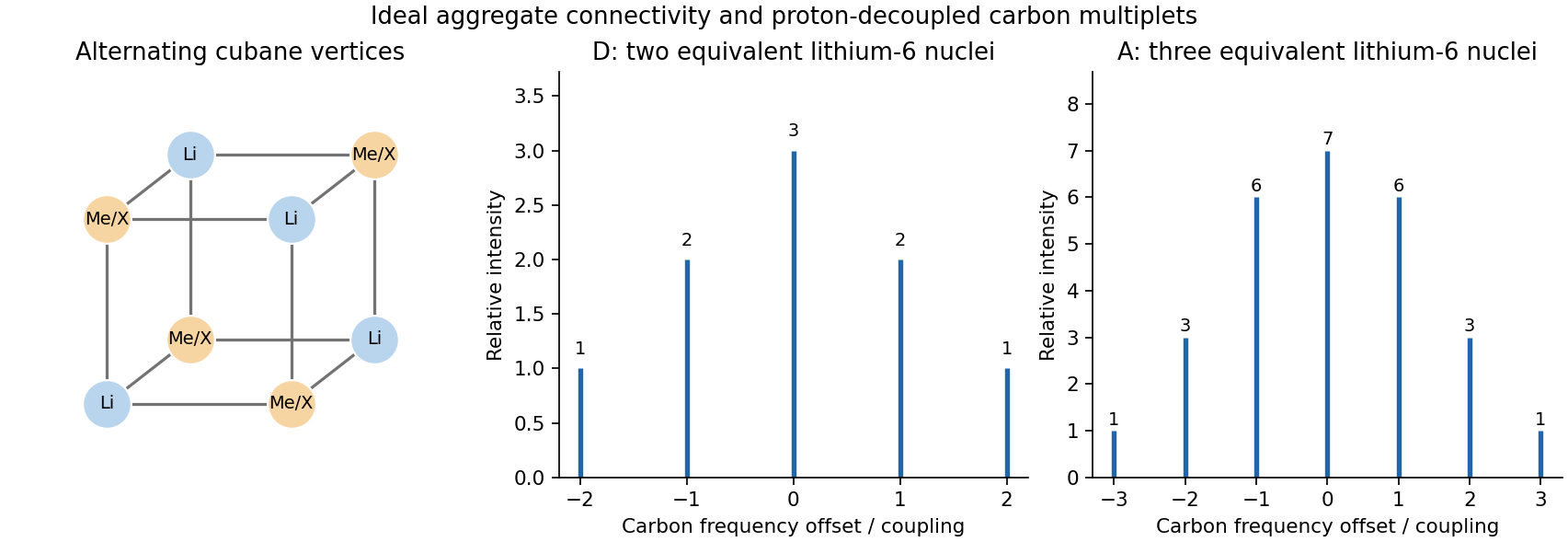
In the slowly exchanging cubane A each methyl carbon is bonded to three equivalent Li nuclei with . Its single carbon environment gives a septet, with first-order intensities .
In B the three methyl vertices remain equivalent by the ideal threefold symmetry, but each carbon sees two equivalent Li of one type and one Li of the other. The carbon resonance is therefore a quintet of triplets (15 first-order lines if both couplings are resolved and unequal): the equivalent pair gives , and the third Li gives . Accidental equality of couplings can collapse this to a septet.
D has one methyl-carbon environment coupled to two equivalent Li, giving a quintet . E has no methyl carbon. These patterns assume proton decoupling, resolved , ideal aggregate symmetry and slow exchange; without proton decoupling each methyl-carbon pattern is additionally split by its three attached protons.
The first transformation is an Achmatowicz rearrangement, followed by protection and selective reduction; the last is a Johnson-Claisen rearrangement.
- Butyllithium removes the furan 2-proton, giving a 2-lithiofuran. Its carbon attacks the aldehyde carbonyl; protonation of the resulting alkoxide gives the furfuryl alcohol. Carbon-carbon bond formation occurs at the lithiated position.
- Electrophilic oxygen transfer from mCPBA to the electron-rich furan gives an oxidized, ring-opened intermediate. Opening the oxygenated furan gives a hydroxy enedicarbonyl: the original furfuryl hydroxyl then attacks the remote aldehyde intramolecularly. This expands the five-membered furan into a six-membered lactol containing an enone carbonyl. The original furfuryl oxygen becomes the pyran ring oxygen; oxidation of the furan supplies the new carbonyl and lactol functionality.
- AgO/MeI converts the lactol OH into its methyl acetal: oxygen attacks methyl iodide by SN2 reaction, with iodide removal and proton transfer. This protects the anomeric position.
- LiAlH delivers hydride to the remaining ketone carbonyl, followed by protonation. The methyl acetal survives these basic reducing conditions, leaving the depicted allylic alcohol.
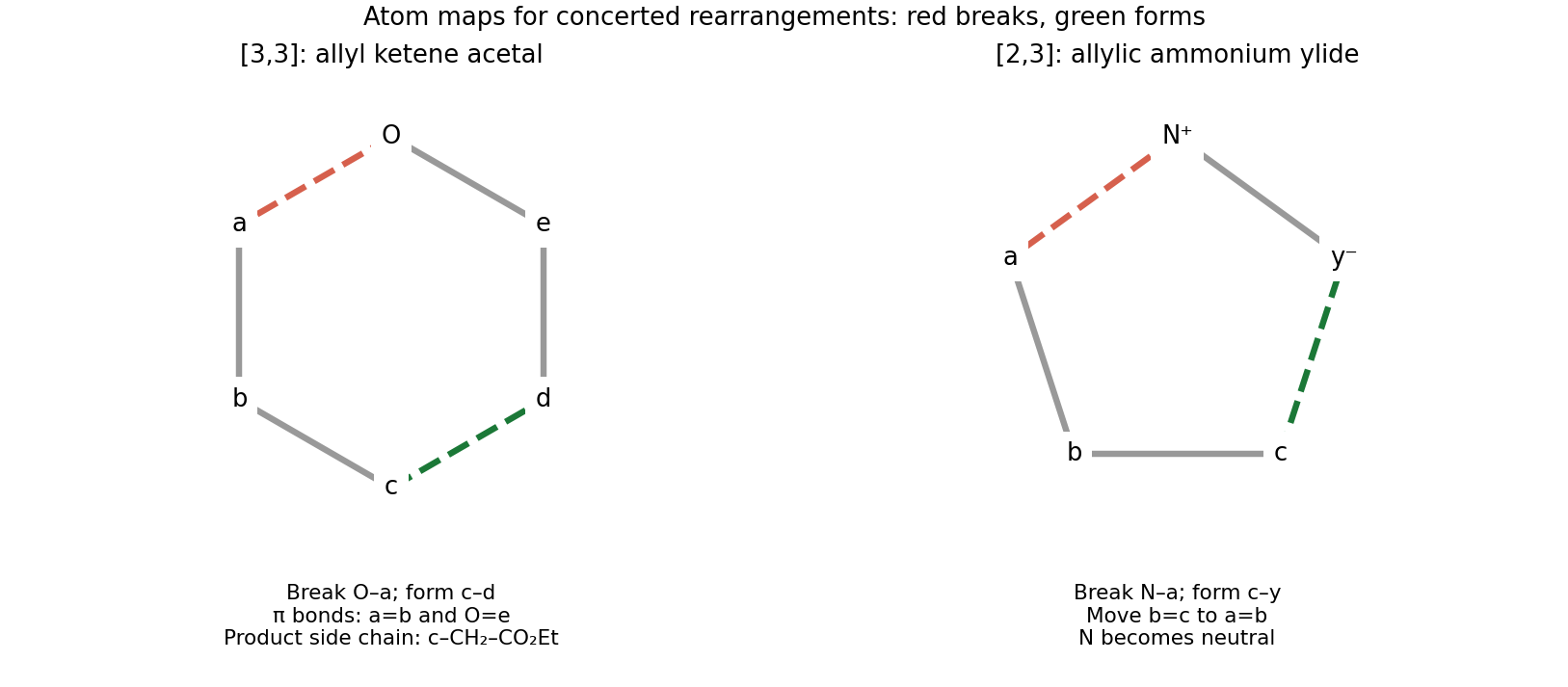
- Under weak-acid catalysis, that allylic OH replaces an ethoxy group of triethyl orthoacetate. Loss of another ethanol molecule, with removal of a methyl proton, gives the mixed ketene acetal . A six-electron, chair-like Claisen rearrangement breaks the allyl-O bond, forms a bond between the terminal allyl carbon and the ketene-acetal CH, and moves the ring double bond one position. Carbonyl formation gives the substituent.
The acetal protects the other oxygenated position during hydride reduction. The orthoester transfers an acetate-derived two-carbon unit through a ketene acetal; it does not directly substitute the allylic OH with an intact acetate ion.


For a concrete choice, draw the intermediate in the planar ring orientation used in the question and put the allylic OH on the upper face, with a solid-wedge C-OH bond. Fix either configuration at the R-bearing and methoxy-bearing centres and retain it throughout; no absolute configuration is specified by the question.
Draw the six-membered rearrangement array with its allylic C-C-C segment along the same ring edge and the O-ketene-acetal tether above that edge. Suprafacial transfer forms the new ring-carbon–CHCOEt bond on that upper face: draw it as a solid wedge, replacing the original allylic OH with the shifted double bond. The R-bearing and methoxy-bearing stereocentres retain their configurations. The opposite OH epimer transfers the tether from the opposite face and gives the opposite new stereocentre. Favor the chair-like transition structure that puts the larger tether substituents outward. This explicitly correlates the selected OH face with the new bond rather than invoking a freely rotating allylic carbocation.
Propionic acid is a weak, relatively high-boiling acid: its normal boiling point is about , compared with about for acetic acid. It provides mild proton catalysis while remaining in the hot orthoester mixture more effectively. This is useful because ketene-acetal formation and the thermal Johnson-Claisen rearrangement require heating, whereas strong acid would threaten the pyran acetal.
This is a practical catalyst choice, not an absolute mechanistic prohibition on acetic acid; acetic-acid-catalysed orthoester rearrangements are also possible.
Write Im for an imidazolyl group. The acid protonates one imidazole nitrogen, and its carboxylate attacks the central carbonyl of carbonyldiimidazole. Collapse of the tetrahedral intermediate expels imidazole and gives the mixed anhydride . Acyl transfer to imidazole, with decarboxylation, produces the activated acyl imidazole , CO and imidazole.
The amine attacks the RCO carbonyl of that acyl imidazole. Its tetrahedral intermediate collapses with loss of imidazole; proton transfer gives . The carbonyl originally belonging to CDI leaves as CO, while the product amide carbonyl is the original acid carbonyl. Imidazole serves both as a leaving group and a proton-transfer base.
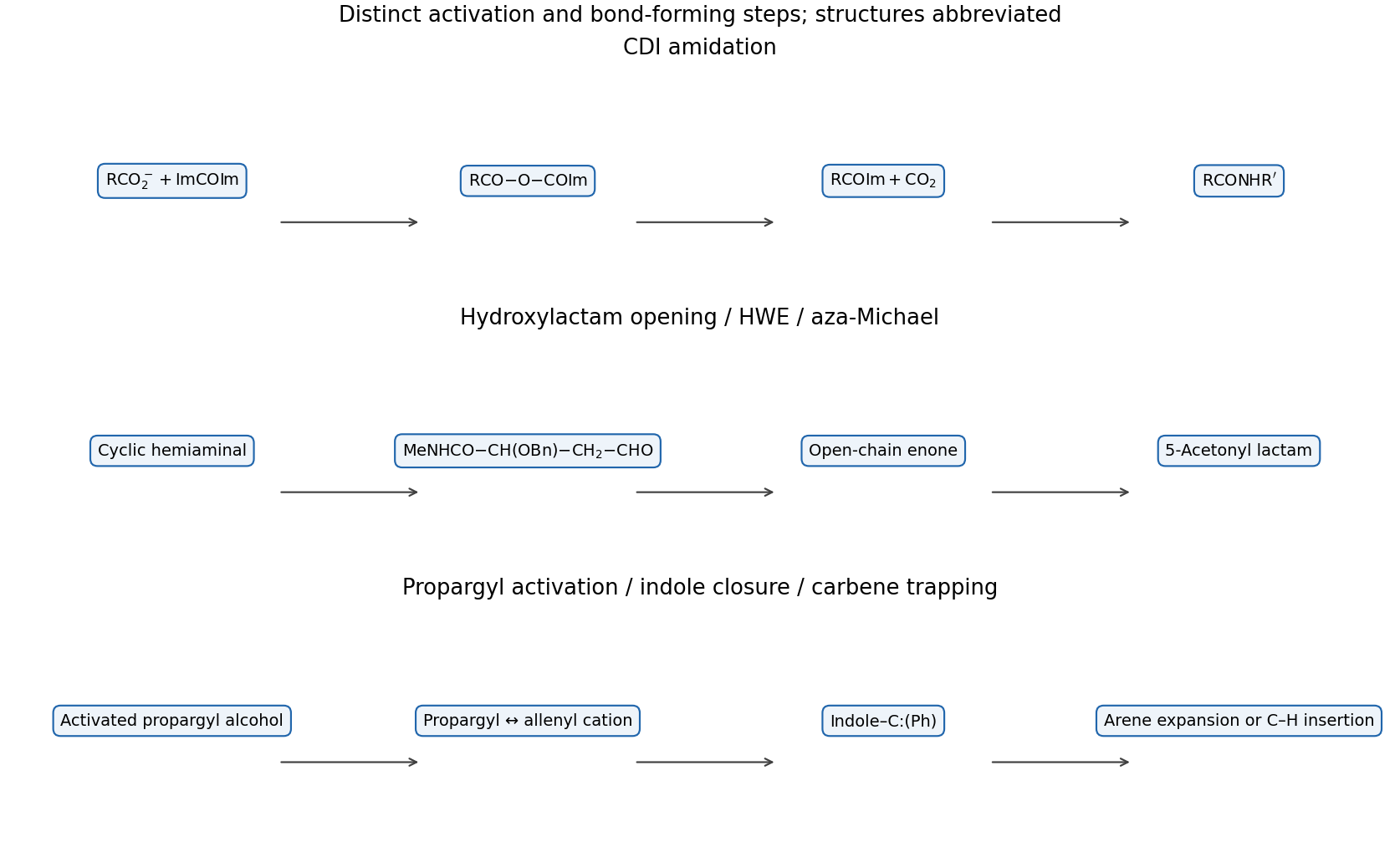
Activated acyl transfer, hemiaminal opening and carbene formation
. Details. 
Carbonyldiimidazole activates the acid under mild conditions without first isolating an acid chloride. CO and imidazole are convenient byproducts; the latter also buffers proton transfers. Avoiding strongly acidic acid-chloride-forming conditions can preserve sensitive protecting groups and reduce unwanted side reactions. The activated intermediate still reacts readily with an amine, whereas the unactivated acid and amine would mainly form an ammonium carboxylate.
The alcohol first attacks CDI, forming an activated O-carbonylimidazole derivative. Its departure gives the resonance-stabilized propargyl/allenyl cationThe ortho amino nitrogen attacks the central carbon of the allenyl system, closing the five-membered indole ring. Electron redistribution and loss of the N-H proton establish the indole aromatic system while leaving a carbene at the original distal, phenyl-bearing alkyne carbon.
For atom tracking, the original carbinol carbon becomes indole C3, the proximal alkyne carbon becomes C2, and the distal becomes the exocyclic carbene. Attack at the distal alkyne carbon would make a six-membered ring and cannot give the displayed skeleton. This carbene-based rearrangement has a primary experimental precedent.[ref]
With an N-trityl substituent, the carbene attacks a nearby trityl phenyl ring. Addition across an arene bond gives a norcaradiene-like cyclopropane, followed by electrocyclic opening to the seven-membered cycloheptatriene: this is a Buchner ring expansion. Intramolecular trapping explains the fused product rather than an intermolecular carbene reaction.
With N-tert-butyl, there is no pendant arene. Instead the carbene inserts into a C-H bond of one tert-butyl methyl group. The new bond between the carbene carbon and that methyl carbon closes the five-membered N-containing ring; H is transferred to the carbene carbon in the same insertion. The remaining two methyl groups stay on the carbon attached to N.
No stereochemical information need survive from the starting carbinol. Ionization converts that tetrahedral stereocentre into a planar, delocalized propargyl/allenyl cation before cyclization. In achiral conditions the two enantiomeric pathways to the new stereocentre in the tert-butyl-derived product are equivalent, so an enantiopure alcohol is expected to give racemic product. A claim of retained enantiopurity would require evidence for unusually effective conformational memory or ion-pair control.
Osmium tetroxide adds to the alkene through a concerted cyclic addition, giving a five-membered osmate ester with both C-O bonds on the same face. Hydrolysis releases the vicinal diol; NMO reoxidizes reduced osmium so that OsO can be catalytic.
The two new hydroxyl groups are therefore syn. For the drawn substrate, approach opposite the two existing solid-wedge substituents is less crowded: draw both new C-OH bonds dashed, while retaining the solid-wedge COBn and NHBoc bonds. The major diol is cis at its two new centres and anti to the pre-existing substituted face.
Syn delivery is the stereospecificity of cyclic osmylation; preference for one of the two diastereotopic alkene faces is substrate-controlled diastereoselectivity. Attack from the other face would still be syn but would give the minor diastereomer.
The hydroxylactam is a cyclic hemiaminal. Its alkoxide can open to the corresponding aldehyde/amidate, in its protonated representation. This exposes an aldehyde without reducing or replacing the lactam carbonyl.
The ketophosphonate anion attacks that aldehyde. Formation and collapse of the phosphorus-containing intermediate give the predominantly E enone and phosphate by Horner-Wadsworth-Emmons reaction. The amide nitrogen then closes by intramolecular aza-Michael addition at the enone beta carbon. Protonation of the ketone enolate gives the observed five-membered lactam with a substituent.
A folded, relatively unencumbered closure places OBn and the developing side chain in outward-facing positions; the expected major product has OBn and the C5 acetonyl substituent cis. With the OBn wedge retained, show the new C5–CHCOCH bond as a solid wedge. The closure is diastereoselective, while the original wavy hemiaminal centre is erased by aldehyde formation. This facial prediction rests on the preferred folded conformer rather than retention of either starting hemiaminal epimer.
This is a thermal Claisen rearrangement followed by intramolecular acetal exchange. Identify the six-atom array as the cyclopentenone enol-ether C=C–O–CH–C=C unit. In its concerted rearrangement:
- The O–CH bond breaks.
- A new C-C bond joins the other end of the cyclopentenone enol double bond to the cyclohexene carbon bearing CH(OEt).
- The former ether-bearing cyclopentene carbon becomes a ketone, and the cyclohexene double bond becomes the exocyclic methylene.
The intermediate is thus a substituted cyclopentane-1,3-dione, with the acetal tether now correctly placed for six-membered-ring closure. Its enol oxygen attacks the acetal carbon, replacing OEt and releasing ethanol. Enolization gives the conjugated cyclic enol ether drawn in the product; the second ethoxy group remains.
A chair-like Claisen rearrangement transition structure with the phenyl-bearing part of the cyclohexane directed outward avoids severe axial crowding. Suprafacial bond formation and the pre-existing configuration give the two indicated ring-junction hydrogens on opposite faces: the left H is a wedge and the right H a dash in the supplied orientation. Closure favors the acetal epimer with outward OEt, drawn as a wedge, while the original Ph remains dashed. This is substrate-controlled diastereoselection followed by conformationally selective acetal closure, rather than independent arbitrary assignment of three centres.
Articles were limited to the first 100 out of 300 total.
Articles by others on the same topic
There are currently no matching articles.