A stable charge-stabilized dispersion has an interaction barrier large compared with . In DLVO theory, the total pair potential combines attractive Van der Waals forces with repulsion from overlapping electric double layers. Similar surface charges raise the free energy of overlap; a sufficiently high positive barrier prevents thermally diffusing particles from reaching the deep primary minimum near contact.
Other stabilization mechanisms include steric stabilization by solvated surface chains and combined electrosteric protection by charged chains. Such contributions are additional to the simplest DLVO pair potential. Increasing salt shortens the Debye length, so double-layer repulsion becomes shorter-ranged and the protective barrier can decrease.
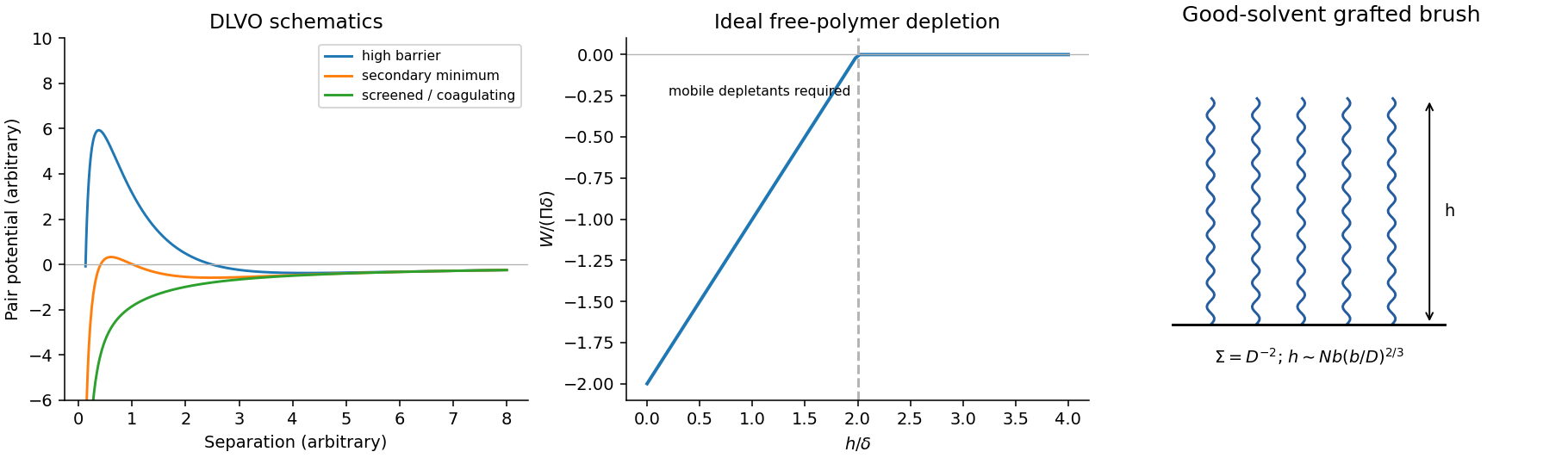

Primary-minimum aggregation occurs when particles can cross the repulsive barrier and reach near contact. Its deep attractive well usually makes escape slow on experimental timescales, giving effectively irreversible coagulation. Higher electrolyte concentration screens the repulsion and can eliminate the barrier. The critical coagulation concentration is the electrolyte concentration at which rapid, approximately diffusion-limited coagulation sets in under the specified conditions; in an idealized DLVO description it is associated with loss of the protective barrier. Ion valence and surface boundary conditions strongly influence this threshold.
Secondary-minimum flocculation traps particles at a larger separation in a shallow attractive well. The primary barrier can remain intact, so particles form loose aggregates without reaching molecular contact. Such flocs are often reversible on dilution or a suitable change in ionic strength. If the secondary well is very weak compared with , the dispersion remains largely unassociated; if screening removes the primary barrier, the particles can proceed to the much deeper primary minimum. “Aggregation” and “flocculation” have variable usage, so the physical distinction here is explicitly shallow, separated association versus near-contact coagulation.
Articles by others on the same topic
There are currently no matching articles.