TODO — user-deferred biology. This biological subquestion is intentionally left unsolved under the current scope.
TODO — user-deferred biology. This biological subquestion is intentionally left unsolved under the current scope.
In electrophoresis, an applied electric field drives a charged particle and its associated diffuse ionic atmosphere relative to the liquid. Electric forcing is balanced by viscous stresses, giving a steady velocity in the linear regime. The relevant electrokinetic potential is the zeta potential at the slipping plane, rather than necessarily the solid surface potential.
For a thin electric double layer, the surrounding layer develops an electro-osmotic flow and the Smoluchowski electrophoretic mobility is . The sign of fixes the direction. This transport is different from dielectrophoresis, which can move a neutral polarizable particle in a nonuniform field.
Here , so the thin-double-layer result givesand therefore m s, along the field for the positive zeta potential.
In the opposite limit , the Hückel electrophoretic mobility is , giving m V s, two-thirds of the thin-layer value at the same . Both asymptotic expressions are independent of radius at fixed zeta potential; the crossover depends on . These classical approximations neglect double-layer relaxation and strong-potential corrections.
The amphiphile packing parameter is : hydrocarbon volume divided by the product of effective head-group area and maximal tail length. For a spherical core of radius , ; requiring gives spheres for . Cylindrical cores instead have , favouring cylinders or rods for roughly . Lower-curvature bilayer structures are favoured towards ; intermediate ranges can include flexible or closed bilayer morphologies.
The charged sulfate head groups make the effective area sensitive to electrostatic repulsion, salt and counterion binding. Screening can reduce that area, increasing and favouring growth from spheres towards elongated micelles. These are geometric selection rules, not exact phase boundaries or a claim that every morphology is stable at any concentration.
For a dodecyl tail, take . The given relations yield nm and nm. The spherical-core condition is , henceEquality corresponds to a maximally extended tail reaching the core centre. A smaller head-group area would require a spherical radius larger than the available chain length. The estimate assumes all twelve tail carbons contribute to the hydrocarbon core; partial penetration or hydrated head-group geometry would modify it.
At the limiting area, the spherical core radius is nm. Its aggregation number isAbove the critical micelle concentration, free monomers remain approximately at 8 mM, so 42 mM of surfactant units are in aggregates. ThusThe concentration is of whole aggregates, not the concentration of surfactant molecules inside them. The estimate neglects micelle polydispersity and concentration-dependent growth.
A stable charge-stabilized dispersion has an interaction barrier large compared with . In DLVO theory, the total pair potential combines attractive Van der Waals forces with repulsion from overlapping electric double layers. Similar surface charges raise the free energy of overlap; a sufficiently high positive barrier prevents thermally diffusing particles from reaching the deep primary minimum near contact.
Other stabilization mechanisms include steric stabilization by solvated surface chains and combined electrosteric protection by charged chains. Such contributions are additional to the simplest DLVO pair potential. Increasing salt shortens the Debye length, so double-layer repulsion becomes shorter-ranged and the protective barrier can decrease.
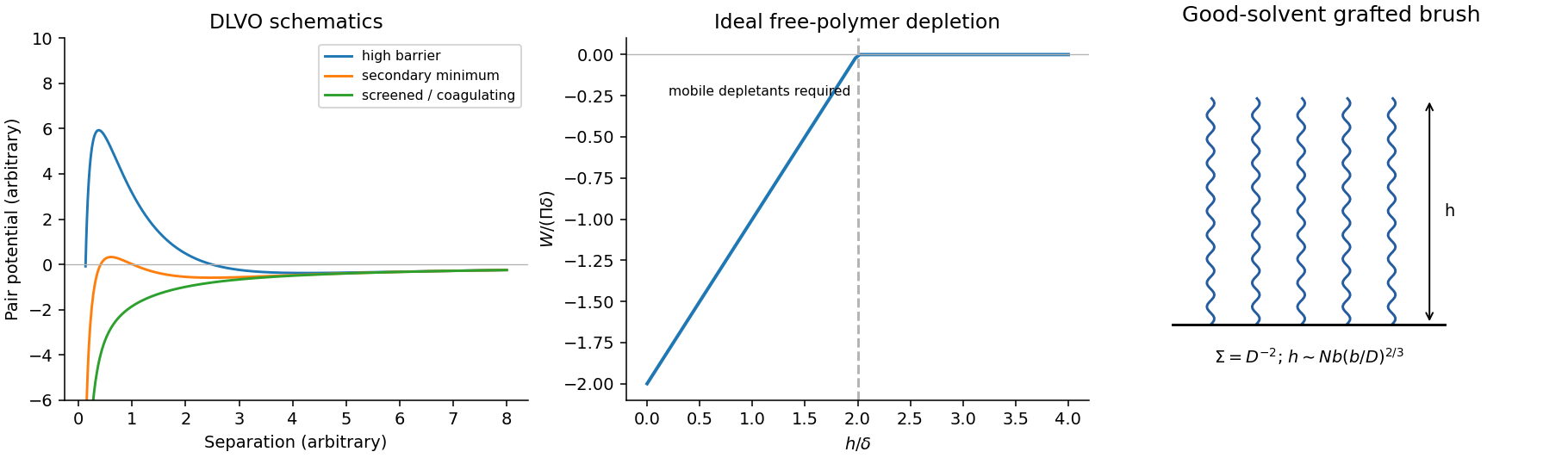

Primary-minimum aggregation occurs when particles can cross the repulsive barrier and reach near contact. Its deep attractive well usually makes escape slow on experimental timescales, giving effectively irreversible coagulation. Higher electrolyte concentration screens the repulsion and can eliminate the barrier. The critical coagulation concentration is the electrolyte concentration at which rapid, approximately diffusion-limited coagulation sets in under the specified conditions; in an idealized DLVO description it is associated with loss of the protective barrier. Ion valence and surface boundary conditions strongly influence this threshold.
Secondary-minimum flocculation traps particles at a larger separation in a shallow attractive well. The primary barrier can remain intact, so particles form loose aggregates without reaching molecular contact. Such flocs are often reversible on dilution or a suitable change in ionic strength. If the secondary well is very weak compared with , the dispersion remains largely unassociated; if screening removes the primary barrier, the particles can proceed to the much deeper primary minimum. “Aggregation” and “flocculation” have variable usage, so the physical distinction here is explicitly shallow, separated association versus near-contact coagulation.
The grafting density is the inverse area per chain:For a neutral polymer brush in a good solvent, stretching costs per chain while excluded-volume interactions cost . Minimization gives . With ,An isolated good-solvent coil has size nm, much larger than nm, consistent with strong overlap. The brush height is below the 20 μm contour length. This estimate assumes good-solvent excluded volume and locally planar geometry; the source gives neither solvent quality nor particle radius, so a unique curved-brush thickness is not established. An ideal-solvent brush has different scaling.
A depletion force requires mobile nonadsorbing polymers excluded from the gap, rather than grafted chains alone. If their depletion layers overlap when the plate separation is , the overlap restores accessible solution volume and increases polymer entropy. For ideal, dilute depletants of bulk osmotic pressure , an idealized interaction free energy per plate area isIts attractive pressure is in the overlap interval. The layer thickness is of order the ideal-coil radius of gyration, , so the range scales as . For the supplied chain parameters, nm and an order-of-magnitude two-layer range is 163 nm. Grafted brushes instead oppose compression through stretching and osmotic penalties; they can coexist with depletion attraction if free depletants are present, but the mere existence of a grafted layer does not create a reservoir of depleting chains. The source does not specify that reservoir's concentration, so its attraction magnitude cannot be calculated.
Articles by others on the same topic
There are currently no matching articles.