For a homogeneous mixture an approximate interpolation is the Fox equation, Tg−1=w1/Tg1+w2/Tg2, with temperatures in kelvin. Two transitions are not guaranteed merely by block architecture: short blocks, miscibility or insufficient experimental resolution can give one broad transition. The contrast is between domain-specific segmental environments and a more uniform mixed environment.
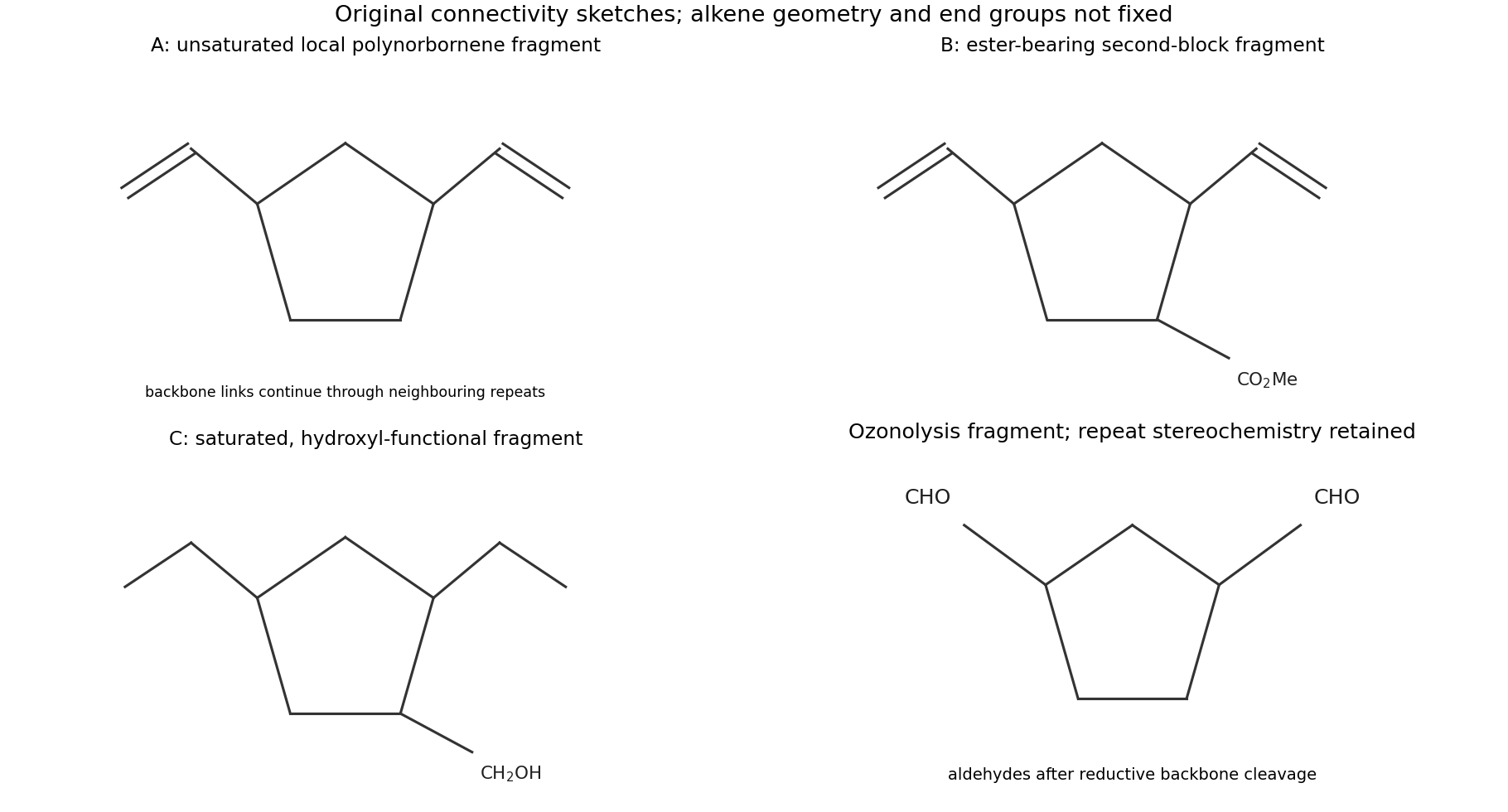
Chas a saturated backbone and pendant CH2OHgroups in its second block.Hydrogenation converts every backbone CH=CH to CH2CH2; lithium aluminium hydride then reduces each CO2Me to CH2OH. The resulting connectivity is [CH2CH2−C5H8]50−[CH2CH2−C5H7(CH2OH)]75.
This is approximately 14.27 kg mol−1 plus the net end-groupmass. The termination chemistry is unspecified, so a more precise whole-chain mass is not determined; the methyl group lost during ester reduction must not remain in the second repeat'smass.
Pendant alcohols can form reversible borate bridges, schematically P−O−B(OH)−O−P′ and B(O−P)3, where P and P′ belong to different chains. Tetrahedral boratespecies are also possible depending on pH and water content. A bridge must connect different network strands to act asa cross-link; an intrachain loop does not contribute equivalently to elasticity.
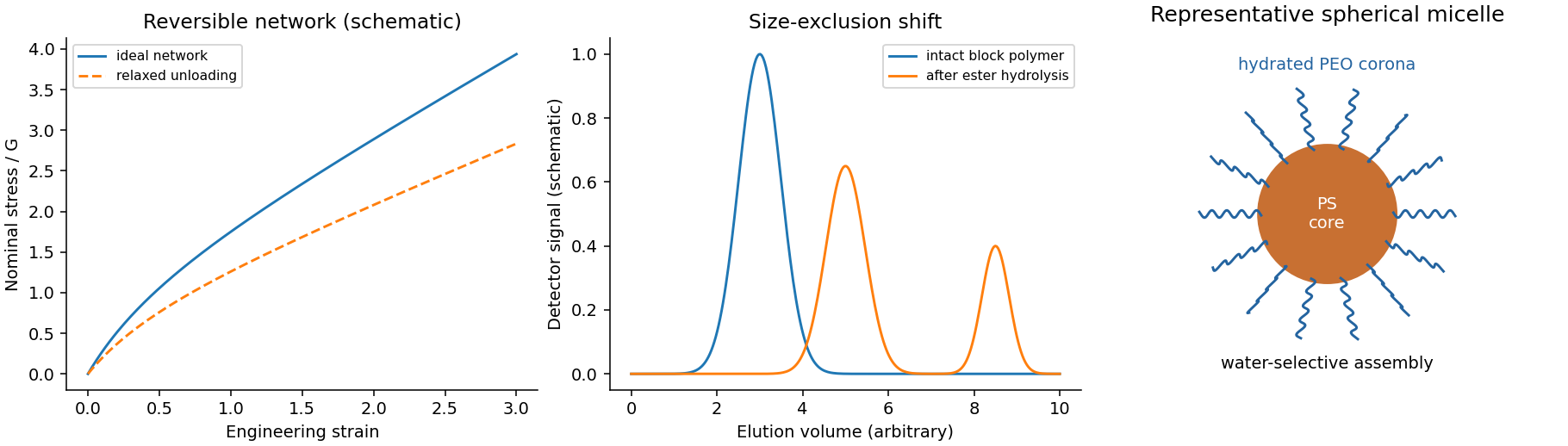
where λ is the extension ratio and νe the density of elastically active strands. The initial response is soft; stronger extension gives increasing stress and ultimately finite-chain extensibility. Reversible borate exchange permits stress relaxation, rate dependence and a loading–unloading hysteresis loop, rather than permanent ideal elasticity at arbitrarily long times.
Heating C under oxygen-free conditions homolytically cleaves its benzylic C–O bond to the nitroxide, releasing a benzylic radical and TEMPO. The radical adds styrene repeatedly; reversible trapping by TEMPO controls the active radical concentration. D is therefore a poly(lactide)–polystyreneblock copolymer with junction PLA−OCH2CH(Ph)−[CH2CH(Ph)]m−O−TEMPO and the hydroxyl end of PLA retained. This is nitroxide-mediated polymerization; atemperature around 120–130 °C is a representative condition for a TEMPO/styrene system, rather than an exact universal optimum.
Styrene, benzoyl peroxide and TEMPO provide the required radical addition–trapping sequence. Heating the peroxide breaks its O–O bond into benzoyloxy radicals. Before decarboxylation, PhCO2∙ can add to styrene's terminal carbon, generating the resonance-stabilized radical PhCO2CH2C˙HPh. Coupling with the oxygen-centred TEMPO radical then gives PhCO2CH2CH(Ph)−O−TEMPO, the benzoate-protected alkoxyamine A.
The connectivity distinguishes this route from initiators that leave acarbon-based radical fragment at the chain end. Competition with benzoyloxy-radical decarboxylation affects yield, so this is a plausible preparation rather than a claim of exclusive product formation. Subsequent benzoate cleavage reveals B's hydroxyl group without requiring rupture of its alkoxyamine linkage.
B has formula C17H27NO2. Lactide's entire cyclic diester mass is incorporated; multiplying its molar mass by two again would double-count its two lactyl units. The estimate assumes quantitative initiation, conversion, nitroxide recapping and no chain transfer or loss of chain-end fragments.
The principal surviving polymer is a polystyrene chain bearing the junction HOCH2CH(Ph)− end and its nitroxide-derived distal end. In gel permeation chromatography, the intact block copolymer normally elutes earlier than this smaller surviving polystyrene coil. Lactate and short hydrolysis fragments elute later still, provided the column and detector resolve such small solutes. The polymer peak therefore shifts to larger elution volume; its height need not remain constant under amass-sensitive detector. Elution reflects hydrodynamic volume, so calibration against polystyrene standards does not supply an exact absolute mass for the original mixed block.
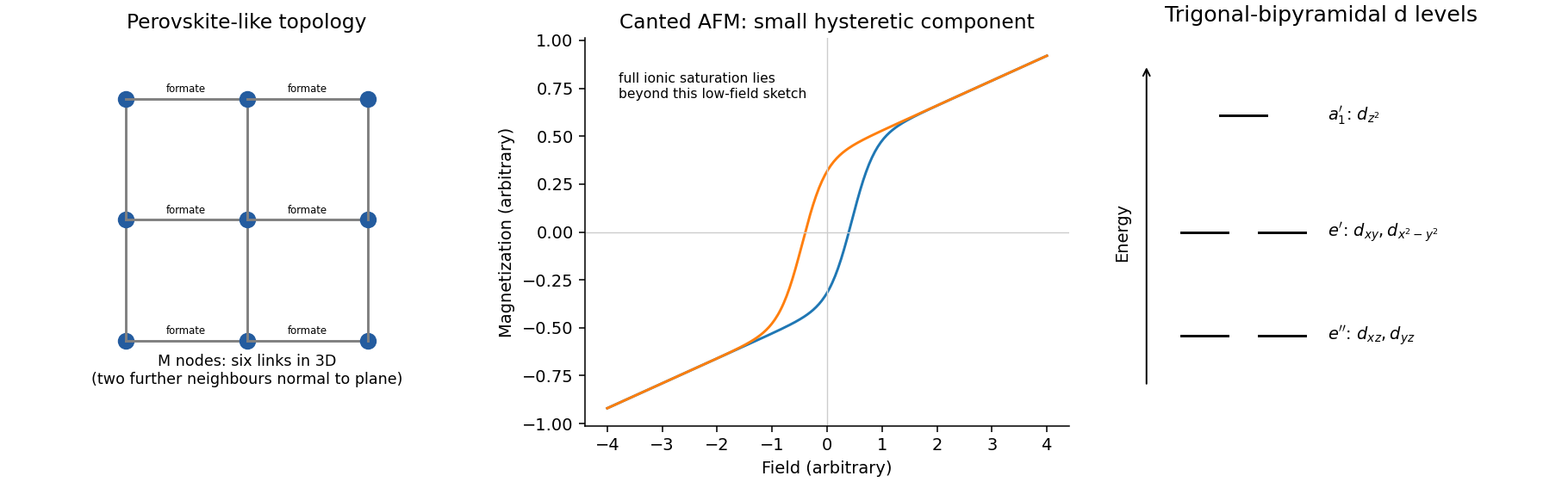
Place the trigonal axis along z, the axial ligands on ±z and the equatorial ligands in the xyplane. The ordering is e′′(dxz,dyz)<e′(dxy,dx2−y2)<a1′(dz2). The e′′pair has nodal behaviour along both the equatorial ligand directions and the axial axis, minimizing direct ligand repulsion. The in-plane e′pair points into the equatorial region. The dz2 lobes point at both axial ligands and its torus also samples the equatorial ligands, giving the largest repulsion in the regular point-chargegeometry.
Rotation by 120° and reflection in the equatorial plane preserve the geometry; they enforce the indicated doublet degeneracies. The ordering concerns a regular trigonal bipyramid with equivalent ligand-field assumptions, not every distorted five-coordinate complex.
For two independent identical ions at sufficiently high temperature, Curie's law gives χT=2(NAμB2/3kB)g2S(S+1). In the cgs units used here, NAμB2/3kB≃0.125cm3Kmol−1.
Fe(II), Co(II) and Ni(II) have S=2, 3/2 and 1, respectively. The corresponding high-spin occupancies, ordered as (e′′,e′,a1′), are
Hund filling puts one electron in each orbital before additional pairing. Spin-only dimer values at g=2 would be 6.0, 3.75 and 2.0; the observed larger values anticipate orbital contributions. The spin assignments require the chemically appropriate high-spin states, rather than rounding the measured χT directly to aspin-only integer.
The radical'smagnetic orbital has πsymmetry. Fe(II)'s partly occupied e′′set supplies a matching metal πmagnetic orbital, permitting electron transfer and predominantly antiferromagnetic metal–radical exchange. In Co(II) and Ni(II), that set is filled; their unpaired metalelectrons occupy orbitals of different symmetry. Approximate orthogonality suppresses the usual antiferromagnetic kinetic-exchange pathway, favouring ferromagnetic metal–radical coupling through the remaining exchange contributions.
This orbital-symmetry argument assumes the intended idealized binding geometry. It predicts exchange signs, not exact magnitudes; distortion and additional orbital mixing can alter the competition.
Their degeneracies 2,2,4,4,6sum to 18, matching 3×3×2. For dominant ferromagnetic J, the ground multiplet has S12=2, S=5/2.A weak antiferromagnetic J′ does not overcome the two strong metal–radical bonds.
A frustrated triangle has two ferromagnetic metal–radical bonds and an antiferromagnetic metal–metal bond. With the Hamiltonian convention above, take J/kB=+800K and J′/kB=−8K. In the maximally aligned ground state the two metal–radical products are 1×1/2 and the metal–metal product is 1×1. Therefore
Here FC=−1 denotes complete satisfaction of all exchange interactions; the small deviation 1+FC=0.0198 quantifies the weak frustrated contribution in this normalization. The numerical answer assumes antiferromagnetic metal–metal exchange. The printed magnitudes alone do not establish that sign. If the metal–metal exchange were instead ferromagnetic, all three bonds would be satisfied and FC=−1. The ground-statescalar products also follow directly from S12=2, S=5/2, so a separate classical approximation is unnecessary for this fully polarized multiplet.
For an axial spinHamiltonian HD=DSz2 with D/kB=−25K, the minima are mS=±5/2. The highest levels along the reversal ladder are the mS=±1/2 doublet. Hence
about 1.25 kJ mol−1 or 12.9 meV per molecule. Using ∣D∣S2 would incorrectly put ahalf-integer spin at a nonexistent mS=0 level. Transverse anisotropy and quantum tunnelling of magnetization can create faster relaxation pathways, so this axial ladder barrier need not equal an experimentally fitted effective barrier.
Frequency-dependent ac susceptibility probes relaxation: a peak in the out-of-phase component occurs approximately when ωτ=1. Measuring its displacement with frequency determines τ(T); an activated region may fit τ=τ0exp(Ueff/kBT). A low-temperature departure can reveal tunnelling or other relaxation channels.
Low-temperature, sweep-rate-dependent magnetizationhysteresistests whether reversal is slow on the measurement timescale. A loop opening below the blocking temperature, variation with sweep rate and possible tunnelling steps provide complementary evidence. Isothermal remanent magnetization decay after field removal directly measures the associated relaxation time. A single open loop alone would not distinguish isolated-molecule blocking from collective ordering or impurities.
The framework is a three-dimensional network of corner-connected MO6octahedra, with each apparent corner connection extended through a bridging formate, M−O−CH−O−M. Each metal is coordinated by six oxygen donors from six formates, which link it to six neighbouring metals in the perovskite-like topology. The guanidiniumcation occupies the larger cavity and can hydrogen-bond to formate oxygenatoms. Charge balance is +1+2−3=0.
At high temperature, approximately independent paramagnetic ions give the appropriate Curie constant. The negative Weiss temperatures and the reduction of χT on cooling initially indicate predominantly antiferromagnetic correlations. The sharp rise near the ordering temperature nevertheless reveals a strongly enhanced low-field magnetic response.
Weak ferromagnetism from canted antiferromagnetic order is the consistent model. Importantly, the plot has different magnetization scales: the left axis belongs to Mn and Fe; the right belongs to Co and Ni. Approximate low-temperaturefield-cooled readings are 40, 50, 450 and 390 G cm3 mol−1, respectively. Dividing by 5585 gives
These moments are tiny compared with fully aligned moments of about 5.09, 4.40, 4.25 and 2.47 μB, calculated using the Curie-derived g values below. A conventional ferromagnet of the full high-spinions would have much larger spontaneous magnetization; a simple bipartite array of identical metal sites also supplies no obvious unequal sublattice moments for ferrimagnetism. Opposed large sublattice moments with a small transverse uncompensated component reconcile the net response with negative Θ.
If the 10 Oe field has aligned the weak-ferromagnetic domains, Mweak=gSμBsinα estimates sublattice canting angles of roughly 0.08°, 0.12°, 1.1° and 1.6°. These are illustrative, not precision structure determinations: the low field may not fully align the domains, and the readings are graphical. Bulk magnetization strongly supports this model but does not uniquely establish every spin direction; magnetic neutron diffraction would test the microscopic arrangement.
High-spin Mn(II), with an approximately orbitally nondegenerate d5ground state, stays closest to the free-electron value. Fe, Co and Ni have stronger orbital admixture, particularly Co in this effective Curie-law comparison. Spin-orbit coupling creates magnetic anisotropy, which can make reversal of the weak-ferromagnetic domains slower and enhance field-cooled/zero-field-cooled separation. Afield-cooled sample selects domains as it orders; a zero-field-cooled sample initially has competing domains and can remain pinned when a small measuring field is applied.
Define H=−2J∑⟨ij⟩Si⋅Sj. Each site has z=6 exchange-connected neighbours. In mean-field theory, replacing neighbours by their mean spin produces the effective field that yields
for Mn, Fe, Co and Ni. Negative Jmeans antiferromagnetic exchange in this convention; aHamiltonian written with −J instead of −2J would have twice these numerical values. The increasingly negative values indicate a growing effective exchange energy, although different orbital occupancy and anisotropymean that they are not a simple universal function of d-electronnumber.
A three-dimensional six-connected framework is more favourable to mean-field reasoning than isolated chains, but the theory neglects short-range correlations, anisotropic exchange and fluctuations. The ratios ∣Θ∣/TC≃1.65,1.69,3.75,2.10 show substantial departures from the simplest unfrustrated isotropic mean-field relation. The values are therefore effective high-temperature exchange estimates, not a complete microscopic fit to the ordered phases.
This is distinct from the much smaller weak-ferromagnetic domain moment, approximately 450 G cm3 mol−1 at low field. A low-temperature isothermal loop should have a small hysteretic central component superposed on the antiferromagnetic field response. Reversal changes the selected weak-ferromagnetic domain and produces remanence and coercivity. At larger fields the magnetization continues to increase as the opposed sublattice moments rotate; aspin-flop or spin-reorientation feature may occur depending on field direction and anisotropy. Only sufficiently strong fields approach the full ionic saturation value, so the small low-field loop must not be labelled as saturation at 4.25 μB.
Below the ordering temperature, coherent spincorrelations produce magnetic Bragg intensity. Depending on the magnetic propagation vector, this can appear as additional peaks or as added intensity at positions already occupied by nuclear reflections. A magnetic unit cell larger than the chemical one gives extra reciprocal-spacepositions; a zero-propagation-vector canted structure need not do so.