Student suggested answers for the past ten years are available on Chemistry Moodle. Official course guide: past papers and suggested answers New solutions for years covered by that archive are skipped; existing wiki drafts are retained.
The held 2015 interdisciplinary papers are also skipped under the 2015 departmental policy releasing suggested answers after five years; applying the Parts III policy to shared IDP1–3 is a scope inference, not an inspected private answer file.
The three cover variants share the question body below. Each printed question is included once.
An aromatic–aliphatic polyamide and methanol are formed. Let . The polymer repeat unit isEach amide linkage comes from nucleophilic acyl substitution: an amine attacks an ester carbonyl, the tetrahedral intermediate expels methoxide, and proton transfer produces methanol. There are approximately molecules of methanol for complete repeat units in a long chain; the precise finite-chain count depends on its end groups. Removal of methanol drives this step-growth polymerization.
Syndiotactic polypropylene is the expected principal product:The bridged cyclopentadienyl–fluorenyl metallocene has approximately site symmetry. Activation by methylaluminoxane gives a cationic zirconium–alkyl polymerization-active site. Repeated coordination chemistry and migratory insertion of propene extend the chain. The two environments encountered during successive insertions favor alternating stereochemistry, giving syndiotactic tacticity. There is no stoichiometric small molecule eliminated in the propagation step; initiator fragments and chain-transfer products belong to the end groups.
Predominantly head-to-tail poly(3-hexylthiophene) is formed, with thiophene rings connected through their 2 and 5 positions. The hexyl groups occupy equivalent 3 positions along the conjugated polymer.
Selective iodine–magnesium exchange first generates an organomagnesium monomer while retaining the carbon–bromine bond. Nickel-catalyzed Kumada coupling then joins the organomagnesium end of one ring to the brominated end of another. Transfer of the nickel center to the new chain end permits catalyst-transfer polymerization and favors head-to-tail regioregularity. Organic side products of the activation include isopropyl iodide; magnesium halides accompany the coupling. The repeat unit itself contains neither iodine nor bromine.
An approximately alternating styrene–maleic anhydride copolymer is produced. Its backbone alternates a segment with the two former alkene carbons of a maleic anhydride unit; those latter carbons remain connected to the intact five-membered cyclic anhydride ring.
Homolysis of benzoyl peroxide supplies initiating free radicals. Cross-propagation between electron-rich styrene and electron-poor maleic anhydride is favored over successive additions of the same monomer. Both carbon–carbon double bonds become backbone sigma bonds, without loss of a small molecule from each monomer. Initiator-derived benzoyloxy or phenyl fragments can occur at chain ends, with carbon dioxide formed when benzoyloxy free radicals decarboxylate.
In (i), any pair of compatible functional groups can react: monomers, oligomers and long chains all participate. For an equimolar, strictly bifunctional mixture without cyclization in step-growth polymerization, the Carothers equation givesHere is functional-group conversion and counts the original monomer molecules. Large degree of polymerization therefore requires nearly complete conversion.
In (ii), growth occurs only at the metal-bound chain end. If initiation is rapid and chain transfer in chain polymerization is negligible, the number of chains is fixed andThis is the linear conversion dependence of living polymerization. Actual zirconocene systems can undergo chain transfer, so linear growth is a limiting model, not a consequence of coordination polymerization alone.
In (iv), a newly initiated chain rapidly attains a large size and then undergoes radical termination. Further conversion mostly creates additional chains. Thus high degree of polymerization can occur at low conversion, without the systematic linear increase of an ideal living system. temperature, initiator depletion and monomer depletion can change that size during the run.
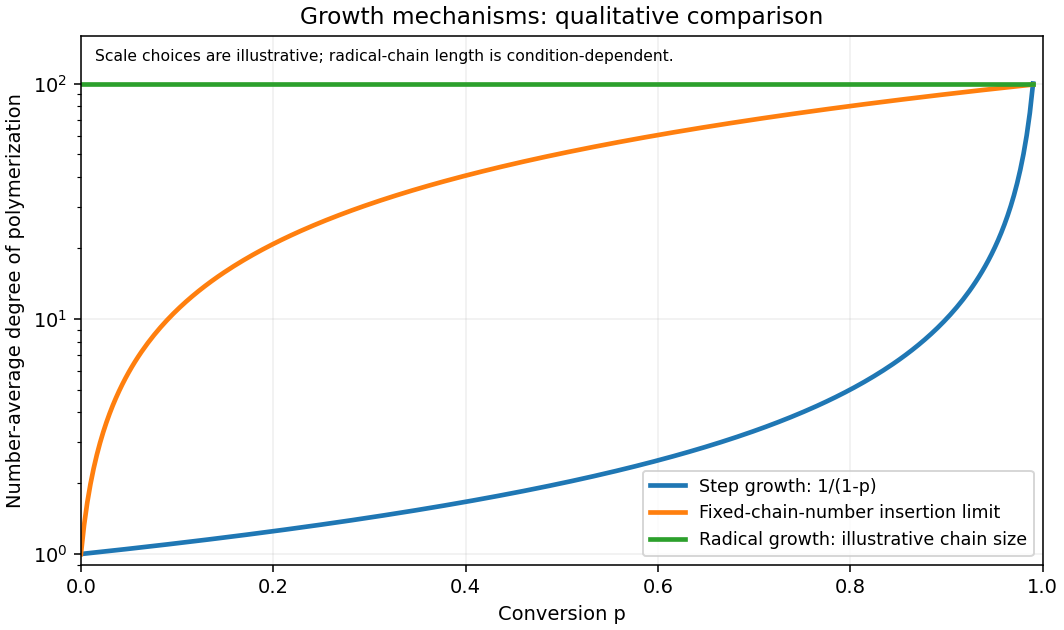
Contrasting idealized degrees of polymerization during three growth mechanisms
. Details. For the ideal equimolar step-growth polymerization, givesThis counts individual starting molecules, so it is only roughly one diamine–diester pair per average chain, rather than a long polymer. In a successful radical polymerization, many monomers normally add between initiation and radical termination. The styrene–maleic anhydride copolymer in (iv) therefore has the larger expected degree of polymerization.
Conversion alone does not specify the radical-chain length: the conclusion assumes ordinary polymer-forming conditions, rather than arbitrarily high initiator concentration or extremely strong chain transfer in chain polymerization.
Gel permeation chromatography separates by solution hydrodynamic volume, rather than molar mass alone. At equal molar mass, a more extended chain accesses fewer pores and elutes earlier. The relatively rigid, conjugated poly(3-hexylthiophene) is the natural first-eluting candidate, compared with the more flexible chains, provided all samples are molecularly dissolved.
This is a structural prediction, not an unconditional ordering: solvent quality, polymer aggregation and column interactions affect retention, and the hydrogen-bonding polyamide may not dissolve adequately in tetrahydrofuran. An insoluble sample cannot be assigned an ordinary solution gel permeation chromatography elution time.
A differential refractive index detector can detect all four polymers when their refractive-index contrasts are nonzero. Light scattering with an appropriate concentration detector can additionally provide molar mass. A single ultraviolet detector is unsuitable as the universal detector because polypropylene lacks the strong chromophores present in the aromatic and conjugated products.
The four shortest contacts are the three Cu–N bonds and Cu–OR bond. They define an approximately square equatorial set. The two remaining Cu–O contacts are longer and define a strongly elongated axial direction, as expected for the Jahn-Teller effect of Cu(II).
Choose along the long contacts and towards the short equatorial donors. The singly occupied, predominantly metal magnetic orbital is then , with substantial Ligand in coordination chemistry admixture. All three pyrazine nitrogen donors lie in this equatorial set, so both ladder directions have strong metal–Ligand in coordination chemistry orbital overlap. Neighboring copper centers communicate through comparable pyrazine superexchange pathways. Virtual electron transfer between half-filled orbitals stabilizes the antiparallel arrangement, giving antiferromagnetic interactions in both directions with comparable magnitudes. The axial oxygen donors are much less effective exchange routes.
At high temperature, tends towards the nearly constant Curie constant of weakly correlated centers. On cooling, falls because neighboring spins increasingly correlate antiparallel. The broad maximum in marks the crossover from the high-temperature Curie-like regime to substantial short-range order.
At still lower temperature, the Magnetic susceptibility becomes small because the antiferromagnetic ladder favors a singlet-like ground state and has few thermally accessible magnetic excitations. An even-leg spin ladder can have a spin gap, which reinforces this suppression. A broad Magnetic susceptibility maximum and falling support short-range antiferromagnetic correlations; they do not establish a three-dimensional Néel transition. Such a transition would require independent evidence, rather than identifying the broad maximum itself as the ordering temperature.
An ideal cubic perovskite structure is obtained by putting La at the cube corners, Re at the body center, and N at the face centers. In fractional crystal coordinates one convenient basis isThe counting is La, one Re and N per cell. Corner-sharing octahedra form the network, with La in the larger interstices. The ideal cell illustrates the connectivity; octahedral tilting can lower the actual crystal symmetry.
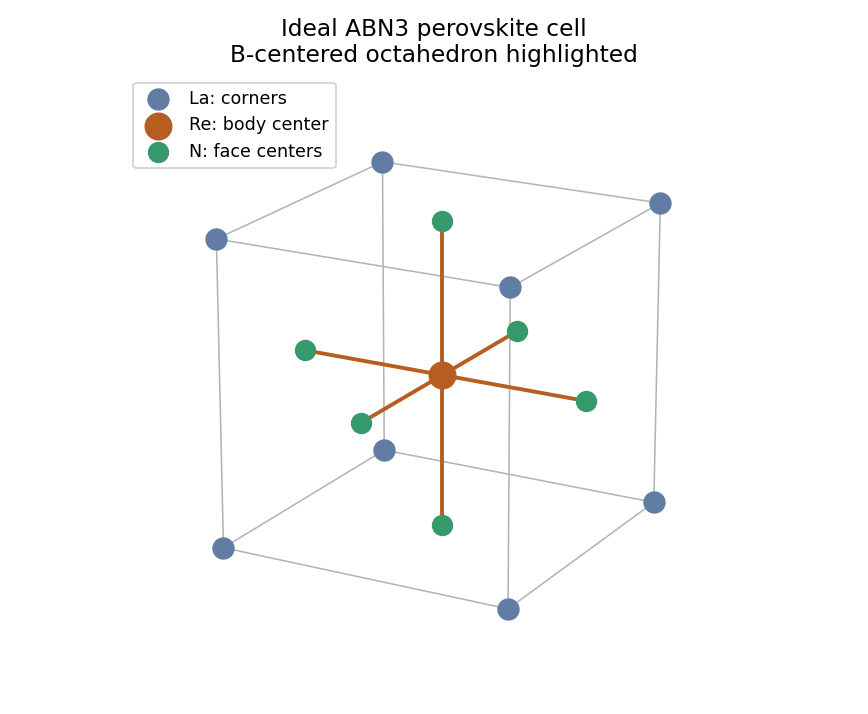
Formal ionic counting gives La(III), N(−III), and therefore Re(VI), with a configuration. An isolated localized center would carry a saturation magnetic moment of order , much larger than the value quoted. It is not a ion made diamagnetic simply by an octahedral ligand field.
The spatially extended Re orbitals overlap strongly with N orbitals. Re–N interactions raise the -derived antibonding states, while interactions mix the states with the nitrogen network. Repetition through corner-sharing octahedra turns these combinations into broad energy bands. The nominal electron occupies a delocalized, partially filled band rather than an isolated magnetic orbital.
Only electrons close to the Fermi energy change their occupations appreciably in an applied magnetic field. Consequently a Pauli paramagnetism has a small, nonzero field-induced magnetization:when is the density of states including both spin directions, expressed per formula unit and per unit energy. This band model explains a very small moment without requiring the absence of electrons in the Re-derived band. The reported material has metallic transport and a Pauli-like response.[ref]
Preparation of bulk-phase nitride perovskite LaReN3 and topotactic reduction to LaNiO2-type LaReN2 by Simon D. Kloß and others. Magnetic and transport measurements, Figure 4
The description “saturated” in the question should not be interpreted as complete alignment of one localized spin per Re: a nearly linear metallic response over a laboratory field range need not be a true fully spin-polarized saturation moment.
TODO: user-deferred biology. Metal binding in a protein is deferred under the current nonbiology scope.
TODO: user-deferred biology. Enzyme assignments and catalytic electron requirements is deferred under the current nonbiology scope.
TODO: user-deferred biology. Wild-type metalloenzyme activity is deferred under the current nonbiology scope.
TODO: user-deferred biology. Single-mutant metalloenzyme activity is deferred under the current nonbiology scope.
TODO: user-deferred biology. Multiple-mutant metalloenzyme selectivity is deferred under the current nonbiology scope.
For a homogeneous polymer solution, examine the curvature of the mixing Helmholtz free energy with respect to composition. A composition fluctuation into equal volumes at changes the average free energy byThus locally resists fluctuations and amplifies them, leading to spinodal decomposition. The spinodal curve is the locus , separating locally stable or metastable homogeneous compositions from locally unstable ones. The coexistence binodal instead follows a common tangent to the free energy. Between the binodal and spinodal, separation needs nucleation.
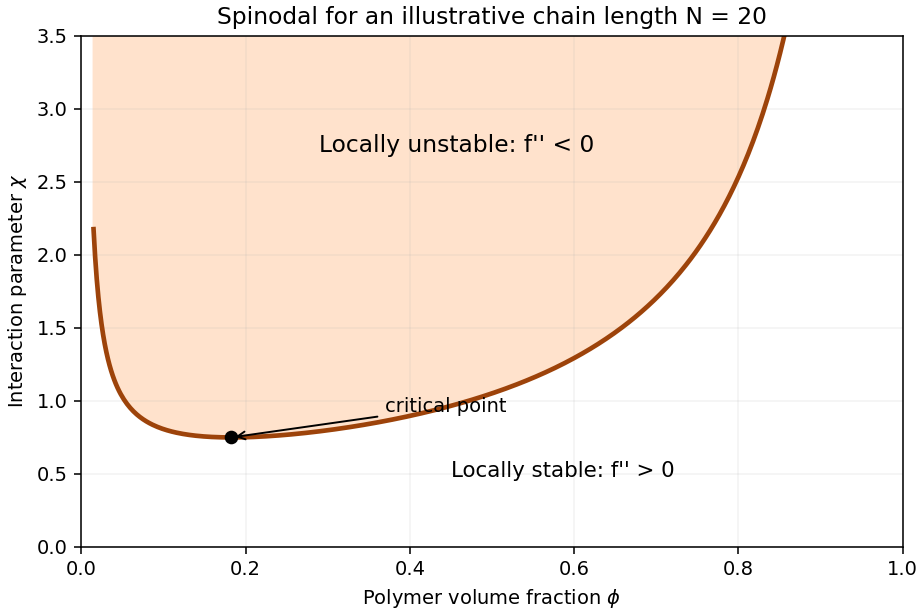


In Flory–Huggins solution theory, is the volume fraction, is the number of equal-sized lattice segments per chain, is temperature, is the Boltzmann constant, and is the dimensionless Flory interaction parameter. The stated is the mixing Helmholtz free energy per lattice site. The first two terms describe mixing entropy; the last describes the contact-energy contribution.
At fixed and composition-independent ,Hence the spinodal isThe homogeneous state is locally unstable when . The minimum gives the critical point of a Flory–Huggins polymer solution:If depends on temperature, the equation converts this result into a temperature–composition boundary.
The critical micelle concentration is the approximate total surfactant concentration above which additional surfactant predominantly enters micelles. Below it, most surfactant is present as separate molecules; above it, the free-monomer concentration changes much more slowly while the micelle population increases.
The crossover occurs when aggregation balances the unfavorable exposure of hydrophobic tails to water against head-group repulsion and the loss of molecular translational entropy. It is an aggregation threshold, not the concentration at which every molecule becomes micellar.
A longer hydrophobic tail makes transfer from water into a micelle more favorable, lowering the critical micelle concentration within this homologous series. Ranking the four quoted concentrations therefore givesThis assignment uses the chain lengths and concentration ranking printed in the question; it does not identify the compounds by substituting an external table of measured concentrations.
For the same geometry, separation and intervening medium, the attractive Van der Waals force scales with the effective Hamaker constant. With the constants treated as applying to those same conditions,The silver particles attract more strongly. This comparison is conditional on a common geometry and on using the appropriate constants across the actual medium. Constants for particles in vacuum cannot automatically be applied unchanged across a solvent.
For two equal spheres of radius , the effective radius in the Derjaguin approximation is . The nonretarded attractive van der Waals potential isDifferentiating with respect to the surface gap givesThus the requested approximation gives an attraction of about pN. Here , whereas the Derjaguin approximation requires . This is the formal estimate requested by the hint, not a quantitatively reliable near-contact approximation for the printed dimensions.
The Stern layer is the compact near-surface layer of specifically adsorbed or closely associated ions. The diffuse layer is the more extended, thermally distributed excess of counterions that screens the surface charge.
For water near , the Debye length can be writtenFor M KCl, M and nm. For a fully dissociated 2:2 electrolyte at the same formula-unit concentration, M, giving nm, half as large. These are linear-screening estimates, not sharp boundaries of the diffuse layer.
In the Asakura-Oosawa model, nonadsorbing polymers are treated as ideal, mutually penetrable particles, but their centers cannot enter a layer around a hard colloid. The polymer osmotic pressure is in the ideal dilute limit, with the appropriate number density in the space dimension considered.
For fixed polymer number, reducing the inaccessible volume increases the available volume and lowers the polymer Helmholtz free energy. Equivalently, at fixed polymer chemical potential, the polymer contribution to the effective colloid potential isWhen the excluded layers overlap, their union occupies less space than two separate layers. More polymer configurations become available, so the resulting depletion force attracts the colloids. It is an entropy-driven effective interaction, even though each microscopic colloid–polymer interaction is purely repulsive.
The unrotated squares have a gap , so their facing exclusion layers do not overlap. Rotation can bring them into contact even though their centers remain fixed. The strongest depletion force comes from parallel faces in contact over a long shared length, rather than a corner-to-corner contact.
Let . Rotate both squares through the same angle relative to their original orientation. Their center displacement has a face-normal component and a tangential component . Face contact requiresThe contacting faces overlap for lengthThese two mirror-related orientations, together with equivalent square rotations, maximize the leading overlap area when . A small polymer gap sacrifices overlap width without a compensating leading increase in contact length.
Each face excludes polymer centers out to distance . At face contact, the combined overlap strip has width and length . Ignoring end corrections of order , the two-dimensional Asakura-Oosawa model therefore givesThe final expression retains only the leading term in . Its dimensions are correct because is a number per area. The zero of this effective potential energy is the well-separated, nonoverlapping-exclusion-layer configuration.
There is no universal ranking from the information supplied. The depletion force scales with polymer osmotic pressure, hence with in the ideal model. London dispersion forces instead depend on the material-dependent Hamaker constant, the intervening solvent, the closest approach and the contact geometry.
Close face contact can give a strong dispersion contribution; the ideal continuum expression even becomes singular without a molecular-distance cutoff. Nevertheless, refractive-index matching can greatly reduce that contribution, and increasing polymer concentration can strengthen depletion force. A quantitative comparison requires those missing material and concentration scales. The two attractive contributions may act together.
Write and . A path with visits to makes unsuccessful excursions back to , followed by one successful step to . Every step has probability one, soThe visit count has a geometric distribution, with success meaning the final step.
For , equivalently , the geometric series givesThus absorption probability is one. The qualification matters: if , the process alternates between and forever and never reaches .
Each visit to corresponds to two steps, one out of and one out of . Hence a successful path with visits contains steps. Taking its expectation over the geometric distribution givesThe last pair is ; it contributes two steps just like each previous excursion.
Using the differentiated geometric series,This is finite for , equals two when every visit succeeds, and diverges as the chance of success tends to zero.
A path with visits makes departures from and departures from . Its conditional mean duration is therefore . Averaging over the geometric distribution,Only the mean waiting times are needed here: linearity of expectation adds their contributions without requiring each residence time to equal its mean.
The same geometric series identity givesA direct renewal check gives the identical result: and , so . This also checks the units: mean first-passage time has units of time, unlike the dimensionless step count.
This is an Ireland–Claisen rearrangement. Number the ester carbonyl carbon , its enolizable carbon , and the three allylic ring carbons , starting at the carbon bearing the ester oxygen.
lithium hexamethyldisilazide removes an proton and trimethylsilyl chloride traps the oxygen of the resulting ester enolate, giving a silyl ketene acetal. Heating permits a six-electron, [3,3]-sigmatropic rearrangement through the arrayThe electron-pair movements are , , and . Acidic work-up cleaves the silyl ester to the carboxylic acid. The benzyl ether remains a protecting group; it is not the migrating bond.
The suprafacial reaction transfers the starting allylic stereochemistry to , where the new side chain is delivered from the original oxygen face. In the product's printed orientation, the new C–C bond is behind the ring and the C methyl group is toward the viewer. At that ring star, the Cahn-Ingold-Prelog priority rules orders the groups as side chain, alkenyl ring direction, saturated ring direction, methyl, giving .
The second star is . Its priorities are carboxyl, substituted ring carbon, , H. A chair-like transition state normally places the bulky side chain pseudoequatorial. However, its absolute configuration also depends on the E/Z geometry of the trapped silyl ketene acetal: opposite geometries give opposite configurations at this star under the same suprafacial ring transfer. The printed conditions do not state solvent or the ketene-acetal geometry. Thus the secure assignment is the ring-star configuration and conditional -star stereochemistry, rather than an unqualified absolute assignment to both stars. Drawing the assumed ketene-acetal geometry and its chair is necessary before selecting one epimer.
A is the kinetic, less-hindered-side silyl enol ether. Its double bond lies away from the methyl substituent. Forming B requires removal of a proton from the more hindered position adjacent to the methyl-bearing carbon.
The base strengths alone do not determine the ratios. trimethylsilyl triflate is strongly electrophilic: oxygen silylation activates the ketone towards deprotonation, and irreversible trapping of the resulting silyl enol ether can make the product ratio reflect competing deprotonation rates. A weak amine therefore need not first produce a substantial equilibrium concentration of the free ketone enolate.
DBU is the strongest and comparatively accessible base, and distinguishes the two sites least strongly, giving the smallest A:B ratio. Triethylamine gives greater preference for the less-hindered site. The more sterically hindered diisopropylethylamine discriminates most strongly and gives the largest proportion of A. Its slightly higher conjugate-acid than that of triethylamine does not reverse this trend, because steric accessibility and the coupled silylation/deprotonation mechanism matter alongside basicity. The data do not establish a simple thermodynamic enolate distribution.
The key sequence is deprotonation, anionic eight-pi electrocyclization, then elimination. Label the conjugated route from the lower cyclopentene to the right cyclopentene aswhere is the methylene joining the lower ring to the central alkene, and carries the substituent.
potassium hexamethyldisilazide removes a proton at . The resulting anion is delocalized over the seven-carbon array: its six pi-bond electrons plus the lone pair make an eight-electron system. Thermal electrocyclic reaction is disrotatory for this electron count. Joining and forms the seven-membered central ring and puts the remaining anionic character at , with double bonds at and .
That anion then forms , expelling the O-dimethylcarbamate group from the attached methylene. This E1cb elimination supplies the exocyclic methylene and explains why no oxygen remains in the depicted product. The disrotatory closure, with the cyclopentene ends folded to avoid unfavorable overlap, gives the trans relationship between the two lower fused-ring bonds shown by the wedge and dash. A simple [3,3] rearrangement would not create the required bond between the two remote cyclopentene termini.
function trapezoid(f, a, b, n):
    dx = (b-a)/n
    total = (f(a)+f(b))/2
    for j in 1,...,n-1:
        total += f(a+j*dx)
    return dx*total

function midpoint(f, a, b, n):
    dx = (b-a)/n
    total = 0
    for j in 0,...,n-1:
        total += f(a+(j+1/2)*dx)
    return dx*total
The trapezoidal rule gives each endpoint half weight; the composite midpoint rule uses one interior point per subinterval. Both converge for a continuous integrand on the closed interval.
The second equality in the printed trapezoidal hint is missing a factor . The average of the left and right rectangle sums is required. For , the uncorrected equality would return instead of .
A weighting function must first be normalized to a probability density. The constant choice on meansEquivalently, transform and use the already normalized on . Independent samples give the unbiased Monte Carlo integration estimator
function uniform_monte_carlo(f, a, b, N):
    require N >= 2
    total = 0
    total_squared = 0
    for j in 1,...,N:
        u = independent_uniform_0_1()
        value = f(a+(b-a)*u)
        total += value
        total_squared += value*value
    average = total/N
    sample_variance = (total_squared-N*average*average)/(N-1)
    integral = (b-a)*average
    standard_error = abs(b-a)*sqrt(sample_variance/N)
    return integral, standard_error
For a general positive normalized importance density , replace each sample contribution by with . Here the uniform choice is the special case of importance sampling that assigns equal weight to every region of equal length.
The constant density is reasonable when the integrand has comparable magnitude throughout the interval. It is inefficient for a narrow peak because most samples contribute little while rare samples carry large weights.
For independent importance sampling,A good density has support wherever , is easy to sample and evaluate, and resembles . Subject to normalization, minimizes this variance. For nonnegative , the ideal normalized choice makes every sample contribution equal, although its normalization is generally the unknown integral itself. Uniform weighting is therefore acceptable for a flat integrand, not universally suitable.
For a fixed- canonical ensemble, sample the normalized Boltzmann distribution in phase space:After integrating out the momenta for an ordinary separable Hamiltonian mechanics, configurational sampling uses . The correct equilibrium distribution is ensemble-dependent; the Boltzmann form is the canonical answer, rather than a universal prescription for every possible ensemble.
Articles were limited to the first 100 out of 850 total.
Articles by others on the same topic
There are currently no matching articles.