Each fragment leaves two electrons after allocating one aluminium valence electron to its monovalent cyclopentadienyl ligand. Four fragments therefore give eight cluster electrons. In the tetrahedral arrangement, fragment lone-pair/donor and vacant acceptor orbitals combine into delocalized cluster orbitals. The occupied low-energy set has symmetry, analogous to a filled 1S and 1P shell; higher combinations remain empty. This is a multicentre description, not six independent two-electron Al–Al bonds, which would require twelve electrons.
A schematic molecular-orbital diagram should show the occupied nondegenerate level below the occupied triply degenerate set, separated from the empty higher levels. Detailed energies and ordering of the empty levels require an orbital calculation. On descending Group 13, stabilization of the pair and reduced favourable – mixing can weaken the tendency towards the same compact Al-like bonding pattern; metal–metal distances and preferred aggregation change. Ligand size, donor/acceptor properties and hapticity also tune fragment orbital energies and steric access, so neither substitution of the metal nor of Cp* is electronically innocent.
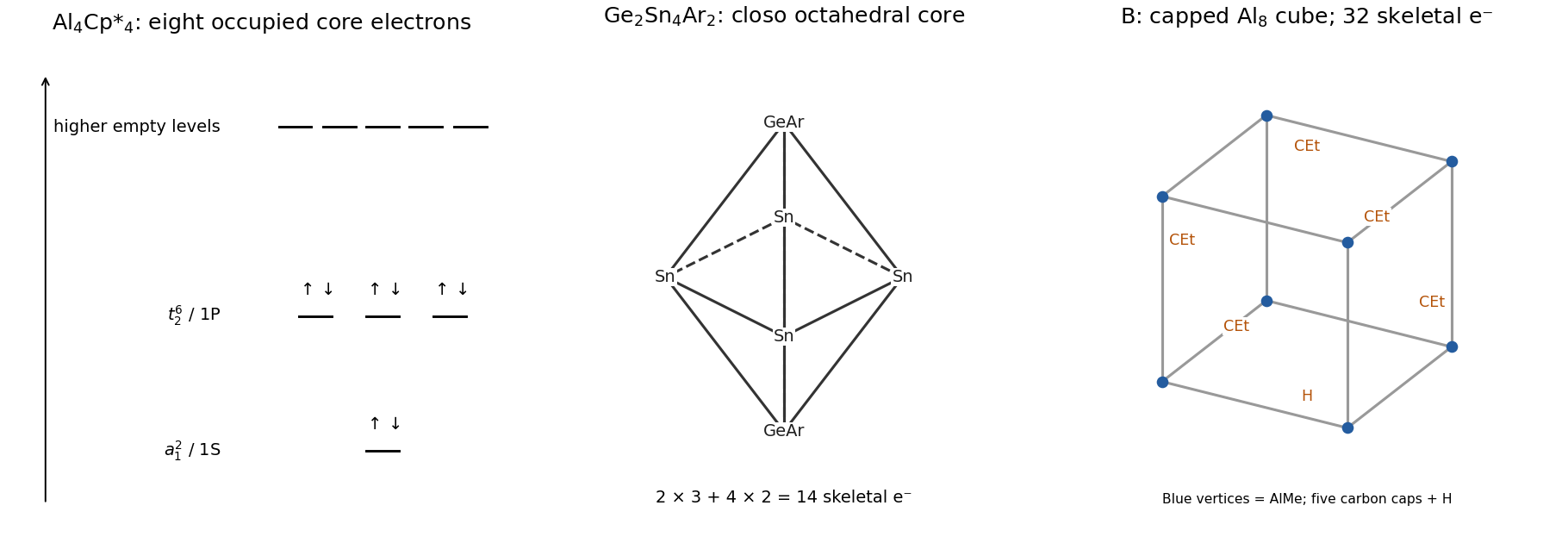
Original cluster orbital filling, octahedral electron counting and capped-cube connectivity
. Details. 
Articles by others on the same topic
There are currently no matching articles.