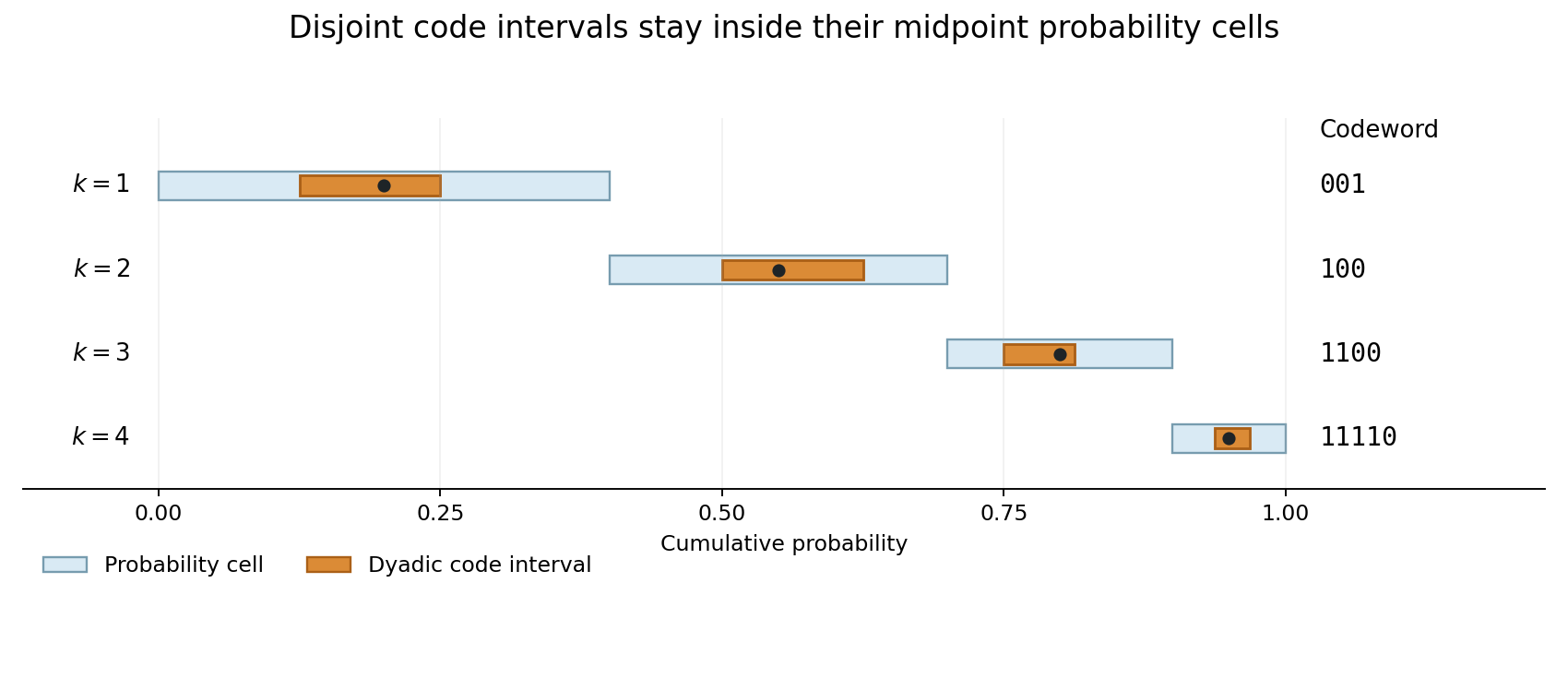
Let and let be the probability cell of symbol . Its midpoint is . Use the binary expansion terminating in zeros at a dyadic rational, so truncation to bits givesThe chosen codeword corresponds to the dyadic interval . It contains , and its width satisfies . ConsequentlyThus . The probability cells are disjoint, so the code intervals are disjoint. If one binary codeword were a prefix of another, its dyadic interval would contain the other's interval, contradicting this disjointness. Hence the code is instantaneous.
Finally, . Multiplying by and summing yieldsThis is the Shannon-Fano-Elias code: the extra bit makes the dyadic interval narrow enough to remain inside the cell around its midpoint.

Articles by others on the same topic
There are currently no matching articles.