The bit rate counts data bits carried per second; the baud rate counts transmitted signal elements per second. A signal element need not carry one whole data bit. In Manchester encoding, each data bit occupies two half-bit signal elements, one high and one low. For example, choose low–high for zero and high–low for one. The compulsory transition in the middle provides a timing reference for clock recovery.
If one data bit lasts seconds, the bit rate is , while each half-bit signal element lasts . With this binary signal-element convention,Thus a 10 Mbit/s Manchester encoding signal uses 20 million half-bit signal elements per second. This is not a count of observed voltage transitions: some bit boundaries also contain a transition and others do not. Calling a whole two-element pattern a symbol gives a different symbol-counting convention; the physical fact is two half-bit elements per data bit.
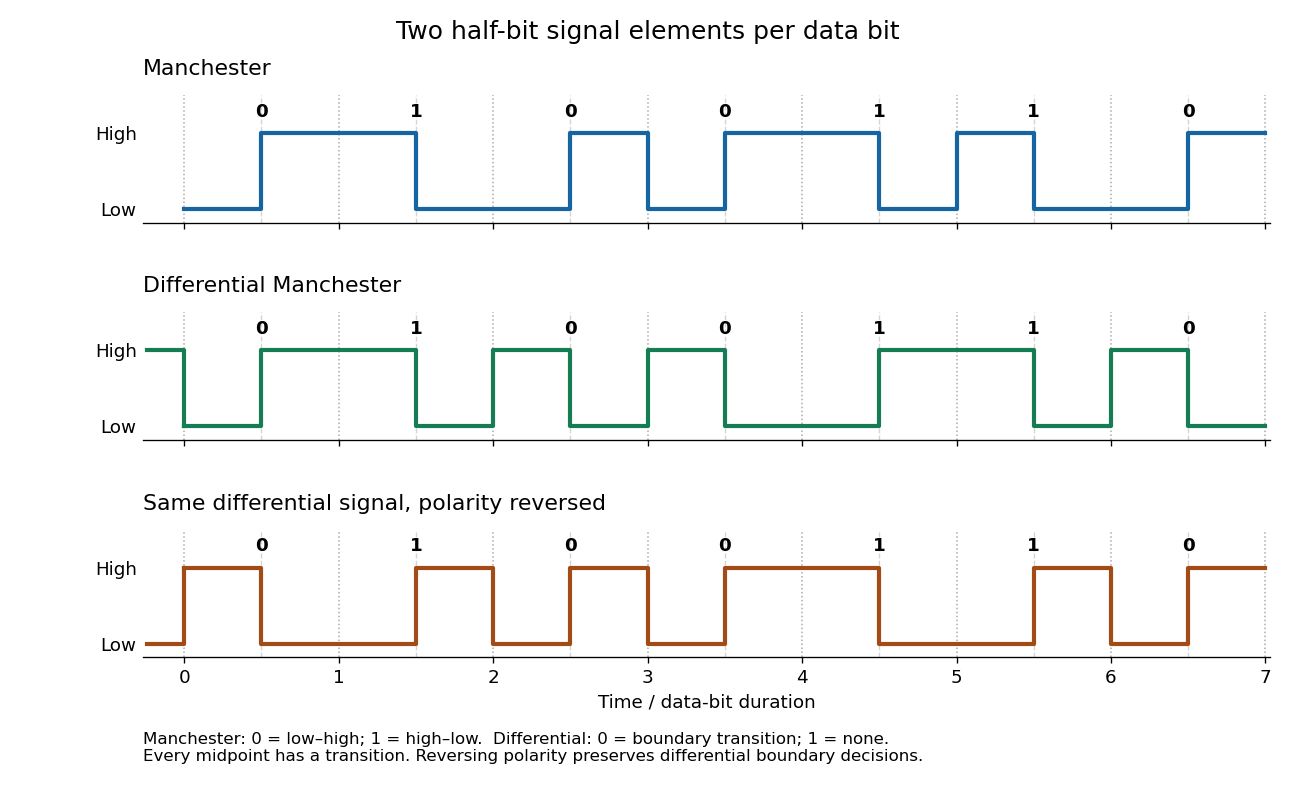
Manchester encoding and differential Manchester encoding for the same seven bits; dotted lines mark bit boundaries and dashed lines mark their midpoints
. Details. 
Articles by others on the same topic
There are currently no matching articles.