Solutions to all three questions of the paper dated 13 June 2015.[ref]
Computer Networks examination paper of the University of Oxford (2015). Cover and printed pages 2–3, A12068W1
The bit rate counts data bits carried per second; the baud rate counts transmitted signal elements per second. A signal element need not carry one whole data bit. In Manchester encoding, each data bit occupies two half-bit signal elements, one high and one low. For example, choose low–high for zero and high–low for one. The compulsory transition in the middle provides a timing reference for clock recovery.
If one data bit lasts seconds, the bit rate is , while each half-bit signal element lasts . With this binary signal-element convention,Thus a 10 Mbit/s Manchester encoding signal uses 20 million half-bit signal elements per second. This is not a count of observed voltage transitions: some bit boundaries also contain a transition and others do not. Calling a whole two-element pattern a symbol gives a different symbol-counting convention; the physical fact is two half-bit elements per data bit.
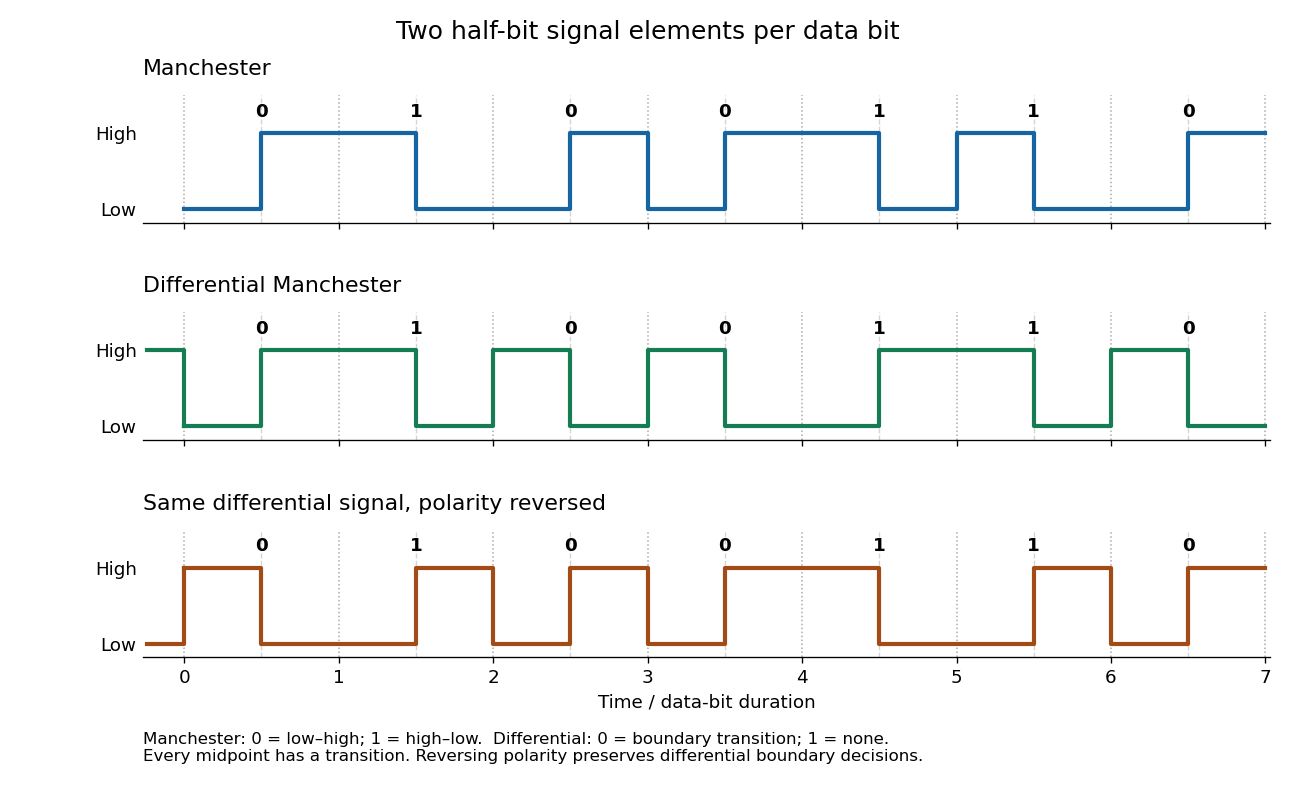
Manchester encoding and differential Manchester encoding for the same seven bits; dotted lines mark bit boundaries and dashed lines mark their midpoints
. Details. 
In differential Manchester encoding, every data bit still has a compulsory transition at its midpoint for clock recovery. The data value is specified by whether a transition occurs at the beginning of the bit, rather than by the direction of the midpoint transition. One convention is beginning transition for zero and no beginning transition for one; interchanging the meanings consistently also works.
Reversing the signal polarity exchanges high and low everywhere, but preserves both the presence and the absence of transitions. A receiver using differential Manchester encoding therefore decodes the same data after a polarity reversal, provided it has acquired the timing and boundary reference. Ordinary Manchester encoding with a fixed low–high/high–low interpretation would exchange the two data values. The advantage is
A block code for line coding divides the data into five-bit groups and assigns each of the possible groups a distinct eight-bit codeword. The receiver reverses that assignment after finding the eight-bit boundaries. There are candidate codewords, so the designer has substantial freedom to select 32 suitable ones and reserve other patterns for control or synchronization.
The choice can limit long runs of equal bits to help clock recovery, balance high and low levels to reduce a persistent offset, and distinguish control patterns from data. These properties must hold across adjacent codeword boundaries too: two individually acceptable words can concatenate into an unacceptable run. The unused patterns can also help error detection and correction: an invalid received pattern exposes some errors, and the Hamming distance between valid codewords determines stronger guarantees. Redundancy alone does not imply that all errors are detected or correctable. Circuit complexity and propagation of a synchronization error also matter.
Before any further line coding or framing overhead, the useful fraction and expansion areThe three extra bits per five input bits are 60% overhead relative to the input, or 37.5% of the encoded output.
A physical link can deliver a continuous stream of bits; the data link layer needs to identify where each separately meaningful unit begins and ends. Framing supplies those boundaries, so the receiver can separate the data-link frame header, data and checking information, associate an error detection and correction result with a particular data-link frame, and regain alignment after damaged input.
Timing the individual bits is insufficient: knowing where each bit begins does not tell the receiver which bit starts a new data-link frame. Thus
Reserve a frame delimiter that cannot occur inside encoded data-link frame contents. For a concrete bit stuffing rule, take the flag
01111110. Between flags the sender inserts a zero after every run of five consecutive one bits, including runs in the checking information. The receiver removes that zero when decoding. The flags themselves are transmitted without bit stuffing. For example, the six payload one bits 111111 are sent as 1111101, so they cannot imitate the flag's run of six ones.[ref]The receiver recognizes the flag before treating input as payload. After five ones, a following zero is a stuffed bit; a following one cannot be ordinary stuffed payload and requires the delimiter/error handling rules. Consequently a delimiter remains recognizable even if the unencoded data contained its exact pattern. Bit stuffing also applies at the end of the payload, so a run cannot spill into a boundary ambiguously.
The frame delimiter should be long and distinctive enough to support reliable synchronization in the presence of errors, but frequent flags and the run constraint cost capacity. For the usual family of flags with a longer run of ones, a longer forbidden run makes stuffing less frequent while making the delimiter itself longer. Valid stuffed data never contains an intact flag; false flags can arise when transmission errors damage that guarantee. Their likelihood depends on the error model, rather than merely on the raw frequency of the unencoded pattern.
The data-link frame length balances fixed header/flag/check overhead against network latency, receiver storage and the cost of a damaged data-link frame. If independent bit errors have probability , an -bit transmission has no such error with probability . Longer data-link frames amortize fixed overhead, but have more opportunities for corruption and, when data retransmission is used, waste more work per failed attempt. They also delay delivery until the whole data-link frame is available. A maximum length limits storage requirements and the damage from a lost boundary. The design balance is
Represent the data bits, most significant first, by a polynomial whose polynomial coefficients lie in the field with two elements . Here addition and subtraction are both exclusive or, with no carries. Choose a fixed CRC generator polynomial of polynomial degree , with leading and constant polynomial coefficients one. Both endpoints know and the bit ordering.
Multiply by , which appends zero bits. Use polynomial division to obtainReplace the appended zeros by the bits of the polynomial remainder , retaining leading zeros when necessary. The transmitted polynomial isThe last equality holds because adding cancels the existing polynomial remainder in the field with two elements. It is the simple systematic cyclic redundancy check convention used here; practical variants can add agreed initialization and final transformations.
The receiver divides the entire received polynomial by . A nonzero polynomial remainder detects corruption. If the received word is , where the ones in the error polynomial mark flipped bits, its polynomial remainder is . Thus the undetected nonzero errors are exactly the multiples of ; a zero result does not prove that transmission was error-free. Operationally, polynomial long division repeatedly cancels a leading one using a shifted copy of , implemented with exclusive or operations.
All the following polynomial coefficients and sums lie in the field with two elements, so . For the constant polynomial,For the linear polynomial, subtracting the leading multiple means adding it:For the quadratic polynomial, first cancel using , leaving ; then cancel using . ThusThe requested polynomial quotients and polynomial remainders are thereforeFor a general polynomial , write with constant . Since , polynomial evaluation at gives . This is the polynomial remainder theorem with in the field with two elements. HenceThe polynomial remainder is precisely the parity bit obtained by taking the exclusive or of all the polynomial coefficients.
Let . With CRC generator polynomial , the appended check has one bit. The preceding polynomial remainder rule gives , so put in the field with two elements. The eight transmitted bits areThey have even Hamming weight, so this cyclic redundancy check is a single parity-check code. For a substitution error polynomial , detection occurs exactly when : an odd number of the eight bits, including the check bit, have flipped. ThereforeIn particular, every single-bit error is detected, while flipping any two distinct bits passes this check. This conclusion assumes that the eight-bit word's boundaries and length are retained; it supplies no general protection against insertions, deletions or lost framing.
Soft state is information maintained by refreshes and allowed to expire when those refreshes cease. It can be reconstructed from continuing communication with the participants that still need it. Hard state instead persists until explicitly changed or removed; a lost deletion or failed participant can therefore leave stale information indefinitely. This distinction concerns the maintenance rules, rather than simply whether the information is in volatile memory.
For example, a router can keep IP multicast membership information for a local network. Periodic membership queries and reports refresh that information; if no member reports within the prescribed interval, the membership expires. A host that crashes without unsubscribing is eventually forgotten. A lost report need not remove membership immediately, because repeated reports and a suitable expiry interval tolerate occasional loss. If the router loses its membership information, subsequent queries and reports rebuild it.[ref]
This is attractive in Internet components because packet loss, host crashes and router restarts need not be repaired by a perfectly delivered sequence of explicit deletions. Refreshes repair some omissions, and expiry removes abandoned entries and releases resources. Components can recover local state without retaining an indefinitely accurate history of everyone else's actions. Soft state does have a cost: refresh traffic, timer storage and temporary stale or missing information, with a tradeoff between rapid expiry and tolerance of delayed refreshes. Its central benefit is
Network address translation lets a router join a private Internet Protocol address realm to the public Internet. On outbound packets it replaces the private source IP address by a public IP address. On returning packets it applies the inverse mapping to the destination IP address, then forwards to the internal host. Basic network address translation changes addresses; the common many-to-one form, network address and port translation, also changes the source transport port so several internal hosts can share one public IP address.[ref]
Traditional IP Network Address Translator (Traditional NAT) (RFC 3022). §§2.1–2.2 and 3.1–3.3: basic NAT, NAPT and translation phases
For example, suppose the public-facing router has IP address
198.51.100.7. An internal TCP exchange might be translated as follows; the addresses are illustrative:An entry records that traffic returning to external transport port 62001 belongs to 10.0.0.2:49152 for this transport protocol. The destination on the return path is rewritten accordingly. A second internal host using the same private transport port can receive a different public transport port. The actual lookup may also use the remote endpoint, depending on the mapping and filtering policy.The router must update the IPv4 header checksum, and any affected TCP or UDP checksum: transport checking includes the relevant IP addresses as well as the transport header. Bindings may be allocated dynamically and removed after inactivity or observed termination. Traffic for a live exchange must traverse a translator that possesses the binding, or equivalent shared information.
An unsolicited incoming packet generally has no dynamic inverse mapping, so exposing a private service usually needs a configured mapping or port forwarding. Application data that embeds a private IP address can also need special handling. Address translation saves public address space, but changes the addressing visible to the two endpoints and can disrupt an exchange if its mapping disappears. Its essential mechanism is
Dynamic network address and port translation has an important soft state aspect: activity refreshes a binding's lifetime, and inactivity eventually expires it without a reliably delivered close message. This is especially useful for UDP, which supplies no connection-closing exchange. Even for TCP, the router cannot assume that it will observe every closing packet.
However, an expiring entry is not necessarily harmlessly disposable. Suppose the binding
10.0.0.2:49152 to 198.51.100.7:62001 disappears while the remote endpoint is still using it. A reply to port 62001 no longer reveals the private destination. New outbound traffic might obtain a different public transport port, which does not reconstruct the old connection as viewed by the remote endpoint. Losing the binding can therefore break the exchange even though both endpoints remain alive. This conflicts with fate-sharing when indispensable connection information resides in a separate router.Static address mappings and configured port forwarding are hard state; a fixed translation rule need not even require a dynamic per-exchange table. ThusDescribing all network address translation information as fully reconstructible soft state would overlook both this recovery limitation and the static configuration.
UDP fits IP multicast because each independent datagram can be delivered to a group without establishing a separate transport connection with every receiver. Ordinary TCP defines a reliable ordered byte stream between two endpoints, with one peer's acknowledgements, receive window and connection state. A group has many receivers with different losses and capacities, so that interface cannot simply be assigned to one group address. A reliable group service can be designed, but ordinary TCP does not provide it. UDP itself adds neither group reliability nor congestion control; applications must provide whatever additional behaviour they require.
A virtual multicast distribution tree lets one packet traverse a shared upstream link and be copied only where branches diverge. Compared with a separate unicast copy per receiver, this saves repeated transmission over the common links. A tree also supplies a unique parent route and avoids forwarding loops when the routing information is consistent. Branches with no interested receivers can be pruned.
For a source-specific multicast distribution tree, a router needs the group identifier and source identifier, the expected incoming interface, the set of outgoing interfaces leading to interested receivers, and information about local group membership. Timers and join/prune information maintain those decisions. This is naturally keyed by for source and group ; other multicast routing designs can use a shared group tree. A router needs the relevant local forwarding entries, rather than a complete list of all group members everywhere. The result is
In reverse path forwarding, a router uses its unicast routing information to ask which interface it would use to send a packet back towards source . It accepts a multicast packet from only when it arrives on that interface, and otherwise discards it. An accepted packet can be forwarded on the other eligible interfaces. This needs no globally computed multicast distribution tree before the first transmission.[ref]
Distance Vector Multicast Routing Protocol (RFC 1075). §2: reverse-path broadcasting and truncation
With stable, loop-free routes and a consistent choice of parent when routes tie, each non-source router selects one upstream parent towards . Following parent links reaches , so the accepted parent links form a source-rooted tree over reachable routers. A packet arriving across a cross-link from a non-parent fails the reverse-path test. Basic flooding can still transmit copies that will be discarded; downstream-neighbour information can suppress such useless transmissions, and a designated forwarder prevents duplicate delivery on a shared local network.
To adapt the forwarding structure to a particular multicast group, retain branches with local members or interested descendants and prune the others. Leaf routers with no interested receivers initiate pruning; a router with no local members and no remaining interested children can propagate that condition upstream. A new subscriber requires a join/graft or later refresh to restore a pruned branch. Thus reverse path forwarding gives the source-rooted reachability structure, while membership and pruning restrict it to useful branches.
This tree need not minimize total transmission cost. Even if the unicast routes are shortest paths under symmetric positive link costs, their union minimizes individual distances from the source, rather than the sum of the costs of all used links. For a small example, let and each cost 2 and let cost 1, with receivers at and . The shortest-path tree uses and , costing 4 in total. Using and costs 3, although the route from to then has length 3 instead of 2. Moreover, real unicast policies may optimize other criteria, and reverse routes need not be best forward routes when costs are asymmetric. Therefore
Transport sequence numbers identify the position of data within an exchange. They let a receiver restore order, recognize duplicates, identify missing data and state precisely what has been received in an acknowledgement. In TCP they count bytes, so one packet can contain several consecutively numbered bytes.
A send window is the range of numbered data the sender is currently allowed to have outstanding. It permits several transmissions before their acknowledgements return, which keeps the path busy despite network latency, while bounding unacknowledged data and the information needed for data retransmission. A receive window specifies the range the receiver is prepared to accept, limiting buffer use and rejecting data outside the current range; an implementation may retain acceptable out-of-order data until earlier data arrive. As acknowledgements and consumption advance, these ranges slide, giving a sliding window protocol. Thus
Flow control prevents a sender from overrunning the receiving endpoint's capacity to buffer and consume data. Congestion control prevents the aggregate traffic from overloading the intervening computer network, especially shared links and router queues. A fast receiver can still sit beyond a congested path; an uncongested path can still lead to a slow receiver. Consequently
TCP implements both restrictions at the sending endpoint, using information from different places. For flow control, the receiving TCP advertises its available receive window in TCP headers. The sending TCP tracks that advertised range together with the acknowledgement number, and must not send ordinary new data beyond its right edge. As the receiving application consumes data, the receiver can advertise more space. A zero receive window stops ordinary new data and invokes the separate probing mechanism.
For congestion control, the sender maintains a congestion window representing its permitted amount of outstanding data given the path's condition. Acknowledgements, duplicate acknowledgements and data retransmission timeouts supply feedback; explicit congestion notifications can also contribute when negotiated. Routers supply the underlying evidence through queuing, drops or marks, but ordinary TCP congestion window management takes place at the endpoints, rather than through a per-connection capacity reservation at each router.[ref]
Ignoring exceptional probe behaviour, let be the number of sent but not yet acknowledged bytes. The two controls combine approximately asThe send window is anchored by the acknowledged sequence position, rather than authorizing a fresh windowful on every send. Acknowledgements release room as old data leave flight. A sudden reduction of a limit can leave already transmitted data above it; the sender then waits instead of recalling those bytes. The receive window is explicit receiver feedback, whereas the congestion window is a local sender variable. No details of their parameter-adjustment algorithms are needed for this distinction.
For two competing TCP connections, each sender's congestion control aims to obtain useful throughput while adapting to shared capacity and avoiding persistent overload. For two comparable, continuously backlogged connections at one bottleneck, the usual fairness objective is approximately half the available capacity each, while keeping the bottleneck productively used. The goal is not for both senders independently to seize the whole link. Unequal delays, implementations, application demands and other bottlenecks mean that equal throughput is not guaranteed.
For two UDP exchanges, there is no corresponding built-in transport congestion control objective: UDP sends datagrams without specifying a congestion response. The applications might implement well-behaved congestion control, rate limiting or no adaptation at all. Consequently two UDP labels alone do not determine either a target share or the resulting allocation. Applications should still manage overload; that responsibility is outside the base UDP service.
For a competing TCP connection and an unresponsive high-rate UDP application sharing an ordinary queue, losses cause the TCP sender to reduce its offered load while the UDP sender continues. The UDP traffic can take much of the bottleneck capacity and severely reduce TCP throughput. If the UDP rate exceeds capacity, it too loses packets; sending more does not guarantee useful delivery. A modest-rate or adaptive UDP application, or a router enforcing fair queueing, gives a different outcome. Thus
Nagle's algorithm prevents the small-packet problem: an application that writes one or a few bytes at a time could generate a separate TCP TCP segment for each write, with transport/link overhead and router work far larger than the useful data. This is a sender-side cause of the silly window syndrome family of inefficient tiny transmissions.
When no data are outstanding, send the first small TCP segment promptly. While data remain unacknowledged, accumulate further small writes instead of emitting another short TCP segment. Release the accumulated data when either enough are available for a full-sized TCP segment, subject to the allowed send window, or the outstanding data have been acknowledged. This makes the waiting adapt to the round-trip time, rather than imposing one fixed batching interval.[ref]
The penalty is extra network latency for later small writes. A short application message split across writes may have its second piece delayed awaiting the acknowledgement of the first. If the receiver uses a delayed acknowledgement while its application awaits that second piece, progress can wait for the acknowledgement timer. It is a delay interaction, not a permanent deadlock while that timer works. Latency-sensitive applications can request that Nagle's algorithm be disabled, accepting the possible extra packets. The tradeoff is
The decisive difficulty is that a TCP receive window update is not itself delivered by a reliable notification channel. The receiver can advertise a newly nonzero receive window, but the packet carrying that advertisement can be lost. With the sender stopped and the receiver expecting more data, neither side need send anything else. The sender can then wait forever despite available receiver space.
A TCP acknowledgement containing only an updated receive window does not occupy new sequence space that would make its loss trigger normal data retransmission. Requiring an acknowledgement of every such notification would introduce a separate reliability rule; that new acknowledgement can itself be lost. Some participant still needs a timer and retry rule. Reordering can also deliver stale advertisements, so transport sequence number and acknowledgement checks are needed in addition to merely sending a notification.
The persist timer assigns the repeated enquiry to the side that has data waiting: the sender periodically sends a zero-window probe, eliciting an acknowledgement with the receiver's current receive window. If one enquiry or response is lost, a later attempt can succeed. Receiver window updates remain useful for prompt resumption; probes provide recovery when those updates disappear.[ref]
Requirements for Internet Hosts - Communication Layers (RFC 1122). §4.2.2.17: zero-window probing prevents indefinite hangs when a reopening ACK is lost
Articles by others on the same topic
There are currently no matching articles.