For a finite normal-form game, a mixed strategy is a probability distribution over player 's pure strategies. Independent randomization by the players defines an expected payoff . A strategy profile is a Nash equilibrium iffor every player and every alternative mixed strategy . By linearity in a player's own distribution, it is enough to check all pure deviations. Equivalently, every pure strategy in the support of a mixed strategy must be a best response to the other players' choices.
With rows and columns ordered Head, Tail, the payoff matrix of ordered pairs isThis is a zero-sum game. There is no pure Nash equilibrium: when the coins match, player 1 gains by switching to a mismatch; when they do not match, player 2 gains by making them match. Since , these improvements are strict.
Let and be the respective probabilities that players 1 and 2 choose Head. Player 1's payoffs from Head and Tail are and . Player 2 is indifferent when the corresponding player-1 payoffs against its two pure actions, and , agree. The resulting unique fully mixed Nash equilibrium isBoth numbers lie strictly between zero and one. If either player instead used a pure action, the other's unique best response would force the pure-action cycle above, so there are no additional partly mixed equilibria. Substitution gives player 1's expected payoff and its negative for player 2.
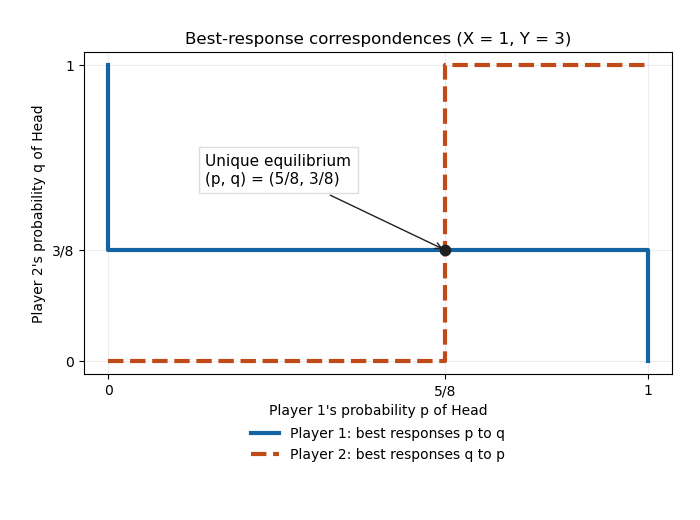
The two best response correspondences intersect at the unique mixed equilibrium
. The horizontal axis is player 1's Head probability , and the vertical axis is player 2's Head probability . Whole intervals at indifference are included. Details.
Yes: choose . The equilibrium expected payoffs are opposite because this is a zero-sum game. They are equal exactly when both are zero. Part (b)'s value vanishes exactly when , and for every allowed . This establishes both existence and the unique suitable positive choice of .
Under the intended positive rewards , a hunter at the all-hare strategy profile receives . A unilateral switch to deer leaves only one participant. Since the integer threshold satisfies with , we have , so that deer hunt fails and pays zero. Thus no player can gain by switching, and the all-hare profile is a Nash equilibrium. At it remains an equilibrium through indifference; negative would invalidate the claim.
Assume and the feasible threshold . An unsuccessful deer hunter would gain by switching to hare, so an equilibrium with deer participants must have . A deer hunter then earns and must not gain by changing to hare; this requires . A hare hunter who joins would earn , so staying with hare requires . Hence the necessary and sufficient conditions for the stated range areThese conditions check every possible unilateral change in this two-action game, so they also prove sufficiency. Equality is allowed because a Nash equilibrium rules out strict improvements, not indifferent deviations. The endpoint has no hare hunter to check; it is an equilibrium exactly when .
Continue with and set . Part (e) requires an interior count to satisfy with ; the all-deer endpoint is allowed when . If is nonintegral and , only works. If is an integer with , both and work. At only remains, while permits only . When , there is no positive equilibrium count.
Thus there are at most two positive counts, and exactly one precisely whenThis includes , when the excluded set is empty. It counts numbers of deer hunters, not the many choices of which hunters participate. The argument is the threshold stag-hunt equilibrium count.
The original paper states only explicitly. Its assertion needs the usual strict positivity of the hare reward. If zero is included, take . Counts and both give unsuccessful hunters zero, and one additional deer hunter still cannot reach the threshold; all unilateral alternatives also pay zero. The count is an equilibrium as well. These are three positive equilibrium counts, contradicting an unrestricted reading. More generally, for , the positive counts are and .
Articles by others on the same topic
There are currently no matching articles.