At fixed radiation wavelength, differentiating Bragg's law gives . With constant linear thermal expansion coefficient ,Both scattering angles decrease as the lattice expands. Substitution givesThese are shifts of , not of the Bragg angle alone. As a finite-step check, using gives . It produces shifts and , consistent with the first-order estimate. A strictly constant differential coefficient would instead give ; its difference from the linear length approximation is second order in this small expansion.
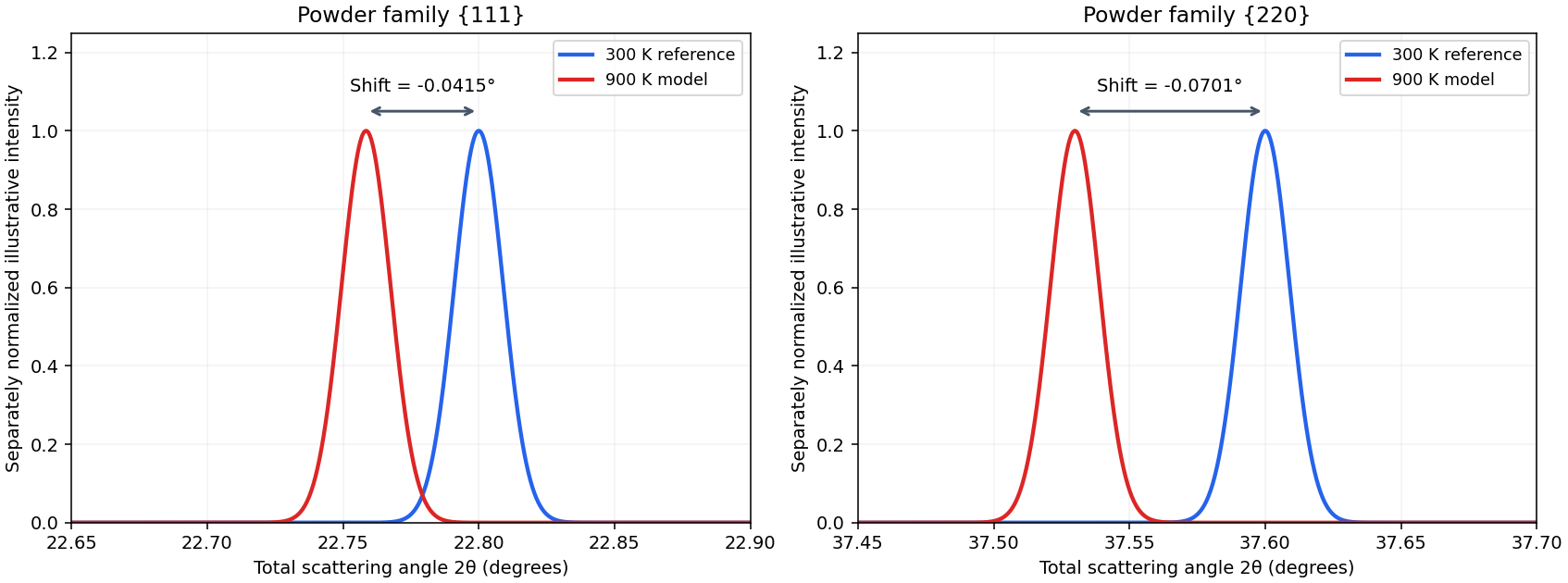
Calculated thermal shifts of the two lowest-angle diamond-cubic powder lines
. Original illustrative line profiles centred on the stated scattering angles and their calculated shifted positions. Each line is normalized separately; the chosen common Gaussian width is not a measured instrumental width, and the panels do not predict an intensity ratio. The finite-step curves use . Details.
Articles by others on the same topic
There are currently no matching articles.