Paper code B3 in 2012–2013; B6 in 2014–2019 and 2021–2022.
Source bundle pages 76–80. The paper cover establishes 2022; the attachment filename uses 2021.
The ordered crystal structure consists of a primitive cubic lattice with the four-site atomic basisin fractional crystal coordinates. The drawing shows all boundary representatives of these sites. Eight corner gold chemical atoms, shared among eight unit cells each, contribute one gold chemical atom. Six face-centred copper chemical atoms, shared between two unit cells each, contribute three copper chemical atoms. Thuswhich gives the required stoichiometry. Although the unlabelled positions form a face-centered cubic lattice, a face-centering lattice translation exchanges gold and copper and therefore fails to preserve the ordered crystal structure. Its Bravais lattice is primitive cubic lattice.
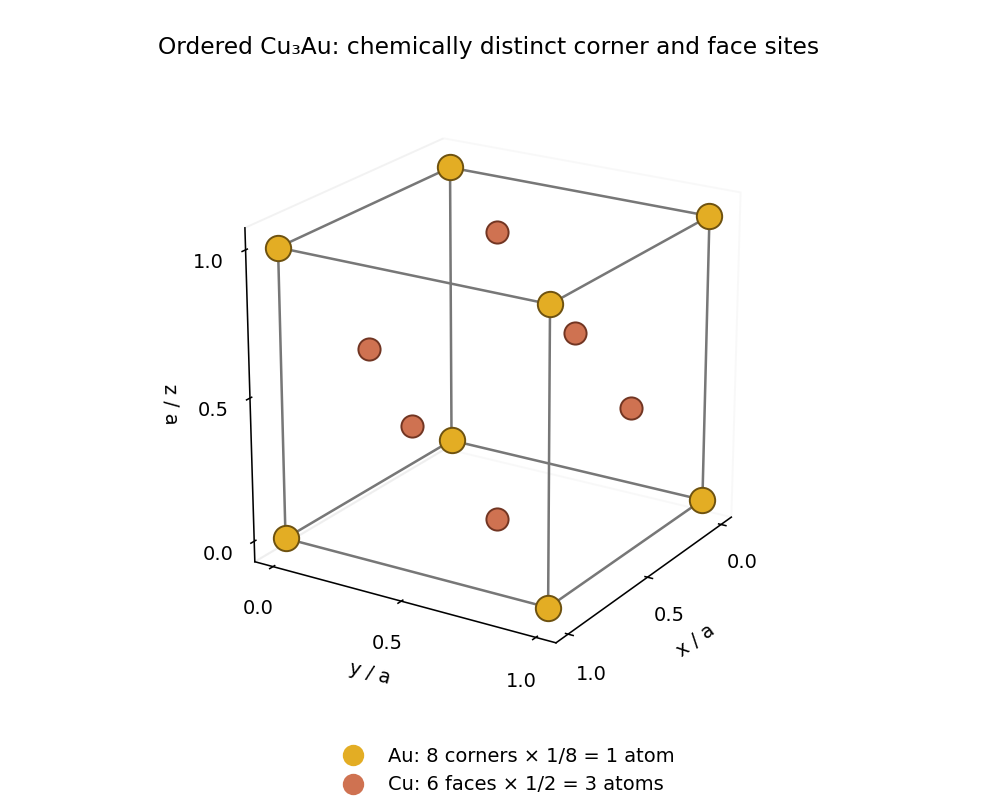
For the reciprocal lattice vector , sum the atomic scattering factors with the atomic basis phase factors. Taking the positive phase convention gives the structure factorChanging the phase convention complex-conjugates the structure factor and leaves the diffraction wave intensity unchanged. Since the Miller indices are integers,If all three Miller indices have the same integer parity, all pairwise sums are even. Otherwise exactly one pairwise sum is even and two are odd. ConsequentlyThe corresponding structure factors are and . Reflections with mixed integer parity are superlattice reflections that reveal chemical ordering in alloys.
In elastic scattering, the incoming and outgoing wave vectors have equal magnitude . Their mutual angle is . The scattering vector therefore has magnitudeThe elastic Bragg scattering condition is , givingEquivalently, turns this relation into Bragg's law, , with the reflection order incorporated into the Miller indices.
The primitive cubic lattice has . Combining this with Bragg's law gives the Bragg angleUsing and yieldsThese are the full scattering angles; the Bragg angles themselves are half as large.
At each reflection, the argument of the atomic scattering factor isSubstitution into the given atomic scattering factor approximation givesThus the structure factors are and . The powder diffraction multiplicity is : choose which Miller index is zero in three ways and the signs of the other two in four ways. For , the eight sign choices give . With the specified instrumental and angular factors omitted, the integrated powder diffraction wave intensity is proportional to , soIt would be incorrect to use the same atomic scattering factors at the two different scattering vectors, or to omit the powder diffraction multiplicity.
The stoichiometry fixes the site probabilities to gold and copper. Every site in the average crystal structure therefore has the same atomic scattering factorThe average structure factor isAt the bracket vanishes, while at it is four. HenceThe powder diffraction multiplicity is unchanged, so its coherent Bragg diffraction wave intensity equals the ordered value under the stated equal-lattice constant approximation.
The zero refers to the coherent Bragg diffraction peak of the average crystal structure. A random alloy can still give occupational diffuse scattering at the same scattering vector: the average of the squared amplitude includes fluctuations as well as the square of the average amplitude. Such background is not a surviving Bragg diffraction peak.
Replace every coloured site in the drawing by an identical site carrying . The face-centering lattice translations now preserve the average crystal structure, whose Bravais lattice is a face-centered cubic lattice. One choice of primitive lattice translation vectors isA coherent Bragg diffraction peak requires for all three primitive lattice translation vectors. Thus , , and must all be even, equivalent to all three Miller indices having the same integer parity. This is the face-centred cubic selection rule: is forbidden and is allowed. The restoration of these lattice translations explains the disappearance of the ordered superlattice reflections.
Specify the normalization of the alloy sublattice order parameter rather than assuming that its endpoint values uniquely define it. Let be the probability of gold occupation at a corner site and defineThe complementary copper probability is , so the corner-site atomic scattering factor isThe stoichiometry provides one gold chemical atom per four-site unit cell. If all three face sublattices are equivalent, their gold occupation probability obeys . ThereforeAt the corner and face sites carry pure gold and pure copper; at they have identical statistical compositions. These formulas describe the branch with and equivalent face-site averages.
Use the same atomic basis phases as in the ordered structure factor, replacing each atomic scattering factor by its site average. For the reflection with equal integer parity,Conservation of the total composition removes the alloy sublattice order parameter from this amplitude. For the reflection with mixed integer parity,The coherent powder diffraction wave intensities consequently satisfyHere the lattice constant, atomic scattering factors, powder diffraction multiplicities, and omitted experimental factors are held fixed. The ratio of a superlattice reflection to a fundamental reflection can therefore measure the magnitude of the alloy sublattice order parameter.
The boundary of the first Brillouin zone is . The unperturbed free electron model assigns the kinetic energywhere is the bare electron mass and is the reduced Planck constant. This is the free kinetic energy at the Brillouin zone boundary, not the already split energy band edge. A constant mean potential energy may be absorbed into the choice of zero of energy.
Write for the potential energy of an electron in an electrostatic potential , where . With , the coupling in the nearly-free electron model is the Fourier coefficientIf a symbol already denotes the electron potential energy, as in part (c), it replaces without another factor .
At the Brillouin zone boundary the two resonant plane waves have unperturbed energy . Their Hamiltonian operator in the two-state basis has diagonal entries and off-diagonal entries ; its eigenvalues are . ThusThis is the local band gap in the two-wave nearly-free electron model.
For zero coupling, , and the two folded energy bands areThey touch at , where the underlying free plane wave branches cross. A nonzero Fourier coefficient replaces this crossing by an avoided crossing, with . The lower energy band moves downward and the upper energy band upward. Both branches are smooth near for .
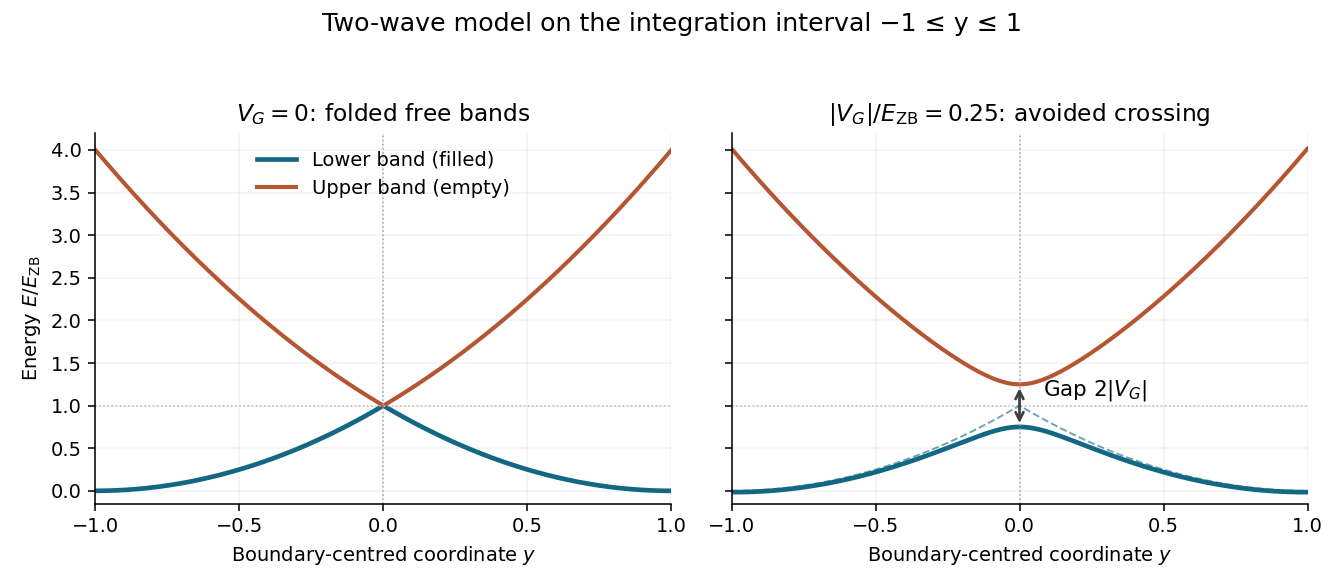


The figure uses the boundary-centred interval required in part (b). With the printed definition , this is the translated Brillouin zone . The printed instead corresponds to ; the local two-wave formula must be folded appropriately before treating it as a dispersion over that entire zone. It must not be integrated over as though it were the filled first energy band there. The subsequent calculation follows the explicit continuation prescribed in part (b).
For a long chain of length with periodic boundary conditions, each spin has quantum states in a wavenumber interval . Including two spin states, a full energy band contains electrons. The state counting in a Bloch band therefore gives the energy densityThe integral of is . For , the even square-root integral isFor example, this follows by setting , applying the supplied antiderivative, and evaluating both endpoints; the lower-end logarithm contributes . HenceThe continuous zero-coupling limit is . This agrees with directly integrating the one-dimensional free electron model up to at two electrons per unit cell.
At every and every ,so the lower energy band lies strictly below its zero-coupling counterpart. Its state counting in a Bloch band and complete occupation are unchanged. Subtracting the two energy densities directly givesThusEquality holds at . This is the downward displacement of the filled lower energy band in the sketch. The upward displacement of the empty upper energy band contributes nothing to the zero-temperature electronic energy density.
For , the Taylor expansions needed in the exact energy density areSubstitution yieldsThereforeHere Big O notation describes the neglected small-coupling terms, and the logarithm is natural. The nonanalytic term comes from the formerly degenerate quantum states near the Brillouin zone boundary; a uniform nondegenerate perturbation theory expansion of the integrand would fail there. This is the same mechanism as the Peierls energy gain.
Regard as an electron potential energy, and take . Each cosine supplies half its coefficient to each of its two Fourier coefficients. The nonzero coefficients areThe Fourier coefficient connecting the two plane waves at is , so the two-wave band gap isAt the actual periodic potential has period and no Fourier harmonic at . The crossing at the artificially halved Brillouin zone boundary then has zero band gap. Higher-order weak-potential corrections can change the proportionality coefficient at nonzero ; the displayed coefficient belongs to the given two-wave approximation.
There is also a small-displacement qualification in the source: the claimed positions of the potential energy minima are correct to first order in , not exactly. Put . ThenAt and , this equals approximately , rather than zero. For , expanding about and gives minima at and . This does not alter the leading Fourier coefficient or the linear opening of the band gap.
Without the Peierls distortion, adjacent chemical atoms are separated by . The primitive unit cell contains one chemical atom and contributes one electron. A energy band with two spin states accommodates two electrons per primitive unit cell, so the first energy band is half filled. Its true first Brillouin zone extends to , while the Fermi points are at .
Describing the same chain with a doubled unit cell of length merely folds the half-filled energy band into two branches that touch at those Fermi points. The unbroken lattice translation by prevents an artificial band gap there. A Peierls distortion breaks that smaller lattice translation and supplies the missing Fourier coefficient at ; the lower folded energy band can then be completely filled and separated from the upper energy band. Thus the zero-band gap result at agrees with the original one-electron band filling.
Define the dimensionless coupling , so that . Substitution into the energy density from part (b) gives, within the prescribed continuation of the two-wave nearly-free electron model,Its value at is understood by continuity. For ,Both electrons per doubled unit cell have been included. The fixed harmonic affects the underlying energy bands beyond the two-wave approximation; the expression here is the energy density requested from part (b), rather than an exact solution for all harmonics of the full periodic potential.
Use the same normalization for the elastic energy and electronic energy density: if is an energy per unit cell, divide it by first; if it is already per length, use it directly. Write its coefficient per length as and put . The small-distortion change in total energy density isNo minimization calculation is needed. For arbitrarily small nonzero , the logarithm is negative with arbitrarily large magnitude. Hence the negative electronic Peierls energy gain, proportional to , eventually exceeds any fixed positive quadratic elastic energy. There are distorted configurations with lower energy than the undistorted configuration for every finite and nonzero coupling. The ideal zero-temperature infinite-chain model therefore hasThe source's is correct when denotes a nonnegative distortion amplitude. If is signed, the energy density is even and the two signs describe equally stable patterns related by a lattice translation. For example, , so a negative equilibrium distortion has the same energy as the positive one. The zero-coupling case instead has its minimum at . The argument assumes a coupled chain, complete lower-energy band filling and zero temperature; it does not by itself establish finite-temperature long-range order in an isolated one-dimensional system.
Let , with the Boltzmann constant, the absolute temperature, and the common equilibrium chemical potential. The conduction band minimum and valence band maximum are and ; their separation is the band gap . The positive parameters in the supplied density of states functions are the band effective masses of electrons and electron holes, not necessarily the bare electron mass.
The electron occupation is the Fermi-Dirac distribution . The appropriate statistical factors are for electrons and for electron holes. In a nondegenerate semiconductor, and , so the Boltzmann approximation givesFor the conduction band, set and then . The supplied integral yieldsFor the valence band, set to obtainThe effective density of states factors include the two spin states already present in the supplied density of states functions. Multiplication cancels the chemical potential and gives the semiconductor mass-action lawHere is the intrinsic carrier concentration. Equality additionally requires an electrically neutral intrinsic semiconductor. The product law also applies to an equilibrium doped semiconductor while both populations remain nondegenerate. The derivation assumes parabolic energy bands, the stated spin degeneracy, and a single common chemical potential.
For a single impurity level in a crystal with allowed occupations zero and one and equal occupied/empty statistical weights, the Fermi-Dirac distribution givesSince and ,The same result follows from the two grand canonical ensemble weights and .
The equal-statistical-weight convention is necessary for the printed formula when and count whole donor impurities. More generally, donor charge-state degeneracy gives . An ordinary singly occupied donor with two spin orientations and a nondegenerate empty state has ratio ; at its occupied-to-empty ratio is two, a concrete counterexample to treating the printed expression as universal. The following part uses the paper's ratio-one convention.
Assume uncompensated donor impurities, negligible intrinsic electron holes, and a nondegenerate conduction band. Then charge neutrality equates the conduction electron number density to the ionized-donor number density:The low-temperature condition relative to the band gap supports neglect of intrinsic carriers; one also needs and the Boltzmann approximation for the conduction electrons. Combining part (b)(i) with the effective density of states result givesEliminate the chemical potential by writing . With the donor binding energy ,Writing , the physical root of the resulting quadratic equation isThis lies between zero and . At semiconductor carrier freeze-out, , it becomes ; at essentially complete ionization, , it tends to . Including donor charge-state degeneracy would replace by .
There are three regimes. At the lowest temperatures, most donor impurities retain their electrons; thermal ionization gives semiconductor carrier freeze-out. The result from part (b) isThis produces the approximately straight descending low-temperature tail on the logarithmic scale plot against . The activation energy in the exponential is , because the chemical potential adjusts with donor ionization.
At intermediate temperatures, the donor impurities are essentially fully ionized while intrinsic excitation remains small. Charge neutrality gives , producing the extrinsic plateau, roughly from to in the figure.
At higher temperatures, excitation from the valence band to the conduction band creates electron-hole pairs. The intrinsic carrier concentration grows as for constant parabolic band effective masses and constant band gap. With ionized donor impurities, charge neutrality and the semiconductor mass-action law giveThus when . This explains the renewed rapid rise and the eventual intrinsic branch; that branch is governed by the band gap, rather than the donor binding energy.
The plateau in both source plots is approximately , soThese are graphical estimates, not high-precision fitted material parameters. To extract activation energies consistently with part (a), retain the temperature powers in the effective density of states factors.
On the semiconductor carrier freeze-out tail, put . ThenFor example, the right-hand graph gives roughly at and at . Subtract the known prefactor contribution before interpreting the slope:Thus , to the accuracy of the drawing. Ignoring the weak prefactor gives about , a similar rough estimate.
For the intrinsic branch, useThe left-hand graph gives and , both far above . ThereforeHere . Omitting the prefactor over this wide temperature interval would instead give approximately , so it is not a negligible correction for the band-gap extraction from intrinsic carrier activation. The source graph warrants an approximate narrow band gap, rather than several significant figures.
For a fixed open-shell electron configuration in the LS coupling regime, Hund's rules select the free-ion ground term in the following order:
- Maximize the total spin , subject to the Pauli exclusion principle.
- Among terms with that , maximize the total orbital angular momentum .
- For a less-than-half-filled subshell choose the smallest total angular momentum, ; for a more-than-half-filled subshell choose the largest, . A half-filled subshell has and .
The first two rules come from the Coulomb interaction between electrons within the partially filled subshell, including its exchange interaction. Parallel spins require an antisymmetric spatial wavefunction, reducing close approach and often lowering the repulsive Coulomb interaction energy. Among the allowed high-spin terms, the angular dependence of the Coulomb interaction generally favours the largest ; a simple magnetic alignment argument alone does not derive this second ordering rule.
The weaker spin-orbit coupling then splits a selected term. In LS coupling, its term-level energy is proportional toThe effective sign appropriate to less-than-half versus more-than-half filling gives the third rule. These rules assume the electrostatic term separation dominates spin-orbit coupling; strong crystal field splitting or other coupling regimes require further analysis.
In weak magnetic field and the regime of paramagnetism, localized magnetic moments with total angular momentum and Landé g-factor have SI volume magnetic susceptibilitywithin the Curie–Weiss law. Here counts magnetic ions per volume, is the vacuum permeability, is the Bohr magneton, and is the Weiss temperature. The factor is the zero-field average of the squared angular projection over .
For one magnetic ion per formula unit, a molar volume contains magnetic ions, where is the Avogadro constant. Consequently , and the molar magnetic susceptibility isDefining the dimensionless effective paramagnetic moment by , numerical substitution givesThe normalization is per mole of formula units, which here also means per mole of magnetic ions.
The Curie constant measures the squared magnetic moment averaged over all orientations of the multiplet, givingFor the usual positive Landé g-factor of the ion here, the absolute-value sign can be omitted. This effective paramagnetic moment differs from the maximum projected or saturation magnetic moment, .
The Weiss temperature is the extrapolated zero of in a Curie–Weiss law fit. It summarizes the leading high-temperature effect of interactions between magnetic moments. For the sign conventionwhere are dimensionless angular momentum operators, mean-field theory givesThus positive net exchange interaction in this convention favours parallel magnetic moments, giving and tendencies towards ferromagnetism; negative net exchange interaction favours antiparallel magnetic moments, giving and antiferromagnetic tendencies. Competing interactions can partially cancel in this sum. The Weiss temperature need not equal the actual ordering temperature, and its sign alone is not a complete determination of the low-temperature ordered structure.
Write the fitted inverse molar magnetic susceptibility asThe vertical scale is in , not unscaled inverse SI magnetic susceptibility. The source line is approximately at and at . These readings giveTherefore the effective paramagnetic moment and Weiss temperature areEquivalently, . An uncertainty of order in the graphical Weiss temperature is reasonable; the plotted fit does not justify exact integer parameters. Its positive intercept at requires a negative extrapolated temperature-axis intercept. Thus the dominant interactions have the antiferromagnetic sign in the interpretation of part (b).
The given electron configuration has an inert closed core and two electrons. The Aufbau principle identifies the occupied subshells; the free-ion term within the open configuration is then selected by Hund's rules. A closed core contributes .
Each electron has orbital angular momentum quantum number . Place the two spins parallel, so . The Pauli exclusion principle then requires distinct orbital projections. The largest allowed total projection is , obtained from and , giving the maximum allowed . A larger would place two parallel-spin electrons in the same atomic orbital and is forbidden.
The subshell holds fourteen electrons; is less than half filled. The third of Hund's rules therefore selects . HenceThe term symbol uses and the spectroscopic letter for . The praseodymium ion retains an orbital contribution, so a spin-only estimate would be inappropriate.
With , the measured effective paramagnetic moment gives the Landé g-factorFor the free-ion Hund's rules values , , , the stated formula yieldsThusThe source fit is consistent with the unquenched orbital magnetic moment of the free praseodymium ion, within graphical accuracy. Small deviations need not indicate a change of electron configuration: crystal field splitting, interactions and the fit range can affect a measured magnetic susceptibility.
The 2021 paper occupies bundle pages 74–78; its cover establishes the year despite the attachment's 2020 filename.
Determining antiferromagnetic magnetic order is a good reason to use neutron scattering. The neutron has a magnetic dipole moment, so its scattering amplitude includes the spatial arrangement of electronic magnetic moments. Alternating magnetic moments can produce magnetic neutron diffraction peaks even when there is no change of the nuclear crystal structure. Ordinary nonresonant X-ray diffraction primarily measures the electron density, and is much less sensitive to this magnetic order.
The neutron is nonrelativistic at this kinetic energy. Its de Broglie wavelength isIn elastic scattering, Bragg's law gives . The measured total deflection is , so it must be halved before taking the sine. The reflection order is absorbed into the Miller indices of the diffracting lattice planes. In the order of the four measured rings, the interplanar spacings areThe last digits give the numerical calculation, rather than accuracy beyond the supplied angular precision.
For the cubic crystal system, the Miller indices satisfyThe inverse squared interplanar spacings have ratios approximately . With the lattice constant close to , the appropriate squared-index sums are . Thus the four powder diffraction rings areThe braces collect all symmetry-related lattice planes with the same interplanar spacing. In particular, is forbidden for both a body-centered cubic lattice and a face-centered cubic lattice, but occurs for a primitive cubic lattice. These observations identify the Bravais lattice as primitive cubic lattice, with a multi-atom atomic basis, consistent with a perovskite structure.
Each ring independently gives :Their average is . Allowing for the rounded measured angles, a suitable final value isA larger centred unit cell could relabel reflections, but would conflict with the stated approximate lattice constant.
An applied magnetic field changes the alignment of the manganese magnetic moments. The component of their magnetic structure factor perpendicular to the scattering vector contributes to magnetic neutron diffraction. A field-induced uniform magnetization has the same translational periodicity as the nuclear crystal structure, so its scattering amplitude can occur at the existing reciprocal lattice vectors. The diffraction wave intensities can therefore change without moving the peaks. Their angular positions still measure the same interplanar spacings. This mechanism does not require a measurable change of the lattice constant.
A consistent mechanism is a transition to G-type antiferromagnetism at the Néel temperature. On the manganese primitive cubic lattice, take the magnetic moments to beEvery nearest neighbour has the opposite magnetic moment. The nuclear crystal structure can retain its original lattice constant, while the magnetic order introduces the propagation wavevectorSumming the scattering amplitude from the magnetic moments over sites gives peaks at , where is a nuclear reciprocal lattice vector. Thus all three components of the new Miller indices, expressed relative to the original unit cell, are half-integers. The two smallest squared magnitudes in units of areThe first predicts , agreeing with the new ring. The next squared magnitude is , outside the measured angular range. Taking the observed first magnetic ring as the calibration, Bragg's law predictsUsing the independently fitted lattice constant gives , within the input rounding. One ring alone does not uniquely determine a magnetic order; this proposed nearest-neighbour antiferromagnetic pattern explains both the observed ring and the count of two new rings in the specified interval.
The Bravais lattice is a face-centered cubic lattice. Four inequivalent representatives of its lattice points in the conventional cubic unit cell, in fractional crystal coordinates, areBoundary copies in the drawing do not constitute additional independent lattice points. Attach the two-atom atomic basisto each lattice point. The resulting aluminium phosphide crystal structure is the zinc blende structure. For example, the four phosphorus positions reduced into the conventional unit cell are , , , and , reproducing the heights in the source drawing. There are four aluminium and four phosphorus chemical atoms per conventional unit cell, but only two chemical atoms per primitive unit cell.
Given independent primitive lattice translation vectors , defineThen . The reciprocal lattice consists ofequivalently all wavevectors for which for every direct lattice vector .
For the face-centered cubic lattice, chooseTheir scalar triple product is , and direct evaluation of the cross products givesEvery integer combination has coordinates with all even or all odd. Conversely, for such coordinates the coefficients are integers, so every such point occurs. The even-coordinate points are the corners of cubes of edge , and the odd-coordinate points are their body centres. ThereforeThis is a property of the Bravais lattice; the two-atom atomic basis changes structure factors rather than these reciprocal lattice translation vectors.
There are two chemical atoms in the primitive unit cell, hence six displacement coordinates and six phonon branches at each wavevector. Three rigid translations cost no restoring potential energy in the long-wavelength limit. ConsequentlyFor propagation along , one acoustic phonon has longitudinal polarization along and two have transverse polarization along . The cubic crystal symmetry makes those two transverse directions equivalent. In terms of the elastic stiffness tensor and the mass density,Thus there are two distinct acoustic velocities in general, one longitudinal and a doubly degenerate transverse value. This degeneracy of normal modes concerns the two transverse polarizations; it does not imply equality with the longitudinal speed of sound.
Articles were limited to the first 100 out of 461 total.
Articles by others on the same topic
Condensed matter physics course of the University of Oxford by  Ciro Santilli 40 Updated 2025-07-16