The sites form a face-centered cubic lattice decorated by an identical two-atom atomic basis of a crystal, at fractional displacements and . This is the diamond cubic structure; the eight atoms in its conventional cube are not eight independent Bravais-lattice points.
For identical silicon atomic scattering factors , the conventional-cell structure factor separates into the FCC factor and the two-site motif factor:The first factor vanishes unless are all even or all odd. For all-even indices, the motif also vanishes if ; it survives if the sum is divisible by four. All-odd indices survive, with motif modulus . Thus and are absent by centering, is absent by the diamond basis, and and are allowed.
For a cubic cell, . At fixed X-ray wavelength, Bragg's law makes the smallest scattering angles correspond to the smallest allowed positive values of . These start with and , soThe braces denote whole powder families, including their symmetry-equivalent plane normals. The next family is , with squared-index sum ; using the FCC rule alone would incorrectly insert a line before .
Interpret the reported angles as total scattering angles . The photon energy givesCombining with the two index assignments yieldsThe slight difference is consistent with the rounded angular data, givingThe intensity estimate needs a stated convention. The geometric structure factors obey and , so equal atomic factors give a single-directed-reflection ratio . For a powder line, the powder diffraction multiplicities are eight for and twelve for . Hence a multiplicity-and-structure-factor estimate isif other angle-dependent factors are neglected.
A measured integrated powder intensity also contains the Lorentz-polarization factor, atomic form factor, thermal-motion factor and instrument/sample corrections. For example, in the common unpolarized symmetric powder geometry,Including this factor but still taking equal atomic factors gives , rather than . More generally,within that geometry, before other corrections. The actual form factors and measurement geometry are not supplied, so no unique precision experimental peak-height ratio follows. The values , and refer to distinct explicitly stated levels of approximation; a powder family must not be silently treated as one directed reflection.
At fixed radiation wavelength, differentiating Bragg's law gives . With constant linear thermal expansion coefficient ,Both scattering angles decrease as the lattice expands. Substitution givesThese are shifts of , not of the Bragg angle alone. As a finite-step check, using gives . It produces shifts and , consistent with the first-order estimate. A strictly constant differential coefficient would instead give ; its difference from the linear length approximation is second order in this small expansion.
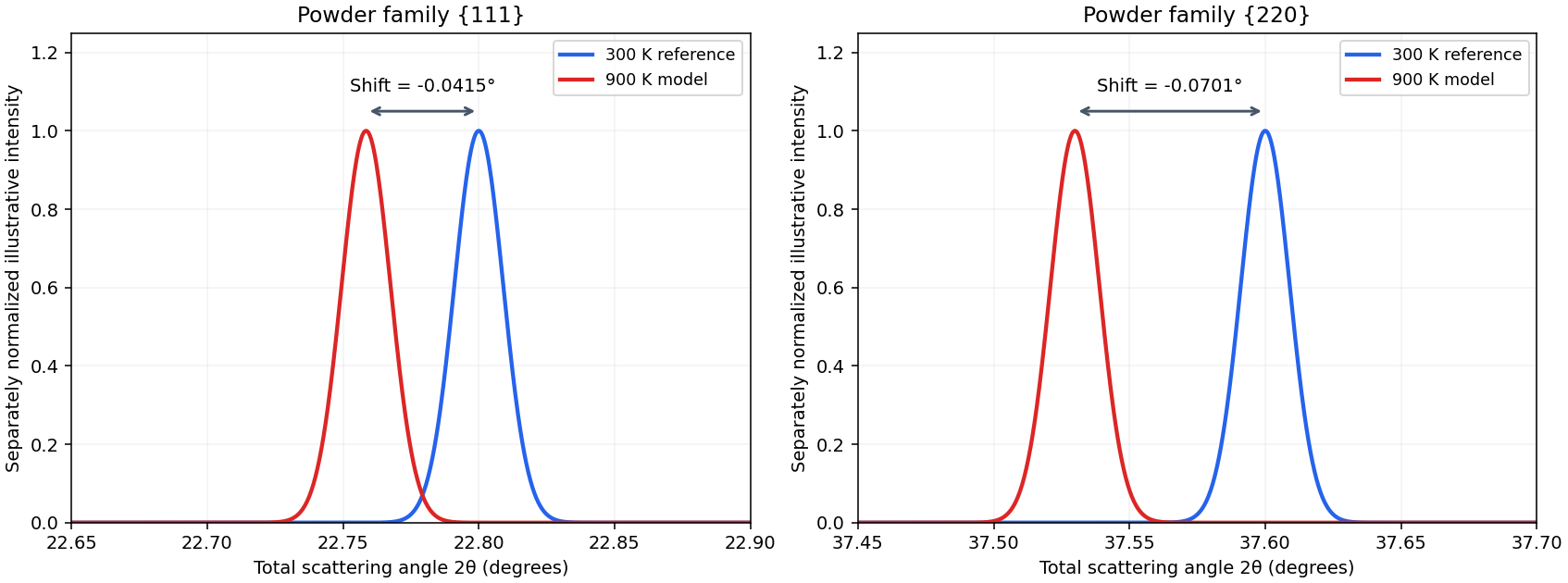
Calculated thermal shifts of the two lowest-angle diamond-cubic powder lines
. Original illustrative line profiles centred on the stated scattering angles and their calculated shifted positions. Each line is normalized separately; the chosen common Gaussian width is not a measured instrumental width, and the panels do not predict an intensity ratio. The finite-step curves use . Details.
Diffraction thermal-expansion thermometry needs a stable monochromatic X-ray beam, controlled collimation, an accurately calibrated angular scale, and an X-ray-sensitive detector with enough counts to fit reproducible line centroids. Crystal monochromators or appropriate energy selection are relevant here; an apparatus for visible-light interference does not directly measure these X-ray peaks. Sample displacement and angular-zero drift should be checked with a suitable reference standard.
The first-order angular sensitivities are about and degrees per kelvin, respectively. A one-kelvin inference therefore requires comparable centroid stability, with high count statistics and control of systematic errors; a centroid can be fitted more precisely than the line width. Fractional wavelength drift also mimics lattice expansion, so the desired temperature precision constrains relative to .
The powder must be at a known uniform temperature and allowed to equilibrate. Mechanical stress, clamping, composition changes, oxidation and phase changes can also shift or broaden peaks. Accurate work requires a calibrated , including the actual temperature dependence of the thermal expansion coefficient, rather than assuming the supplied constant describes every temperature exactly. Using both lines provides a consistency check on a common cubic expansion.
Articles by others on the same topic
There are currently no matching articles.