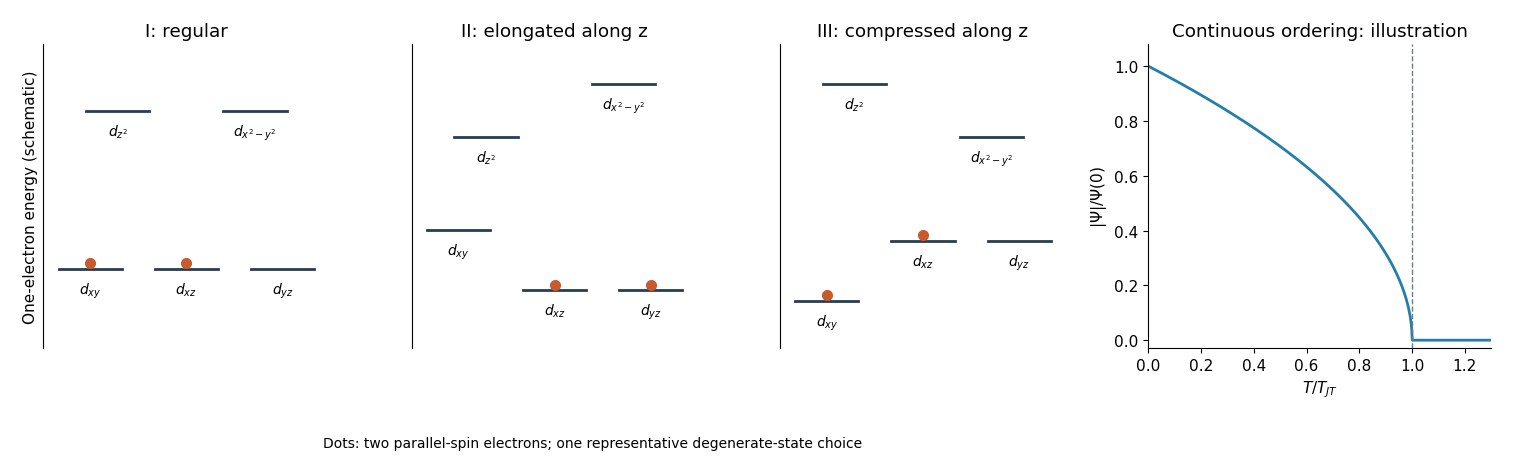
For the regular octahedron, repulsion from the six oxygen ligands raises the two orbitals, and , above the three orbitals, . The latter point between the metal-ligand axes and experience less direct repulsion. The crystal field splitting is therefore a lower triplet and an upper doublet.
For the V ion, Hund's rules put the two electrons into different orbitals with parallel spins, giving . There are three choices for the unoccupied orbital, so the orbital ground state is triply degenerate. Its spin degeneracy is separate. This orbital degeneracy makes a symmetry-lowering Jahn-Teller effect possible.
Take the elongation axis as . The axial oxygen ligands move farther away while the equatorial ones move closer, at fixed mean bond length. Orbitals containing are stabilized relative to their in-plane partners. Thus move below within , while moves below within . The schematic level ordering appears in the figure below; the octahedral gap remains open for a small distortion.
The two parallel-spin electrons occupy and , one each. Filling the entire lower doublet gives a unique orbital configuration, so its orbital degeneracy is one and the spin is still . This is the orbitally quenched configuration relevant to the later spin Hamiltonian.
The energetic preference can be made explicit in a traceless linear splitting model. For an elongation coordinate , write the levels relative to their barycentre as with . Their two-electron ground energy decreases by . For an equal-magnitude compression, the levels are and the two-electron energy decreases only by . With the same quadratic elastic cost, minimizing gives four times the stabilization of minimizing . Thus the small-distortion Jahn-Teller effect favors elongation for this high-spin filling. The argument assumes the linear coupling and harmonic elastic model, rather than claiming that symmetry alone fixes all real-material distortions.
For axial compression along , the ordering is reversed: lies below the doublet, and lies below within . One electron occupies and the other occupies either or , with parallel spins in the weak-distortion regime. The orbital degeneracy is therefore two, with .
The retained orbital degeneracy allows further symmetry lowering and explains why this compressed arrangement does not provide the fully quenched equilibrium of the elongated case in the specified simple model.

Articles by others on the same topic
There are currently no matching articles.