For a free transition-metal ion, degeneracy among different orbital states can support an orbital contribution to its magnetic moment. In a crystal, the electric fields and bonding of the surrounding ligands split those states. If the orbital ground state becomes nondegenerate and is separated from excited orbital states, its wavefunction can usually be chosen real in zero field. Since the orbital angular momentum operator is imaginary in a real-orbital basis, its expectation value then vanishes.
This suppression is orbital quenching. The remaining leading magnetic moment is the spin contribution, approximately with . Spin-orbit coupling admixes excited orbital states and produces residual anisotropy and shifts in the g-factor; quenching does not mean that every orbital matrix element or every higher-order orbital response vanishes. A degenerate ground orbital multiplet need not be quenched until a further distortion removes its degeneracy.
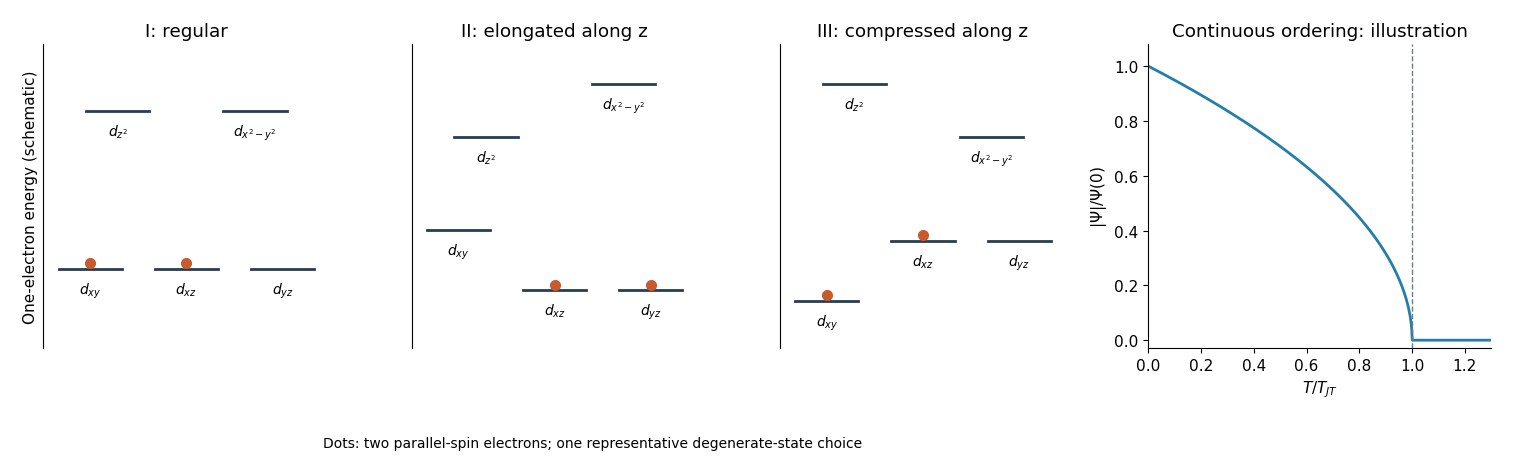
For the regular octahedron, repulsion from the six oxygen ligands raises the two orbitals, and , above the three orbitals, . The latter point between the metal-ligand axes and experience less direct repulsion. The crystal field splitting is therefore a lower triplet and an upper doublet.
For the V ion, Hund's rules put the two electrons into different orbitals with parallel spins, giving . There are three choices for the unoccupied orbital, so the orbital ground state is triply degenerate. Its spin degeneracy is separate. This orbital degeneracy makes a symmetry-lowering Jahn-Teller effect possible.
Take the elongation axis as . The axial oxygen ligands move farther away while the equatorial ones move closer, at fixed mean bond length. Orbitals containing are stabilized relative to their in-plane partners. Thus move below within , while moves below within . The schematic level ordering appears in the figure below; the octahedral gap remains open for a small distortion.
The two parallel-spin electrons occupy and , one each. Filling the entire lower doublet gives a unique orbital configuration, so its orbital degeneracy is one and the spin is still . This is the orbitally quenched configuration relevant to the later spin Hamiltonian.
The energetic preference can be made explicit in a traceless linear splitting model. For an elongation coordinate , write the levels relative to their barycentre as with . Their two-electron ground energy decreases by . For an equal-magnitude compression, the levels are and the two-electron energy decreases only by . With the same quadratic elastic cost, minimizing gives four times the stabilization of minimizing . Thus the small-distortion Jahn-Teller effect favors elongation for this high-spin filling. The argument assumes the linear coupling and harmonic elastic model, rather than claiming that symmetry alone fixes all real-material distortions.
For axial compression along , the ordering is reversed: lies below the doublet, and lies below within . One electron occupies and the other occupies either or , with parallel spins in the weak-distortion regime. The orbital degeneracy is therefore two, with .
The retained orbital degeneracy allows further symmetry lowering and explains why this compressed arrangement does not provide the fully quenched equilibrium of the elongated case in the specified simple model.

The term is the leading electronic energy gain from splitting the initially degenerate orbitals and occupying the lower levels. Its negative sign expresses the lowering of the occupied-electron energy for the chosen elongation branch of the Jahn-Teller effect. The positive coefficient is a linear electron-lattice coupling in this reduced model.
The term is the harmonic elastic cost of moving the ligands away from the undistorted reference structure. Mechanical stability requires . The competition between linear gain and quadratic cost produces a finite equilibrium distortion rather than indefinite elongation.
Complete the square:The minimum is stable because . HenceHere the Jahn-Teller stabilization energy is the positive magnitude of the energy reduction.
The low-temperature bond-length difference is . With the question's thermal criterion,Use and to obtainIn SI units these are about and , respectively. They are estimates within the stipulated energy criterion; a cooperative transition also involves interactions and entropy, so its temperature is not in general exactly an isolated-ion stabilization energy divided by .
Above the transition, and both site types have the same g-factor . For the given spin-only Zeeman Hamiltonian, adjacent levels have the same energy spacing, so fixed-frequency electron paramagnetic resonance gives a single resonance field , ignoring unresolved additional interactions.
Below the transition, half the elongation axes lie along and half along . A field along is parallel to the long bond on one sublattice and perpendicular on the other. The line splits intoThe separation grows on cooling as the distortion grows. Equal site populations give comparable integrated weights when the microwave coupling to the two sites is equivalent; populations alone do not fix all polarization-dependent intensities.
A suitable staggered structural order parameter isFor an -elongated A site and a -elongated B site, , with the opposite sign for the domain interchanging the pattern. The electron paramagnetic resonance data determine its magnitude fromFor small splitting this is equivalently proportional to , but the reciprocal-field formula follows directly from the stated g-factors. It does not fix the sign of the structural domain. In a continuous transition tends continuously to zero at and grows below it, eventually saturating. A mean-field sketch has close to the transition; continuity alone does not determine that exponent. The last panel of the original orbital figure shows this illustrative behavior.
Articles by others on the same topic
There are currently no matching articles.