The Hill radius compares planetary gravity with the differential stellar tide. Expanding the stellar tide near a circular orbit gives , soIt sets the size of the planet's tidal neighbourhood, controls encounter and feeding zone scales, and limits the region within which material can remain bound against stellar shear. It is not itself a solid surface or a guarantee of capture.
The Bondi radius compares planetary potential energy per unit mass with the gas thermal scale,This convention uses the ambient sound speed; definitions based on escape speed can differ by a factor of two. Inside , gravity can substantially perturb thermal gas. Gas still needs a way to dissipate energy and angular momentum to accrete; a geometric boundary alone does not supply a gas-capture rate.
For an embedded hydrostatic envelope a useful outer scale is , subject to disk thickness and gas recycling. Let and . The Bondi-Hill crossover in a protoplanetary disk obeysSmall cores are usually thermally limited, whereas larger ones become tidally limited. These radii also organize pebble accretion: gas drag can turn an encounter into capture, with drift-dominated and shear-dominated regimes depending on particle stopping and encounter times. There is no universal accretion efficiency fixed by or alone.[ref]
Lecture notes on the formation and early evolution of planetary systems by Philip J. Armitage. Version1, sectionIII.C.1, pages32–34: core accretion and envelope boundaries
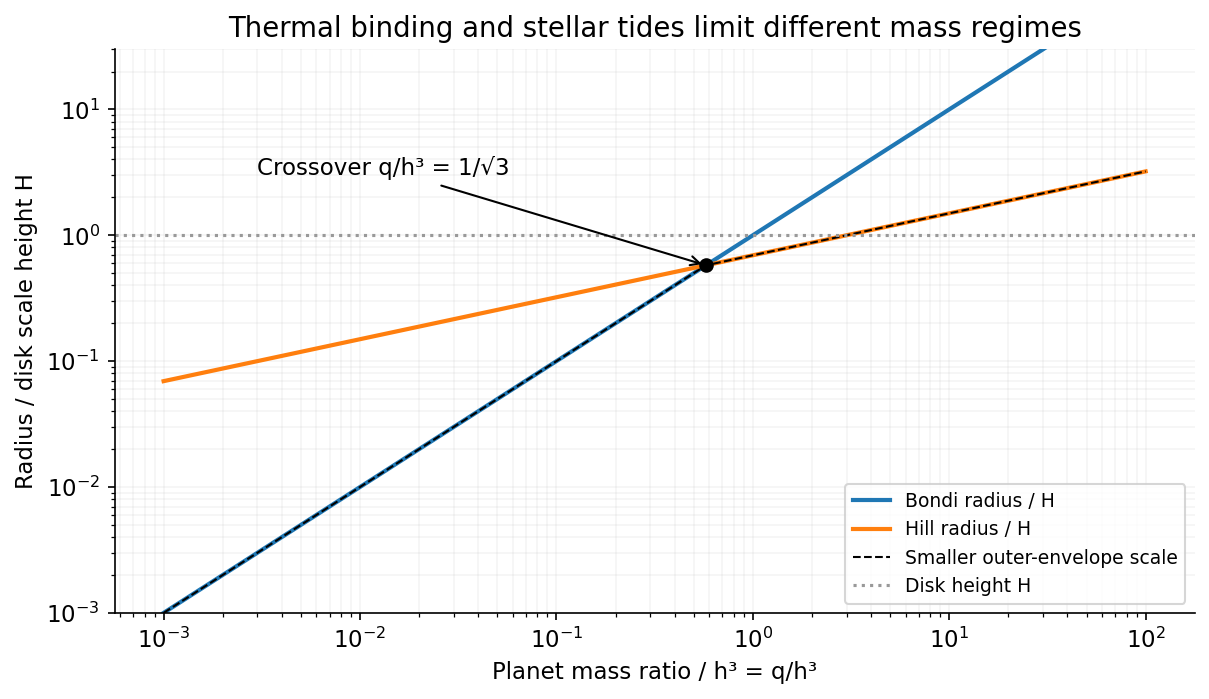
Bondi and Hill radii exchange their roles as the smaller planetary-envelope scale
. Source. Details. 
Articles by others on the same topic
There are currently no matching articles.