A stable sinusoidal radial-velocity semi-amplitude can be stellar reflex motion caused by a companion on a nearly circular orbit. The amplitude is compatible with a giant planet; a low-mass star or brown dwarf viewed nearly face-on can mimic the same projected motion, but requires an increasingly unlikely orientation. Starspots and magnetically suppressed convection can produce a rotational stellar activity signal on a ten-day timescale; contemporaneous photometry, activity indicators and stellar spectral-line bisector and other profile changes distinguish these from a clean common Doppler shift. Solar-like stellar oscillations ordinarily have much shorter periods, so a coherent ten-day oscillation of an otherwise ordinary solar-type dwarf is less plausible. Instrumental drift, sampling aliases and blended spectra also need checking. A sinusoid alone does not establish a planetary origin, and the data do not assign numerical probabilities to these alternatives.
For the minimum companion mass from radial velocity, take a circular two-body orbit and initially . The exact relation and its low-mass limit areWith ,Here is the relative orbital semi-major axis. Nonzero orbital eccentricity multiplies the inferred by at fixed measured , but the sinusoidal model motivates here.
For the radial-velocity sensitivity limit at fixed planet mass, use and interpret the stated detection scale as a semi-amplitude threshold . The largest distance occurs for :For an inclination , this boundary is smaller by . The result assumes adequate time coverage and neglects the stipulated stellar noise. If the detection scale instead denotes a full peak-to-peak excursion, set to half that scale; then increases fourfold.
The stellar-mass scaling of radial-velocity planet estimates changes these inferences because Kepler's third law and the stellar reflex response depend on the stellar mass. At fixed , and , whereas the fixed-mass detectability boundary scales as . ThereforeThe observed period and amplitude are unchanged. The stellar radius does not enter these leading dynamical estimates, but is crucial for the exoplanet transit inference.
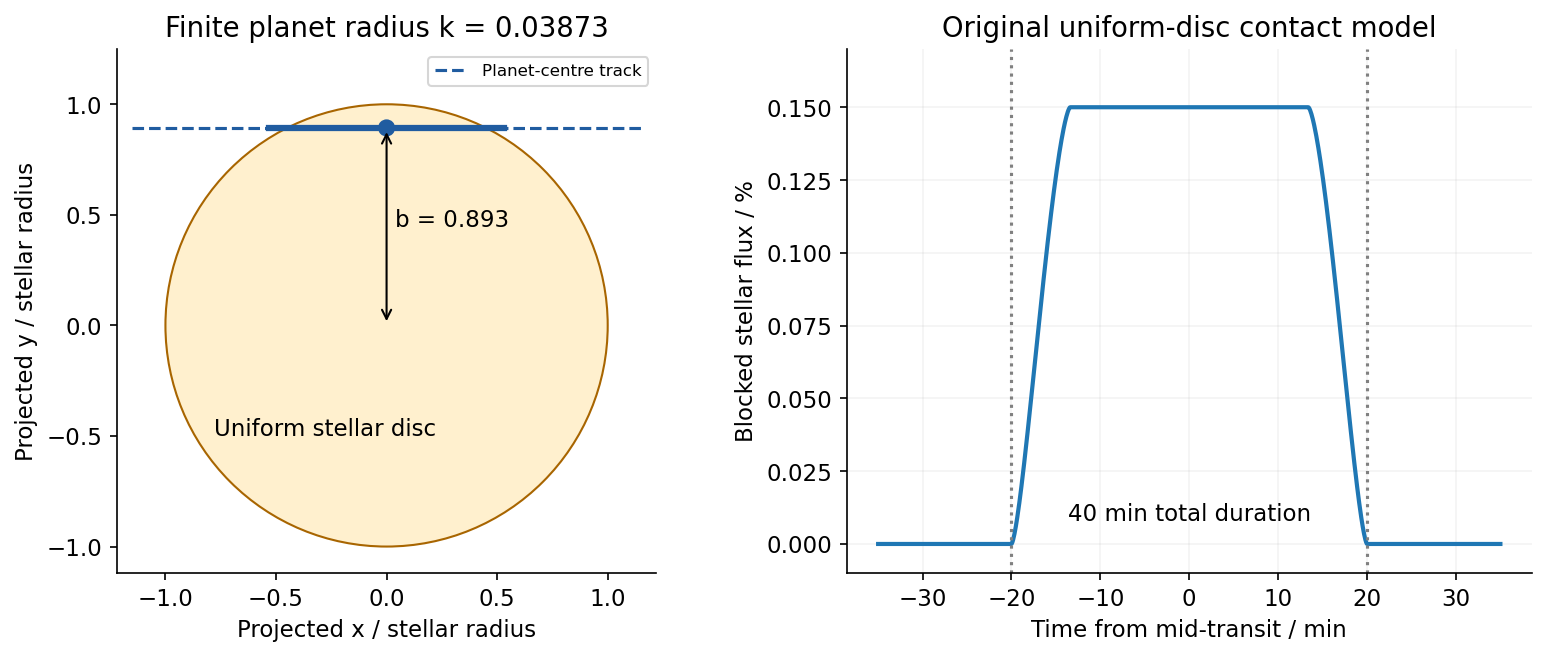
For the transiting companion, assume an opaque spherical planet, negligible transit dilution and negligible limb darkening. Its radius ratio is , henceUsing the revised stellar mass and a circular orbit gives and . Interpret the duration as the total first-to-fourth-contact duration . The impact parameter from total transit duration follows from the total duration of a circular planetary transit:This is noncentral but not grazing: . The small-planet straight-chord approximation gives ; retaining finite and orbital curvature gives the stated value. A duration measured between other contacts needs the corresponding contact formula. Unknown orbital eccentricity and argument of periapsis change the transverse speed and prevent a unique unconstrained ; the numerical estimate is conditional on the stated circular model.[ref]
On the Unique Solution of Planet and Star Parameters from an Extrasolar Planet Transit Light Curve by Sara Seager and Gabriela Mallén-Ornelas. Section3.1, equations1–4: depth, contact geometry and circular-orbit scale
Because the transit constrains , the RV nondetection now bounds the actual planetary mass, rather than only its projected mass. The bulk-density upper limit from a transit and an RV nondetection isThese bounds assume the instrumental threshold can be applied to a fitted signal at the transit period; no statistical confidence level is specified. Such a large radius at this low mass is inconsistent with an ordinary compact rock-and-iron body. A low-density volatile-rich planet, possibly with an extended H/He envelope, is indicated under the planetary interpretation. The observations do not uniquely determine interior composition, atmospheric abundance or formation history; blended eclipses and activity still require validation. There is no luminosity or effective temperature supplied for the host, so a numerical planetary equilibrium temperature cannot be inferred from these data alone.
The numerical conversions above use externally documented , , , , , and . They are conversion constants, not additional measured system parameters.[ref]
Nominal solar and planetary conversion constants by the International Astronomical Union. 2015 ResolutionB3: solar radius and solar mass parameter
[ref]Core accretion builds a solid core and then a massive gaseous envelope before protoplanetary disk dispersal. The solid and gas stages overlap; this is not direct collapse of a whole disk patch.
In a protoplanetary disk, refractory grains and, beyond a snow line, condensed ices provide solids. Settling and protoplanetary dust coagulation build aggregates, but fragmentation, bouncing and radial drift of solids in a gas disk can interrupt simple sticking. Concentration processes such as the streaming instability can produce dense particle structures that collapse into planetesimals. Subsequent collisions build planetary embryos; alternatively, embryos can efficiently capture drifting particles through gas-assisted pebble accretion. Neither the initial planetesimal population nor unrestricted growth through every size should be assumed without a mechanism.
For gravitationally focused growth of a planetary core, the two-body capture cross-section isAn illustrative thin-disk estimate is , up to geometry and velocity-distribution factors. At fixed solid density and random speed, strong gravitational focusing gives : runaway planetesimal growth. As large embryos stir the smaller bodies, encounter speeds increase and focusing weakens, giving oligarchic growth. Consuming the local feeding zone leads toward an isolation mass; radial supply, migration and mergers can extend growth. Snow lines can increase the solid reservoir, but a distant core also grows more slowly because orbital times are longer.[ref]
Lecture notes on the formation and early evolution of planetary systems by Philip J. Armitage. Version1, sectionIII.B, pages27–31: gravitational focusing and planetesimal growth
A growing core binds gas over a scale limited by the smaller of its Bondi radius and Hill radius. The envelope approximately satisfiesAn equation of state, disk boundary conditions, and radiative or convective energy transport close the structure. In an optically thick radiative region,Here is opacity; an unstable radiative gradient instead drives convection. Solid accretion releases roughly , heating and supporting the envelope. Gas capture consequently depends on cooling, not just whether the potential can bind gas instantaneously.
The envelope loses energy on a Kelvin-Helmholtz cooling time, . Lower grain opacity, higher core mass, or reduced solid-accretion heating can accelerate contraction. The critical core mass for gas accretion is therefore model dependent; “of order ten Earth masses” is a common scale, not a universal switch. As envelope self-gravity becomes important and the gas and solid masses become comparable, contraction permits still more gas capture, producing runaway gas accretion. The classical sequence has a rapid solid-growth phase, a slower envelope-growth phase, and accelerated gas accumulation.[ref]
Formation of the giant planets by concurrent accretion of solids and gas by James B. Pollack and others. 1996 model: coupled solid and gas growth, three phases and crossover
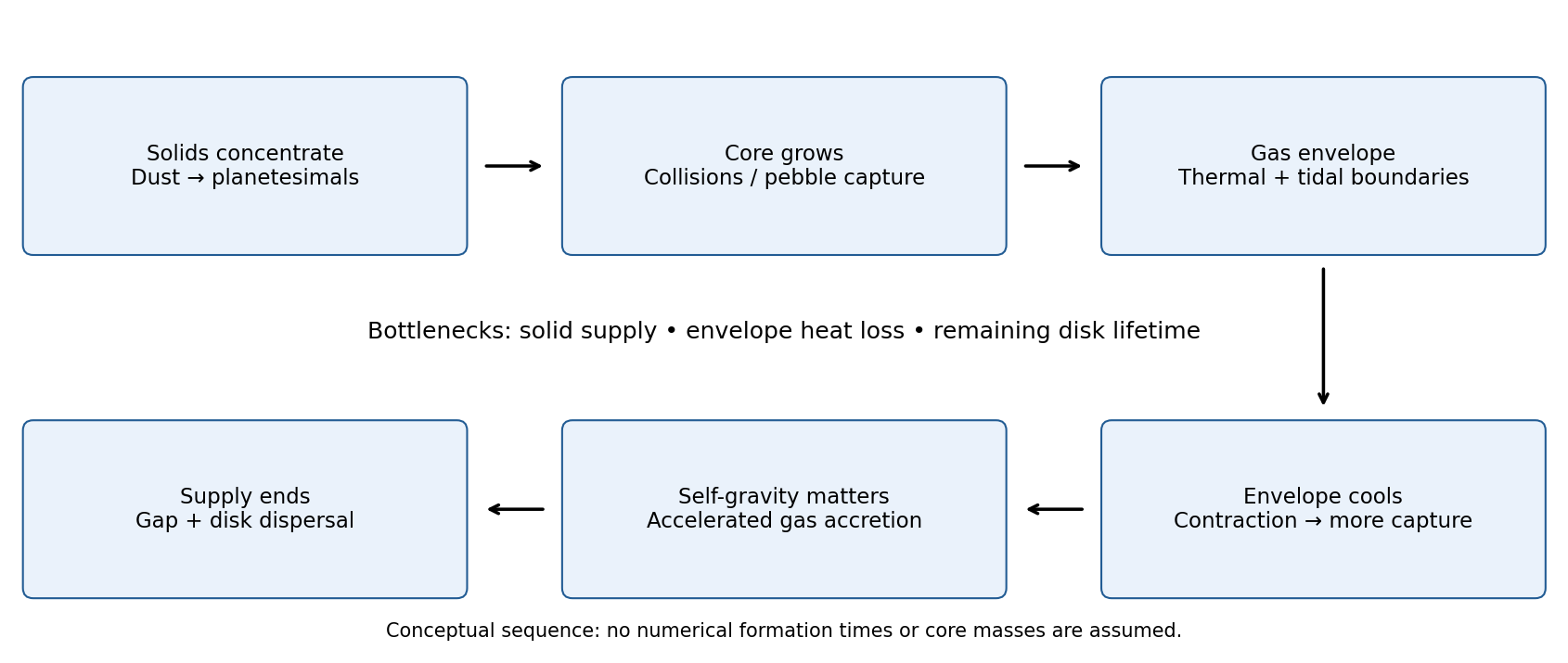
The decisive race is . Failure to cool or obtain a sufficiently large core before gas removal leaves a smaller solid or ice-rich planet. Successful growth is ultimately limited by disk supply, gap opening by a planet, and dispersal; a gap does not completely seal off accretion. Angular-momentum exchange drives planetary migration, so the observed orbit need not be the formation radius. Accretion-shock radiation and subsequent contraction set the young giant's entropy and luminosity; final core mass, envelope enrichment and orbital location depend on the whole growth history, not on one fixed threshold. The necessary cooling, supply and orbital constraints make the model testable rather than an assertion that every embryo must become a gas giant.
A sufficiently self-gravitating disk can fragment directly, bypassing the slow assembly of a massive solid core. In the simplest thin gas-disk model the competition is between self-gravity, pressure and rotational shear. Axisymmetric perturbations havewhere is the radial epicyclic frequency, not the opacity. In a nearly Keplerian disk, . This is Toomre's stability criterion; finite thickness and global/nonaxisymmetric modes modify the precise boundary. The fastest local wavelength is , of order the disk scale height times when .
Instability alone does not ensure bound planets. Compression and shocks heat the gas, raising ; a slowly cooling disk can maintain self-regulated spiral turbulence. Cooling-limited disk fragmentation requires energy loss on a sufficiently short dynamical timescale, conventionally expressed as below a model-dependent threshold. The often quoted belongs to a particular local razor-thin calculation, not every real disk.[ref]
Nonlinear Outcome of Gravitational Instability in Cooling, Gaseous Disks by Charles F. Gammie. 2001 local model: cooling, self-regulated turbulence and fragmentation
Cold massive outer disks are promising sites, but fragment contraction, tidal survival, further accretion and migration determine whether the result remains a planetary-mass body or grows into a brown dwarf.For gravitational collapse of a settled particle layer, if “core collapse” instead denotes a solid-particle layer, its random-velocity dispersion replaces gas sound speed in an appropriate particle-disk stability condition. Settling and concentration can enable collapse into planetesimals; gas turbulence and particle stirring oppose it. This route makes solid seeds for later core accretion and is physically distinct from direct gas fragmentation. In both cases one must establish self-gravity against velocity support and tides, rather than infer collapse from high surface density alone.
The Hill radius compares planetary gravity with the differential stellar tide. Expanding the stellar tide near a circular orbit gives , soIt sets the size of the planet's tidal neighbourhood, controls encounter and feeding zone scales, and limits the region within which material can remain bound against stellar shear. It is not itself a solid surface or a guarantee of capture.
The Bondi radius compares planetary potential energy per unit mass with the gas thermal scale,This convention uses the ambient sound speed; definitions based on escape speed can differ by a factor of two. Inside , gravity can substantially perturb thermal gas. Gas still needs a way to dissipate energy and angular momentum to accrete; a geometric boundary alone does not supply a gas-capture rate.
For an embedded hydrostatic envelope a useful outer scale is , subject to disk thickness and gas recycling. Let and . The Bondi-Hill crossover in a protoplanetary disk obeysSmall cores are usually thermally limited, whereas larger ones become tidally limited. These radii also organize pebble accretion: gas drag can turn an encounter into capture, with drift-dominated and shear-dominated regimes depending on particle stopping and encounter times. There is no universal accretion efficiency fixed by or alone.[ref]
Lecture notes on the formation and early evolution of planetary systems by Philip J. Armitage. Version1, sectionIII.C.1, pages32–34: core accretion and envelope boundaries
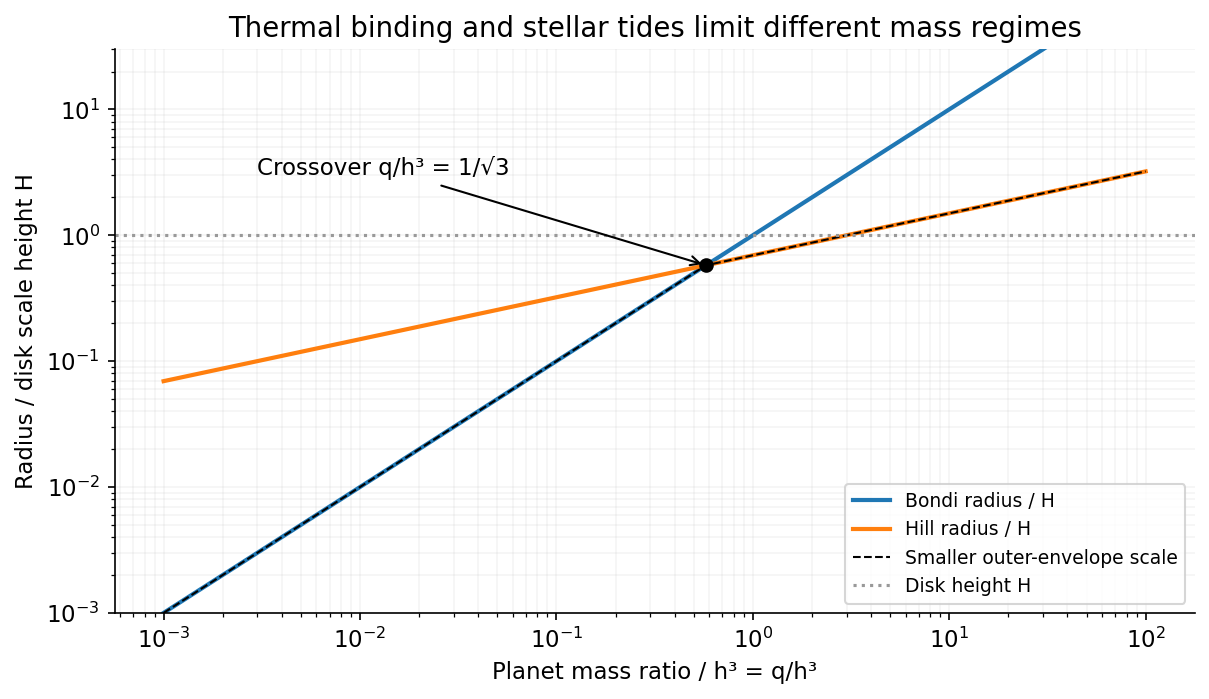
Bondi and Hill radii exchange their roles as the smaller planetary-envelope scale
. Source. Details. Type I migration is orbital angular-momentum exchange between an embedded low-mass planet and its disk without a deep gap. The planet excites spiral density waves near Lindblad resonances; the disk's reaction torques act back on the planet. The outer wake usually supplies a negative torque and the inner wake a positive one, with their small imbalance often driving inward migration. Gas on horseshoe orbits in a planetary disk near corotation adds a corotation torque that depends on entropy and vortensity gradients.
For a thin disk, define , andThe coefficient is signed and depends on disk gradients, thermodynamics and diffusion; it is not a universal constant. For a circular orbit with fixed planet mass, . The Type I migration timescale from disk torque follows from :Thus a more massive embedded core generally migrates faster within this regime, unlike a picture in which migration starts only after giant-planet formation.
In a simple locally isothermal smooth disk the net torque is commonly negative, potentially removing cores before they acquire gas. In a non-isothermal disk an unsaturated entropy-related corotation torque can balance or exceed the negative wave torque, giving a planet trap or outward migration. Viscosity and thermal diffusion help maintain the background gradients across the horseshoe region; without adequate replenishment corotation-torque saturation can suppress that contribution. The linear low-mass scaling requires a small disturbance, roughly ; larger planets, gap formation and strong disk feedback require a different treatment. Type I migration is therefore neither universally inward nor literally viscous advection of the planet.[ref]
Planet-Disc Interactions and Early Evolution of Planetary Systems by Clément Baruteau and others. Sections on Lindblad and corotation torques, saturation and low-mass migration
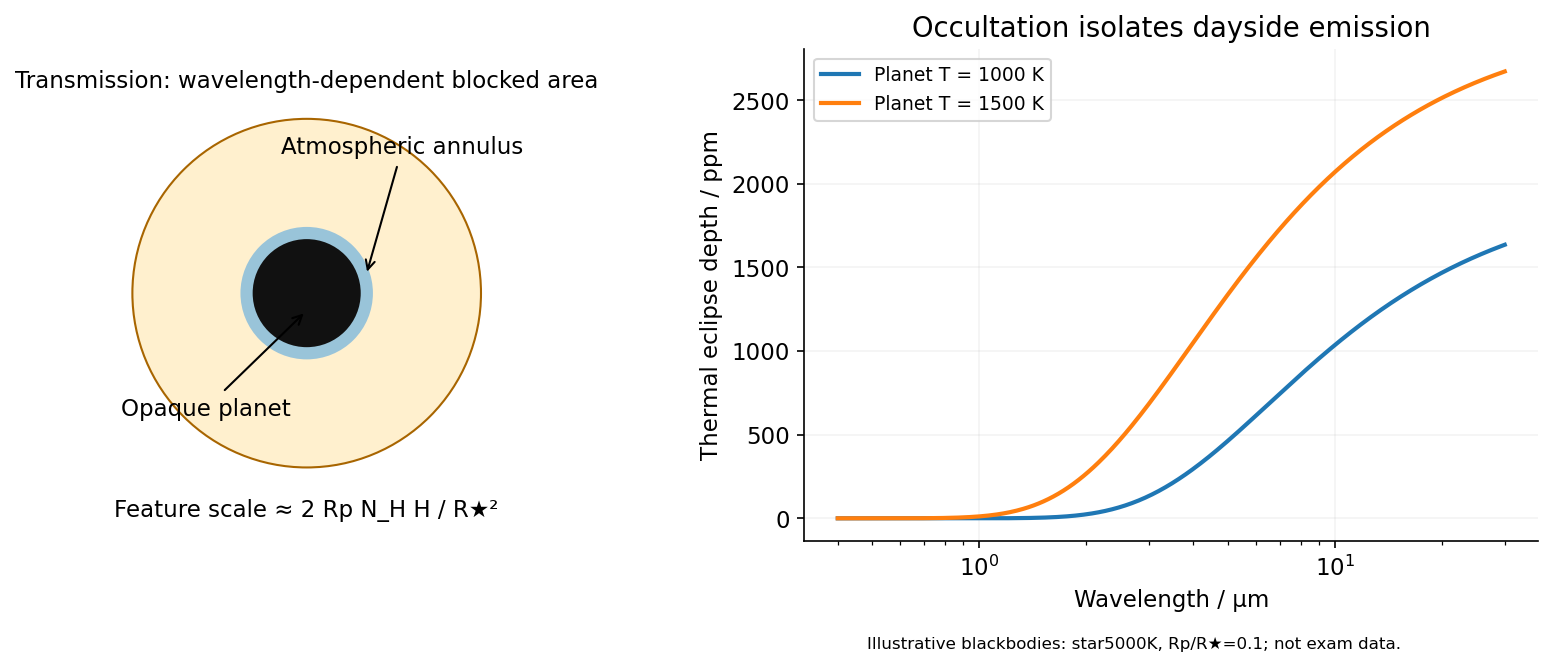
In transit spectroscopy, starlight passes tangentially through the planet's terminator atmosphere during primary transit. Wavelength-dependent opacity changes the effective occulting radius. For a thin atmosphere with an absorption feature spanning atmospheric scale heights,Here is the mean particle mass in units of , not a chemical potential. Large planets with warm low-gravity, low-molecular-weight atmospheres against small stars have larger signals. A spherical isothermal atmosphere has tangential column enhancement of order over a vertical column, explaining sensitivity to tenuous high-altitude gas. Molecular bands, atomic lines, scattering slopes and clouds constrain the terminator, but cloud opacity, reference pressure and abundance-temperature degeneracies limit unique retrievals.[ref]
Theoretical Transmission Spectra During Extrasolar Giant Planet Transits by Sara Seager and Dimitar Sasselov. Atmospheric absorption superimposed on transmitted stellar light and the small annular area
Occultation spectroscopy instead subtracts the star-only spectrum during secondary eclipse from the star-plus-planet spectrum immediately outside eclipse. It measures the dayside planet/star flux ratio. In the blackbody approximation the thermal eclipse depth isLonger infrared wavelengths generally improve contrast for a cooler planet; molecular absorption or emission depends on the vertical temperature gradient. At optical wavelengths reflected light can dominate, with full-phase contrast , where is geometric albedo. Eclipse spectra therefore probe dayside emission or reflection, rather than the transit's slant absorption. Clouds and temperature inversions affect interpretation.[ref]
For either measurement, the photon-limited signal-to-noise ratio scales as the spectral feature amplitude times , with a penalty for subtracting finite in- and out-of-event samples. Finer spectral bins reduce photons per bin; bright hosts, repeated events and stable instruments improve sensitivity. Detector systematics, telluric absorption for ground observations, and variable starspots can limit the practical gain. Space observations remove telluric contamination, not stellar variability or instrumental drift. Neither technique directly measures a unique bulk composition or samples all longitudes of the planet.


Articles by others on the same topic
There are currently no matching articles.