For the radial epicyclic frequency, introduce the effective potential at fixed specific angular momentum : . A circular orbit at satisfies . A small radial displacement obeys . Differentiate at fixed before inserting the circular-orbit relation:For a flat rotation curve, , so .
In a perturbation proportional to , is the integer azimuthal mode number, giving arms for a nonaxisymmetric pattern. Its angular pattern speed is for a real frequency and ; is the unperturbed gas sound speed, or the specified effective fluid pressure-response speed. For growing patterns the angular phase speed uses . Axisymmetric modes have : their pattern speed is undefined, and one must use , not set the pattern-speed expression to zero.
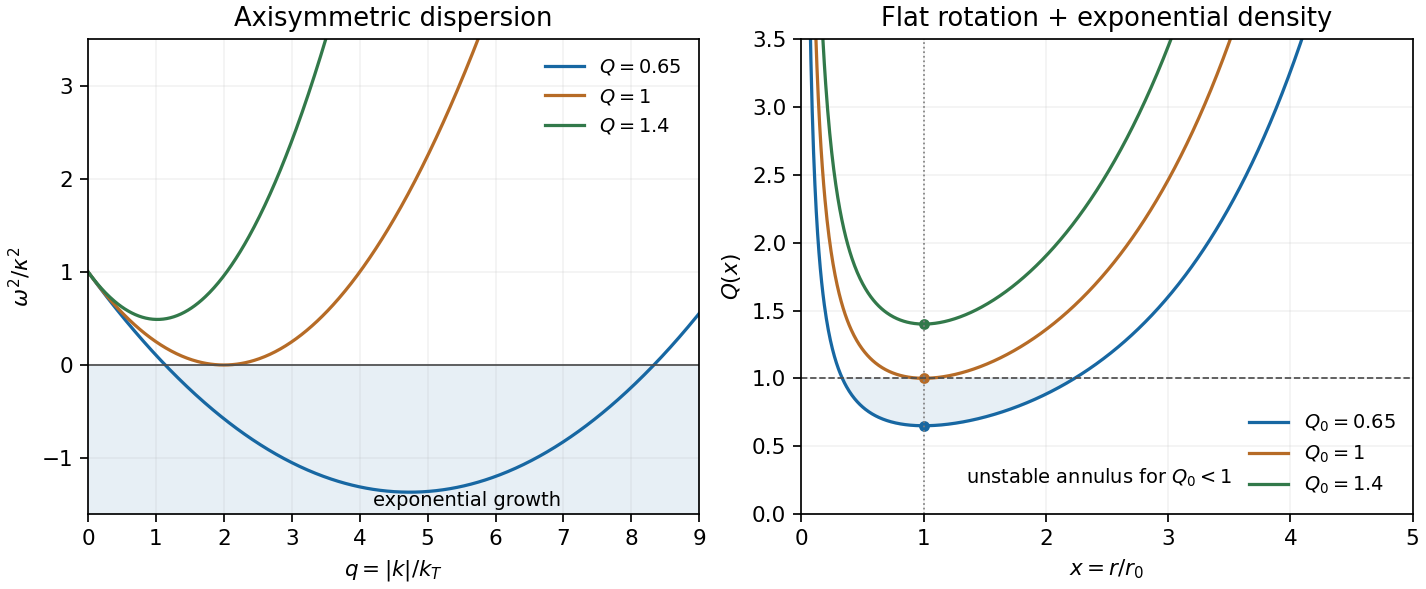
Define the Toomre parameter and Toomre wavenumber byThen givesFor , the minimum is negative precisely when . Thus this condition is necessary and sufficient for an exponentially growing axisymmetric mode within the given local razor-thin fluid model; is marginal. It is not a guarantee against global or nonaxisymmetric instabilities, and the collisionless stellar-disk criterion has a different pressure-response normalization.
The Toomre unstable band and fastest growth follow by minimizing :Here the growing branch has under the stated Fourier convention. Both signs of the radial wave number have the same growth rate. The unstable band is , where .
For the minimum Toomre parameter in an exponential flat-rotation disk with constant , put :The logarithmic derivative is , so the unique minimum occurs at . Both as and as . Hence inner and outer regions are stable within this idealized rotation law, even when an intermediate annulus is unstable. The whole disk is strictly stable in this local axisymmetric test ifEquality makes the ring at marginal. The central conclusion uses the assumed flat rotation curve all the way inward; real central rotation laws need not retain that limit.

Articles by others on the same topic
There are currently no matching articles.