2016 paper: Public original PDF, physical page 810. Student-answer availability for this paper remains unverified.
Original paper: Public original PDF, physical pages810–812; question pages811–812.
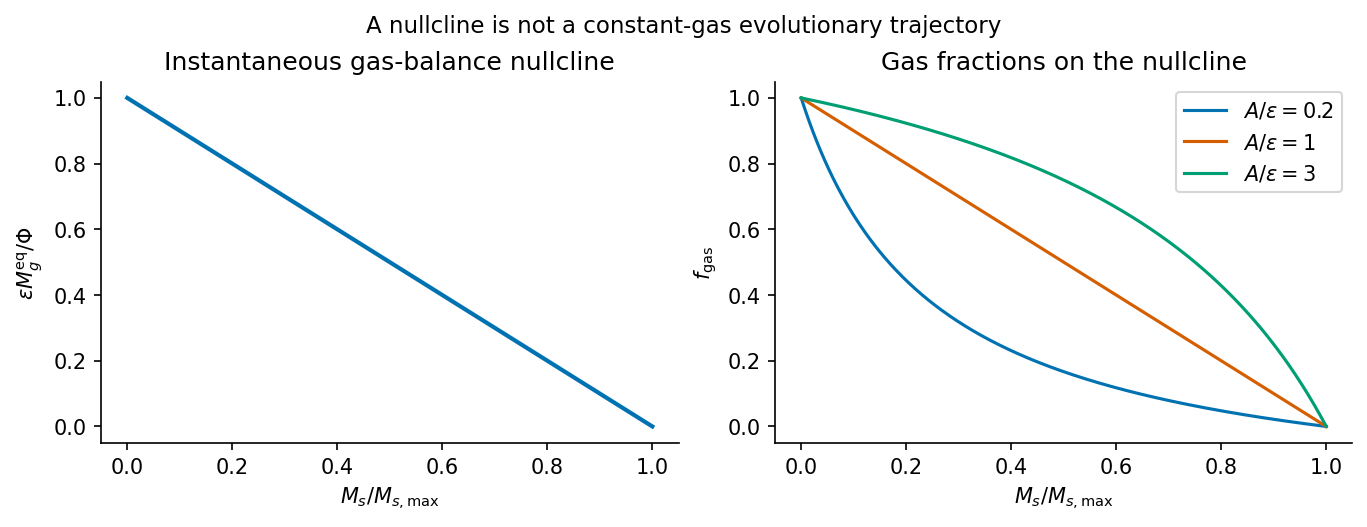
Write , where . For ionized hydrogen with Thomson scattering opacity, radiation force on one electron-proton pair balances gravity whenThe mass-loading coefficient has units of inverse time. With the stated neglect of returned and directly accreted gas, mass conservation givesAt a specified stellar mass, the gas-balance nullcline isA positive reservoir exists only below the limiting massEquality has zero gas, so this is the supremum of masses with a positive instantaneous equilibrium. For , the corresponding gas fraction isIt decreases from one to zero: the derivative is . This is a gas regulator with an outflow increasing with the stellar mass through the assumed black-hole scaling.
There is an important time-dependence qualification. A positive gas mass cannot remain exactly constant forever while the stellar mass continues to increase and is maintained: differentiating would require . The expression above is the instantaneous equilibrium, or a quasisteady approximation when gas relaxation is fast relative to stellar-mass evolution. The only exact fixed point of the coupled idealized equations is . It is not a sustained star-forming state.
Above the limiting mass, for every nonnegative reservoir: the assumed Eddington-driven wind already demands more than the incoming supply, even before star formation consumes gas. The reservoir is depleted and star formation is quenched. The equations must cease to apply when gas runs out; one cannot continue to negative gas mass or power an indefinitely Eddington-luminous nucleus without fuel. At fixed the depletion time from isAllowing to grow only strengthens the initial depletion tendency. If , this particular feedback threshold is absent.
Distinguish the rest-mass supply from the actual black-hole mass growth. With the usual radiative-efficiency definition,At the Eddington limit the growth is exponential:The available time is the difference of the supplied ages, ; no new cosmological age-redshift relation is needed.
Using the printed , together with , , and a Julian year of , givesThereforeThis is about e-folds. The constants just listed are evaluation constants, not additional observational inputs asserted to be on the paper.
Sometimes an elementary growth convention identifies directly with and drops the radiated fraction of the incoming rest mass. That approximation instead gives and . The first result retains the physically distinct supplied and retained masses; the convention must be stated because exponential growth magnifies this difference.
The main implication is already severe in the optimistic calculation: a low-mass stellar-remnant seed has insufficient time under the specified efficiency and strictly Eddington-limited accretion. A heavier seed, earlier formation, a different efficiency, mergers or episodes beyond that idealized luminosity limit can relax the inference. Any duty cycle below unity or sub-Eddington episodes require a larger initial mass within the adopted model. The reported high-redshift quasar motivating this calculation was identified spectroscopically at ; its published age estimate need not replace the ages supplied here.[ref]
Only the photon energy above the hydrogen ionization threshold initially becomes photoelectron kinetic energy. The stated mean therefore suppliesLet be the local number of ionizations per volume per time. Photoionization equilibrium makes this equal to the recombination rate. If is the mean kinetic energy removed per recombination, thermal balance reduces toNeither the ionization threshold nor the density remains in this event-by-event balance. The threshold energy is stored as atomic ionization energy and returned in recombination radiation; it is not a net thermal input. This separation between photoelectron heating and kinetic energy lost by recombining electrons is the relevant cooling balance.[ref]
Heating and Cooling of HII regions by Ian Czekala. Heating by photoionization and Recombination radiation sections
In the elementary mean-thermal-energy approximation, a captured electron removes . This gives the concise estimateThat coefficient is a stated approximation, not a universal recombination identity. Real recombination weights the electron distribution by its velocity-dependent capture rate. If the chosen cooling model instead writes , the precise answer is . The source supplies no recombination cooling coefficient or capture kernel from which a unique more accurate coefficient can be computed. Its emitted-photon average is also being used as the average of the absorbed ionizing photons; spectral filtering would require a different weighted average.
Use the supplied flat radiation-era background equations. Write , with constant. On the expanding branch,Choosing the origin at the big bang givesThe supplied perturbation equation consequently becomesA trial gives , so . Thus both independent modes areThe growing mode is , and the other decays as . At sufficiently late times any nonzero growing-mode coefficient dominates while linearization remains valid.
The calculation follows the stated differential equation, including its coefficient . The name Einstein-de Sitter ordinarily denotes a flat pressureless matter universe, whose growth law is different; here the explicit radiation scaling fixes the intended background. Nor does this scale-free equation describe every subhorizon radiation perturbation: including a pressure-gradient term introduces acoustic behavior. No wavelength-independent claim beyond the supplied model is needed.
For the binding energy of a truncated singular isothermal sphere, build the mass distribution from concentric shells. Its enclosed mass and mass element areThe interaction of a newly added shell with the interior contributes . Counting each pair once,Eliminating givesThe central density is singular, but the mass and this energy integral are finite. The result assumes the stated truncation and no additional gravitating component.
The gravitational potential of a truncated singular isothermal sphere is a separate quantity from this shell-assembly energy allocation. With zero potential at infinity, both interior and exterior shells contribute:It matches at the edge. The equivalent total energy is ; the half prevents double counting. By contrast, counts the escape work of test parcels in a fixed potential and equals . Confusing these quantities would change a local feedback threshold.
Introduce the constant by , and set , the injected energy per unit mass of newly formed stars. Before a local wind switches on, no return or matter exchange impliesIn this independent-volume supernova quenching model, the accumulated injection per volume isFor any specified positive binding energy per unit remaining gas mass , the local threshold isGas conversion must be included in this comparison; replacing the integrated star formation by its initial rate times is only a short-time approximation.
For a quenching front in a fixed galactic potential, take . This treats the gravitating profile as fixed: newly formed stars initially replace gas at the same radius, and later changes of the potential caused by expelled gas are neglected. Gas first becomes unbound at the outer edge, atThereafter the inner edge of the quenched exterior region isThere is no quenched radius inside the galaxy before this onset. The remaining star-forming region is ; the front moves inward. The ideal logarithmically divergent central potential delays complete removal to infinite time in this fixed-profile model. It should not be interpreted as a physical unresolved central core.
The local binding-energy allocation in galactic feedback also admits a different convention, because it calls an energy of a volume element without specifying how the nonlocal self-gravitating energy is assigned to that element. If the intended prescription is instead the shell-assembly contribution from part (a),then at every radius. The same time applies everywhere: all shells quench simultaneously, and there is no continuously propagating radial front. This is a shell-energy toy model, not the escape potential including exterior shells.
Both results follow from explicit definitions. A convention assigning locally replaces by in ; it is again an energy allocation rather than test-parcel escape. Updating the potential after gas loss or choosing a fixed initial-gas binding budget instead of the remaining-gas budget would require an additional closure. The stated independent-volume assumptions do not uniquely choose between these. The displayed escape-potential result and shell prescription must therefore not be presented as interchangeable universal laws.
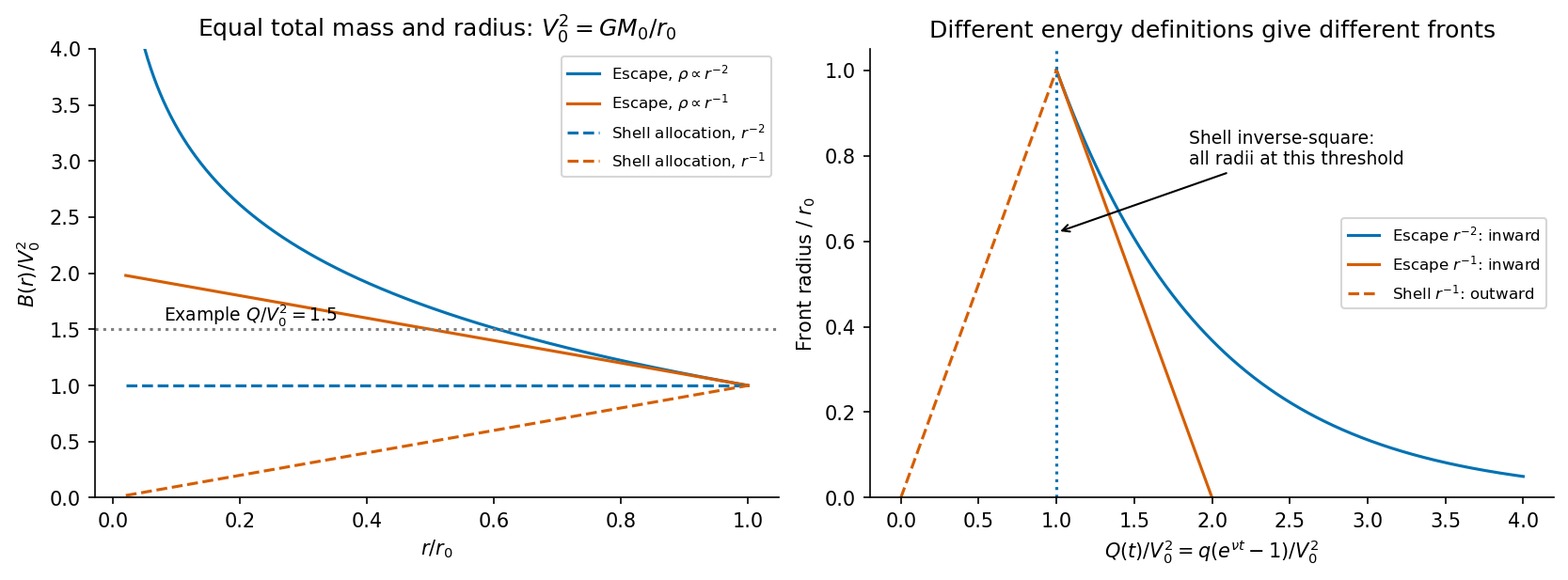
Original comparison of quenching thresholds for two initial density slopes, distinguishing escape potential from shell-energy allocation
. Details. For the shallower initial density profile,Including outer shells, the initial gravitational potential isIts central value is finite. With the same remaining-gas escape criterion and fixed-potential approximation as above,This front is inside the galaxy only when . ThusQuenching still moves from the outside inward, but now reaches the centre in a finite time. The contrast with the escape model is the finite central potential, not a reversed gravitational force.
Under the alternative shell-energy quenching prescription, the conclusion is different:Here the quenched region is inside the front and grows from the centre outward, unlike the simultaneous quenching of the isothermal shell-allocation model. Its edge reaches at . This change of direction is a consequence of the chosen local energy model: increases with radius for this profile, whereas the true binding potential including all outer shells always becomes shallower outward. The source does not identify which local allocation it intends; keeping the conventions explicit resolves the different conditional predictions without discarding the exterior-shell potential.
To test radial stability of an axisymmetric circular orbit, let be the time-independent gravitational potential per unit stellar mass in the midplane. Axial symmetry conserves the specific angular momentum . The radial equation isA circular orbit at obeys . Choose the guiding circular orbit with the same conserved angular momentum as the perturbed star. Setting and expanding at fixed giveswhere the radial epicyclic frequency isHere and refer to the family of circular orbits. They are differentiated as functions of radius only after the perturbation equation has been expanded at conserved stellar .
For a radially stable circular orbit, , so to linear orderThus the orbit performs small simple harmonic radial oscillations about its guiding radius.
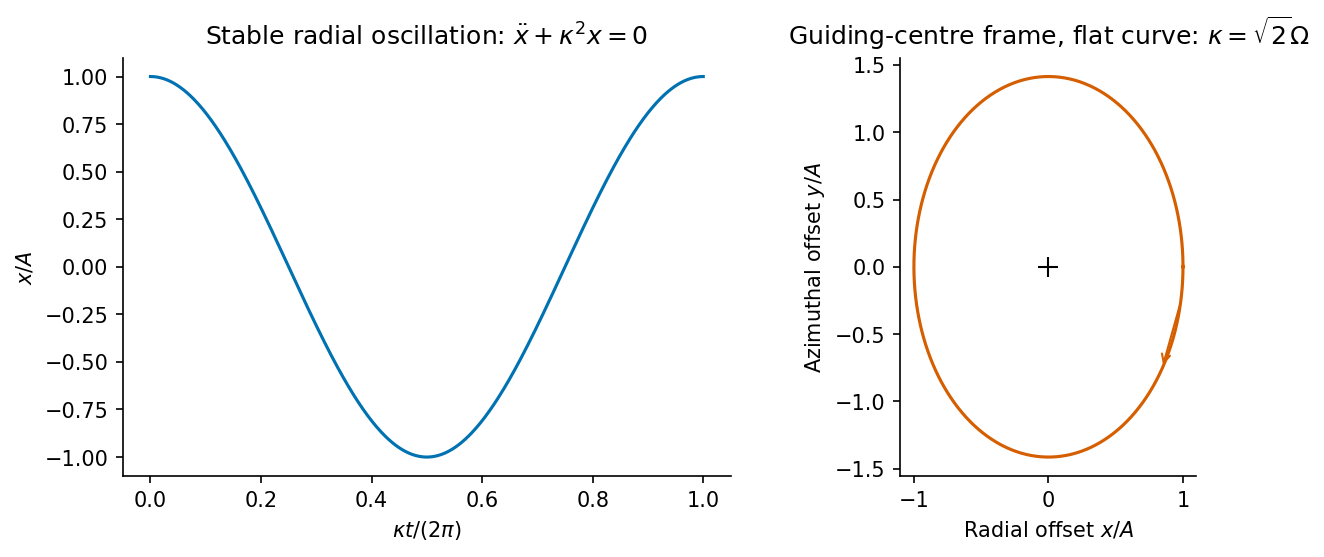
Symmetry alone is insufficient to guarantee stability: gives exponentially growing displacement, and is marginal. The intended statement assumes a stable unperturbed orbit.
For a Kepler potential ; for a flat circular-speed curve ; for solid-body rotation . Conservation of also gives , explaining the accompanying azimuthal epicycle rather than a purely radial motion in the inertial plane.
A protostar forms when a self-gravitating cloud fragment can contract faster than pressure support and energy loss can arrest it. A useful local scale is the Jeans length, , with characteristic Jeans mass and free-fall timefor an initially uniform sphere. Geometry, turbulence and magnetic support change the detailed threshold; none of these estimates asserts that every cloud contracts as a uniform sphere.
While cooling is efficient, compression is nearly isothermal. Then decreases as the density rises, allowing fragmentation. Rotation becomes increasingly important during contraction because a parcel conserving specific angular momentum encounters a centrifugal scale . The resulting accretion disc must transport angular momentum before matter can reach the central object. Infall, a dense accreting interior and an outer envelope can therefore coexist; a protostar is not initially an isolated fixed-mass star.
Increasing optical depth eventually slows radiative cooling. The central gas then becomes less compressible and can form a pressure-supported first core. Molecular hydrogen dissociation absorbs compressional energy and can trigger a second collapse before a compact stellar core is established. Subsequent accretion supplies a luminosity of orderThe retained fraction depends on shock and disc radiation, so this expression is an energy scale rather than a guaranteed luminosity all emerging from the stellar surface.
A central accreting core can be nearly hydrostatic on its short sound-crossing time while its mass, entropy and radius evolve on longer times. A low-mass object is often largely convective because of its opacity and steep radiative temperature gradient; deuterium burning can temporarily contribute to support and moderate contraction. Neither convection nor the timing of deuterium ignition is universal across all masses and accretion histories.
When the main accretion phase ends, gravitational contraction remains an energy source. The virial theorem explains how contraction both heats the interior and supplies radiation: for an ideal-gas-supported object with negligible surface-pressure correction, , so only part of the released binding energy appears as increased thermal energy. The corresponding Kelvin-Helmholtz time isFully convective pre-main-sequence evolution approximately follows a Hayashi track, with decreasing radius and luminosity at comparatively weakly changing effective temperature. Objects developing radiative interiors can follow Henyey tracks. Eventually sustained core hydrogen burning balances the luminosity and the star reaches the main sequence. Massive objects can ignite hydrogen while substantial accretion continues, so “accretion ends, then hydrogen ignites” is not a universal ordering.
A useful structural distinction is therefore between an accretion-powered protostar and a largely fixed-mass pre-main-sequence contraction model. An infrared-bright envelope or disc traces obscured formation and reprocessing of radiation; a schematic evolutionary track should not replace the actual mass- and entropy-dependent stellar-structure problem.
An encounter between galaxies or clusters mainly couples their collective gravitational fields; it need not involve physical impacts between individual stars. Direct stellar collision rates depend on number density, relative speed and gravitational focusing. For two stars the collision cross-section is approximatelyIn an ordinary galaxy, the small geometrical stellar filling factor makes such impacts rare even while the galaxy undergoes a major encounter. Dense stellar cores are an important exception, not a reason to treat all galaxies as collisional fluids.
Tidal forces depend on the gradient of the perturber's field. For a distant fast encounter of mass , impact parameter and speed , the impulse scale for a star at displacement isA more specific result illustrates the geometry. Put the straight-line perturber trajectory in the plane along , with closest approach at . In the tidal and impulse limits,for an initially spherical, nonstreaming target with randomly sampled internal phases. The cross term averages to zero, and . Heating, expansion and tidal stripping preferentially affect weakly bound outer stars. A slow encounter can be adiabatically shielded rather than impulsive; a penetrating or strongly resonant encounter needs more than this distant straight-line approximation.
Disc rotation and orbital orientation matter. Prograde passages can drive stronger coherent distortions than corresponding retrograde passages. Tidal bridges, long tails, asymmetric arms and shells can record the encounter. Restricted gravitational calculations already reproduced prominent bridge and tail structures without requiring individual stellar collisions; full self-consistent models additionally follow the gravity of the responding discs and haloes.[ref]
Galactic Bridges and Tails by Alar Toomre and Juri Toomre. 1972 abstract and §II, close tidal encounters of initially rotating test-particle discs
A first high-speed passage need not bind the pair. Capture or merging requires orbital energy and angular momentum to be redistributed into internal motions, escaping material, gas radiation or the surrounding halo. Dynamical friction transfers orbital energy to a gravitational wake and can bring a bound satellite inward. In a major merger, the potential changes on orbital times and violent relaxation redistributes stellar energies; phase mixing then smooths fine orbital structure. These are collective collisionless processes, distinct from slow two-body relaxation.
Gas behaves differently from stars: gas streams can shock, dissipate energy, lose angular momentum and fuel a central starburst or active nucleus. Gas-poor mergers are correspondingly more nearly dissipationless. Outcomes depend on mass ratio, orbital angular momentum, relative velocity, halo structure and gas fraction: they range from a modest flyby and tidal debris to disruption of a satellite or a merged remnant. Slow encounters in a group are generally more favorable to merging than otherwise comparable very fast unbound passages, but no single speed or mass-ratio threshold follows without an explicit structural model.
Galaxy formation combines gravitational assembly of dark-matter haloes with dissipative baryonic physics. Primordial density fluctuations supply a statistical seed distribution. In linear theory, each Fourier mode evolves through a growth factor and a scale-dependent transfer function; the power spectrum describes the variance by scale. Radiation pressure, free streaming and the time of horizon entry influence the small-scale transfer, so one should not replace the spectrum by a single universal growing power of time.
When fluctuations become nonlinear, overdense regions collapse, virialize and build larger structures through accretion and mergers. Cold dark matter permits a broad hierarchy of bound haloes. A spherical-collapse threshold and a mass-variance prescription, such as the Press-Schechter formalism, organize an approximate halo abundance; departures from spherical collapse and correlated environments limit its literal interpretation.
Gas falling into a halo is compressed and may be shock-heated toward a virial scaleUnlike collisionless dark matter, it can radiate away thermal energy. A rough cooling time iswhere the denominator specifies a chosen optically thin astrophysical cooling function convention. Cooling is effective for condensation when this time is short compared with the relevant dynamical or supply time. Atomic transitions, molecular processes, ionization state, density and metal abundance matter. A stable virial shock is not obligatory for all accretion: cold dense inflows can supply gas in regimes where shock-heated gas would cool rapidly.
The distinction between a gravitationally assembled massive halo and a radiatively condensing luminous component is fundamental. In the classic two-stage picture, non-dissipative clustering builds potential wells while cooling allows gas to concentrate much further than the halo component.[ref]
Core condensation in heavy halos by Simon D. M. White and Martin J. Rees. 1978 abstract, gravitational clustering plus dissipative gas condensation
Angular momentum inherited from tidal torques and later accretion helps gas settle into a rotationally supported disc after cooling; disc size depends on angular-momentum retention and transport. Locally self-gravitating gas fragments and forms stars. Stellar radiation, winds and supernovae then heat gas, drive turbulence, enrich it with heavy elements and can expel it from shallow potential wells. Metal enrichment can also accelerate later cooling, so feedback is more than a single positive or negative energy term.
Galaxy growth is usefully expressed as a gas-budget competition:Here is the promptly returned stellar mass fraction; unlike the simplification in Question1, a general evolutionary model need not set it to zero. The equation separates newly supplied, converted, expelled and recycled gas rather than assuming that halo mass uniquely fixes stellar mass.
Accreting central black holes can provide radiative and mechanical feedback. Heating a halo, ejecting gas or maintaining a hot atmosphere can reduce fresh fuel; removal of a satellite's gas supply and ram pressure in a surrounding medium provide additional environmental routes. Quiescent galaxy assembly can still add stellar mass through dry mergers, so cessation of star formation is not identical to cessation of all mass assembly.
Mergers and disc instabilities can rearrange morphology and trigger bursts, while smooth accretion can rebuild discs. Cosmological expansion changes the supply and merger environment; accelerated late-time expansion also slows linear growth. A predictive model must connect these mechanisms to the stellar mass function, gas fractions, star-formation histories, sizes, chemical abundances and clustering. Those observables test different pieces of the assembly-and-feedback picture; none alone implies a one-to-one instantaneous relation between galaxy luminosity and total halo mass.
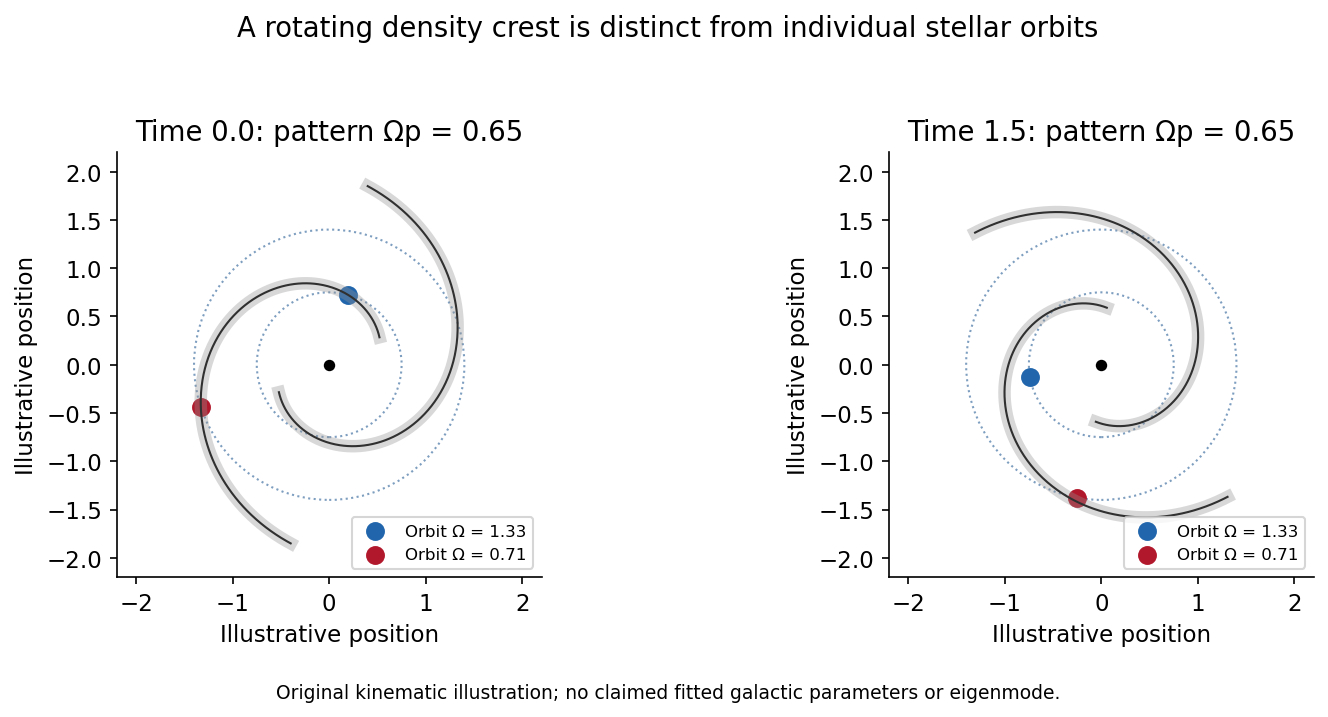
A spiral density wave is an organized density and gravitational-potential perturbation through which stars and gas can move; it is not generally a permanently labelled set of stars. Differential rotation winds a material arm rapidly. In a wave description, a perturbation has phase , with pattern speed distinct from the local stellar angular speed.
For a thin fluid disk the local tightly wound dispersion relation isRotation and pressure resist self-gravity. A collisionless stellar disk requires its stellar response function instead of simply replacing by a dispersion; the familiar local axisymmetric stability parameter is . This is distinct from the gas .
Waves exchange angular momentum at Lindblad resonances and near corotation radius. Swing amplification can strengthen a leading disturbance as shear turns it into a trailing one. Bars or companions can force a coherent spiral; recurrent self-excited disturbances also occur. Thus a single indefinitely steady wave is one model, not a description established for every spiral galaxy. Gas compression and shocks along arms can organize star formation, while gravitational torques redistribute angular momentum. Arm brightness, recent star formation and stellar mass density need not trace precisely the same pattern.[ref]
Spirals in Galaxies by Jerry A. Sellwood and Karen L. Masters. Sections4–6: wave dynamics, recurrent versus quasi-steady patterns, and gas response
Supermassive black holes are compact galactic nuclei with masses typically of millions to billions of solar masses. Their gravitational influence is measured from the motion of surrounding matter; accretion luminosity is evidence of feeding, not a necessary property of every black hole. Keplerian stellar orbits near the Galactic Centre and molecular-maser rotation curves in other nuclei provide particularly direct compact-mass constraints. A rough black-hole sphere of influence is ; resolving it helps dynamical mass estimates.
Accretion converts binding energy into radiation,The latter is the Eddington luminosity for isotropic radiation opposed by electron-scattering opacity, not an absolute luminosity ceiling for every geometry. The retained black-hole mass grows at . Sustained feeding can produce an active galactic nucleus, whereas gas-poor nuclei may be faint. Loss of gas angular momentum is a central feeding problem.
Black-hole mass correlates with classical-bulge stellar velocity dispersion through the M-sigma relation. Accretion-powered radiation, winds and jets can heat or remove gas, linking nuclear growth to galaxy evolution. Such correlations do not establish one universal feedback history, and disks and pseudobulges do not follow the same tight relations as classical bulges. Seed formation, accretion and mergers all contribute; seed masses and feeding histories remain model dependent.[ref]
Coevolution (Or Not) of Supermassive Black Holes and Host Galaxies by John Kormendy and Luis C. Ho. Dynamical evidence, bulge-dependent correlations and different feedback regimes
Galactic star formation requires gas to collect into cold dense regions that can become self-gravitating. Disk-scale gravity, turbulent motions, shear, pressure and magnetic fields affect this collection; formation then proceeds within molecular clouds. A useful local parametrization iswhere the star-formation efficiency per free-fall time summarizes inefficient conversion rather than requiring every cloud to collapse at once.
Across galactic disks the empirical Kennicutt–Schmidt law relates star formation rate surface density to gas surface density, . A slope near is a familiar integrated total-gas fit, while molecular-gas relations in ordinary disks can be closer to linear; the slope and normalization depend on tracer, averaging scale and environment. The gas-depletion time is the corresponding fuel-consumption scale, not a prediction that inflow and recycling cease.
Massive stars supply ionizing radiation, winds and supernova energy and momentum. This stellar feedback can disperse clouds, sustain turbulence and drive outflows, regulating rather than simply extinguishing all future star formation. Fresh accretion and recycled gas replenish the reservoir. UV and recombination-line emission trace young stars, while infrared emission traces absorbed and re-radiated light; extinction, stellar populations and the assumed initial mass function affect inferred rates. A galactic rate reflects supply, cloud formation and feedback together, rather than only the free-fall time of its densest gas.[ref]
Star Formation in the Milky Way and Nearby Galaxies by Robert C. Kennicutt Jr. and Neal J. Evans II. Sections3–6: diagnostics, gas relations and physical interpretation
In a matter-dominated Einstein-de Sitter universe, the growing linear density contrast is proportional to the scale factor. When , linear evolution no longer describes collapse. An overdense region initially expands more slowly than the background, reaches cosmological turnaround, and then contracts under self-gravity.
The spherical top-hat collapse model supplies a useful idealization: pressureless shells obey . At formal collapse, the linearly extrapolated growing mode isThis is a linear extrapolation, not the true finite nonlinear density at that instant. In the ideal energy-conserving spherical model, virial equilibrium gives a virial radius about half the turnaround radius; its mean density at the collapse time is times the cosmic matter density.
Real perturbations are nonspherical: tides and anisotropic collapse produce sheets, filaments and haloes. Collisionless dark matter develops shell crossing and phase mixing rather than radiatively losing its orbital energy. Baryonic gas can shock, cool and collect within the resulting potential wells. Hierarchical merging then assembles larger systems where small-scale fluctuations have sufficient initial power. Press-Schechter formalism connects a collapse threshold with the statistics of the smoothed initial field, but halo abundances and internal structure need more than the single spherical model. These ideas apply after perturbations become nonlinear; one must not extend pressureless subhorizon equations through all radiation-era or horizon-scale conditions.[ref]
With constant isothermal sound speed , the equation of state is . Spherical hydrostatic equilibrium and mass continuity requireTry . With no central point mass, , and hydrostatic balance becomes . The positive-density branch is thereforeThe constant external pressure fixes the truncation radius through , givingThis is the pressure-truncated singular isothermal gas sphere, one hydrostatic solution, not a claim that every isothermal cloud has a singular centre. Its central density diverges, but its enclosed mass tends to zero as .
For inside-out collapse of a singular isothermal sphere, the expansion front is at . The original mass swept by this front isThus the only time-independent accretion scale is . The front-sweeping estimate has coefficient two, but gas takes time to fall from the front to the object; it is not an exact central accretion coefficient. Writefor fixed mean particle mass . Determining the dimensionless coefficient requires the collapse solution; it is not fixed by front propagation alone and is not needed for the requested temperature scaling.[ref]
Self-Similar Collapse of Isothermal Spheres and Star Formation by Frank H. Shu. 1977 expansion-wave solution: central accretion and the free-falling envelope
Well inside the front, where the point mass dominates and infall is approximately pressureless and locally steady, . Conserving the radial mass flux gives the free-fall density profile around a growing point mass:The inner slope is , versus in the undisturbed outer cloud. For constant and negligible initial object mass, and the inner normalization varies as . These are inner asymptotes, not an assertion of an abrupt exact power-law join at the front.
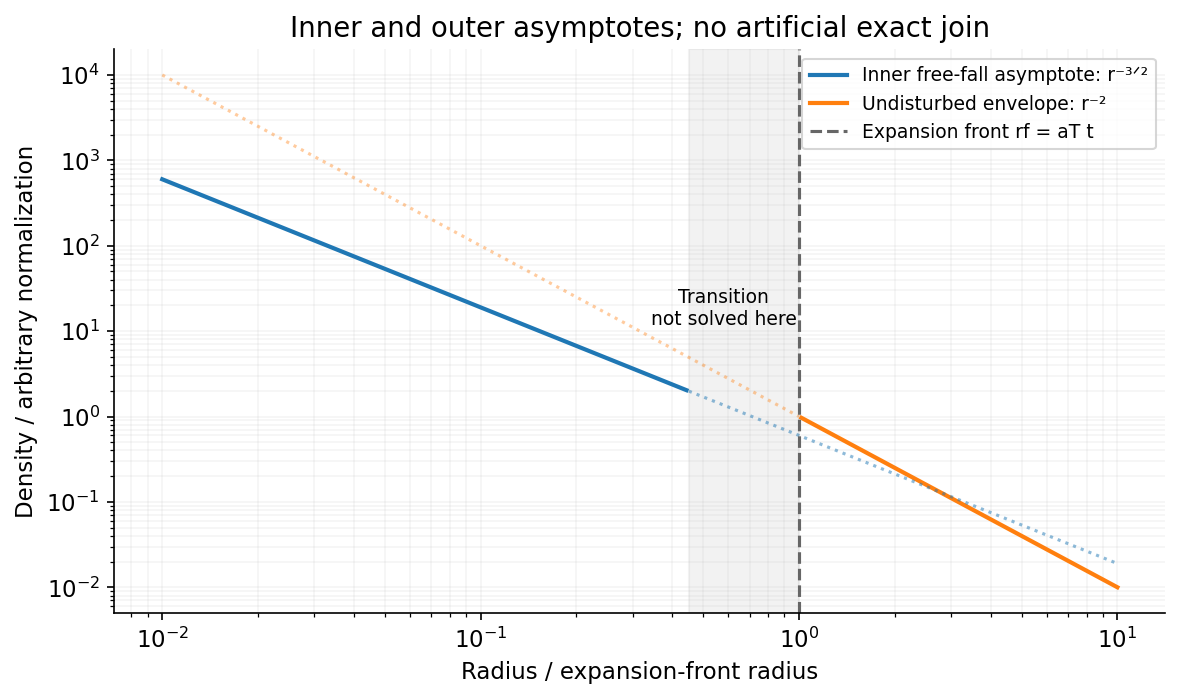
An inside-out collapse has a freely falling inner density slope distinct from the undisturbed isothermal envelope
. Source. Details. At distance , one grain intercepts power through its projected area and emits through its full surface:The blackbody dust sublimation radius follows by setting :Here the supplied luminosity is . The grain radius cancels because both cross-sections scale as . The temperature exterior to this boundary scales as . This estimate assumes isotropic illumination, no shielding, and unit absorption/emission efficiency as specified; real grain emissivities can change it. The numerical evaluation uses the external conversion values and .[ref]
CODATA recommended values of the fundamental physical constants 2014 by National Institute of Standards and Technology. Stefan-Boltzmann constant, rounded at the precision relevant here
The dust-cooled equilibrium is thermally stable under the stated constant irradiation, with fixed dust properties and dust-to-gas ratio. At a fixed position, absorbed power per grain is independent of its temperature, while emission is . A positive temperature perturbation increases cooling, causing a restoring energy loss; a negative perturbation reduces cooling, allowing reheating.
For heat capacity of a grain together with its thermally coupled gas,so the perturbation decays. The thermal stability of externally heated blackbody dust relies on remaining below sublimation with the grain population intact; destruction, variable illumination or finite dust-gas equilibration can change the response. An isobaric parcel with a fixed grain-to-gas ratio has the same restoring sign when heating and cooling are compared per particle.
First specify the perturbation: take fixed gas density, fixed ionic abundance and the same temperature-independent heating, so thermal stability requires at an equilibrium. Let , be the collider density and the atomic density. A two-level optically thin balance isThe critical density of an atomic transition is approximately . At low density, each rare collisional excitation is followed by an escaping photon, soThe isochoric thermal stability of a collisionally excited line therefore givesAt the linear restoring coefficient vanishes; the cooling maximum is marginal to first order and is not robust two-sided stability.
At high density, collisional de-excitation competes successfully with radiative decay, and collisions establish local thermodynamic equilibrium level populations. Detailed balance gives , where . The cooling is thenThus the high-density fixed-density branch is stable for finite , becoming weakly restoring as the upper fraction saturates at high temperature. It is incorrect to retain the low-density factor in the radiative cooling law once populations are thermalized.[ref]
AGN Emission Lines by Hagai Netzer. Section2.2: collisional excitation, critical density and the high-density Boltzmann limit
The isobaric thermal stability of a two-level coolant is a distinct question. If the intended heating is a fixed rate per particle, then and stability tests the cooling per particle. The low-density boundary becomes ; the high-density cooling per particle remains proportional to , so remains stable. If instead heating is constant per volume, the isobaric low-density boundary is , and the high-density stability condition is . The source gives no pressure constraint or explicit heating normalization: the boxed result is the fixed-density answer, with these conditional alternatives stated to avoid asserting a universal boundary.
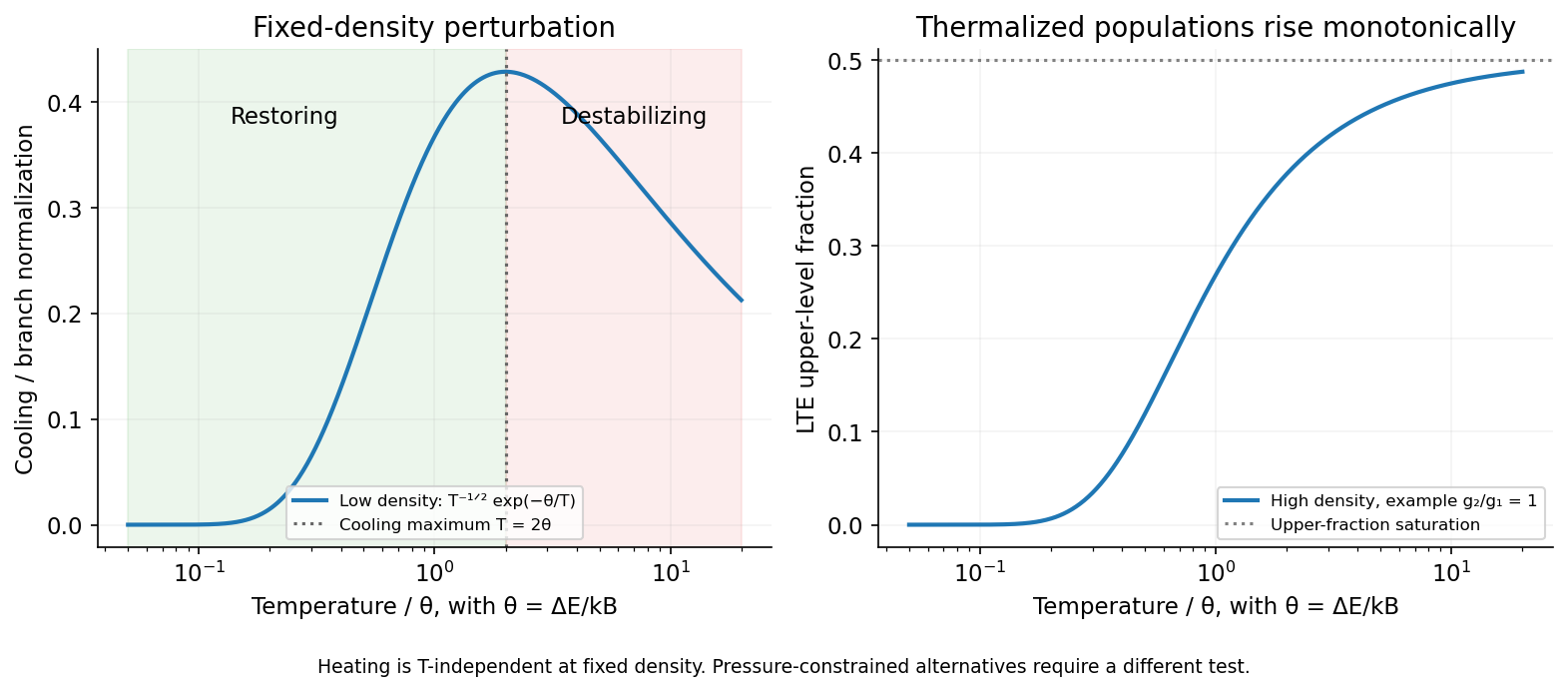
Low-density collisional line cooling has a temperature maximum, whereas high-density LTE emission rises toward saturation
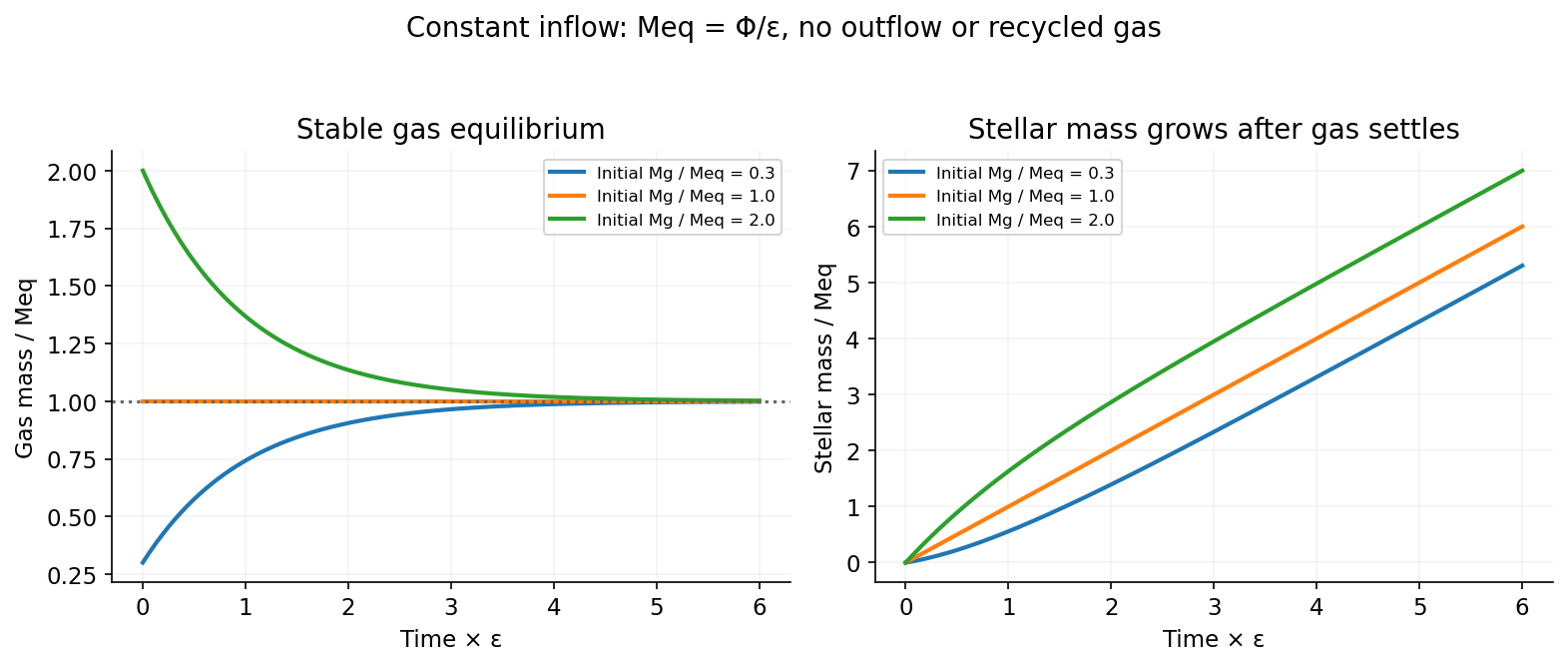
. Source. Details. For constant inflow and efficiency , with no recycling or outflow, mass conservation gives the constant-inflow gas regulator solution:The equilibrium is stable: a gas-mass perturbation obeys . At late times the star formation rate approaches , while the gas reservoir approaches a constant.
Integrating with gives the stellar mass in a constant-inflow gas regulator:It also follows immediately from . The gas mass equilibrates; the stellar mass generally keeps growing. With , these reduce to exponential gas depletion and .
A constant inflow is implicit in the requested steady asymptote, not automatic for an arbitrary prescribed rate. For time-dependent the exact integrating-factor result isa constant late-time gas mass then requires a corresponding asymptotically steady supply. Both printed mark groups remain in this single unlettered continuation of part(a).
Let be the separation of galaxy centres and a small displacement from the satellite centre along the line of centres. Expanding the central point-mass field gives the radial differential accelerationInside a uniform-density satellite, the restoring self-gravity isComparing the two at the same displacement yields the differential-gravity disruption limit of a uniform satellite:The satellite radius cancels because both accelerations are linear in . This is the instantaneous tidal-gravity estimate requested by the given criterion, not a full rotating Roche calculation. Including centrifugal terms for a circular corotating orbit replaces the radial coefficient two by three, giving while preserving the required scaling. An eccentric orbit requires checking the stronger tide near periapsis, and extended density profiles require a more detailed restoring-force calculation.
Put and let , be constant background matter fractions. Define the total matter perturbation and the relative mode . Adding with the background weights and subtracting the two given equations respectively givesThe total and relative density modes of two pressureless matter fluids are consequentlyThese are the general consequences of the supplied equations; a single ratio additionally needs initial-mode assumptions.
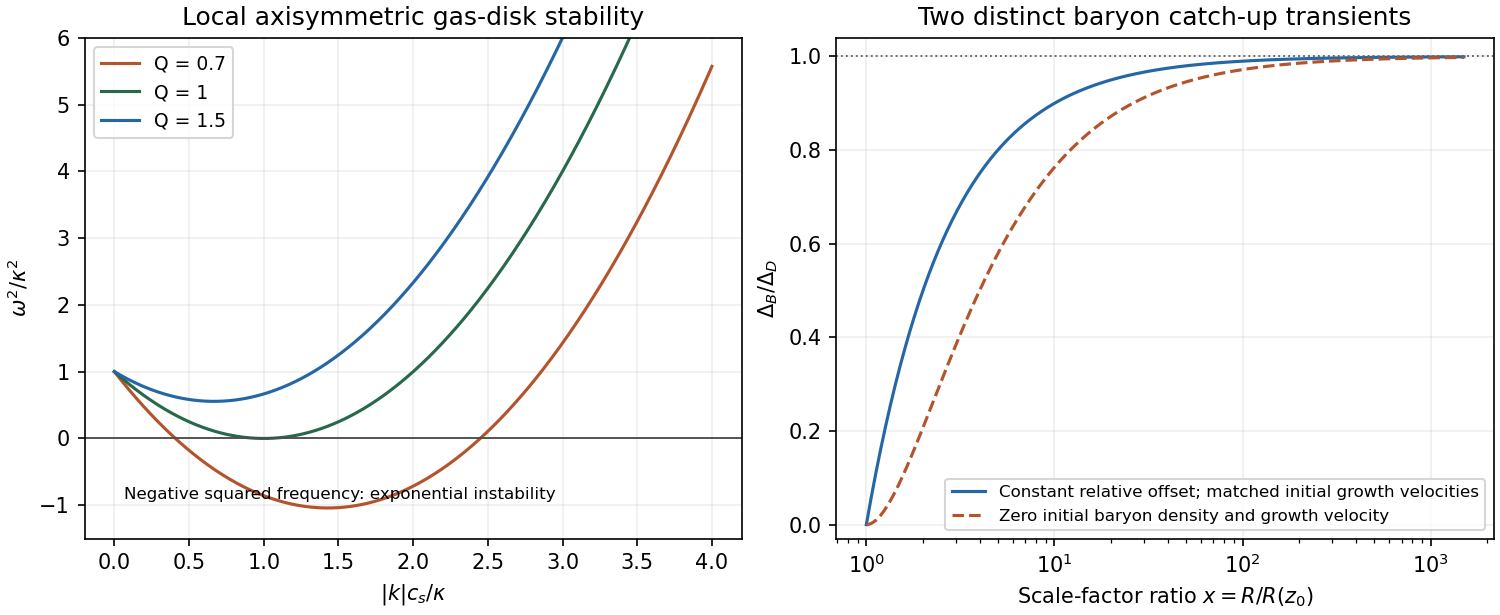
For the usual dark-matter-dominated growing-mode approximation, take , neglect the decaying modes, and set the relative-velocity mode . Then . With at recombination, , so the baryon catch-up approximation after recombination isAt redshifts , replacing by gives the printed . The printed relation is a high-redshift approximation with a specified relative mode, not an exact identity for arbitrary solutions of the two-fluid equations.
For example, retaining a finite baryon fraction with a growing total mode and constant relative mode gives, with ,Alternatively, if initially both and while the dark-matter growing mode is already present, then in the dark-matter-dominated limit the relative transient is not zero andThis shows why the missing initial-velocity convention matters. TODO: the source does not supply the initial relative velocity or a baryon-fraction approximation; those inputs are needed to select the quoted special case uniquely. The general solution and conditional specializations above remain valid.
The physical conclusion is robust: after decoupling, baryonic gas can fall into pre-existing dark-matter potential wells and its fractional density perturbation catches up. The absolute constant offset need not vanish; it becomes small relative to the growing common mode. The pressureless approximation applies on scales above the baryonic Jeans scale and while perturbations remain linear; subsequent collapse requires nonlinear treatment.[ref]
Cosmology by David Tong. Sections3.1–3.3: matter growth, decoupling, Jeans support and dark-matter seeds
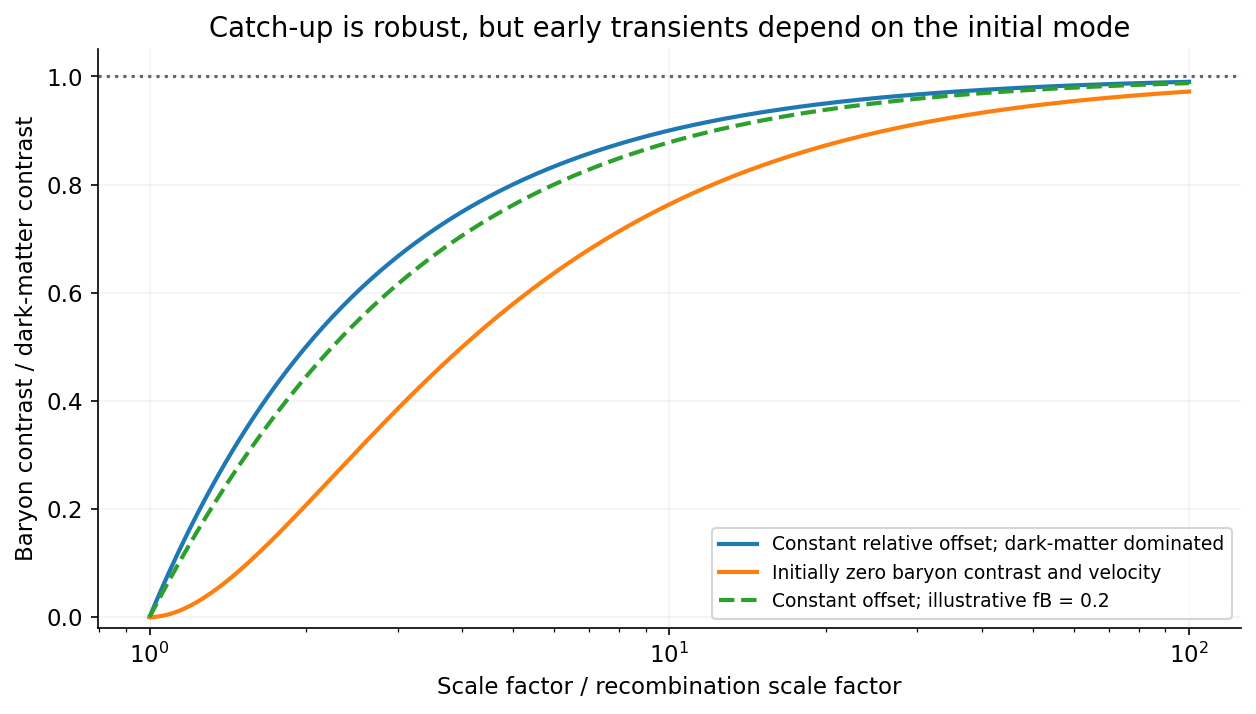
Baryons approach the dark-matter density contrast, with transient behaviour set by the initial relative velocity
. Source. Details. [ref]
https://www.whatdotheyknow.com/request/natural_science_tripos_physics_e_2/response/2340776/attach/2/FOI%202023%20399%20Zahid%20materials.pdf?cookie_passthrough=1. Original public PDF, physical pages 669–671
virial pressure-radius curve with uniform-sphere binding energy. Put . Isothermality makes , so the virial theorem givesThe curve crosses zero at , rises to its maximum atthen decreases toward zero at large radius. Since , a cloud displaced outward at fixed external pressure has a restoring pressure deficit only on the descending branch. Thus the homologous, isothermal radial mode is stable for , unstable for , and marginal at . The negative-pressure branch is not a physical equilibrium with a positive confining pressure. This conclusion uses the stipulated gravitational-energy approximation, not the exact isothermal density profile.
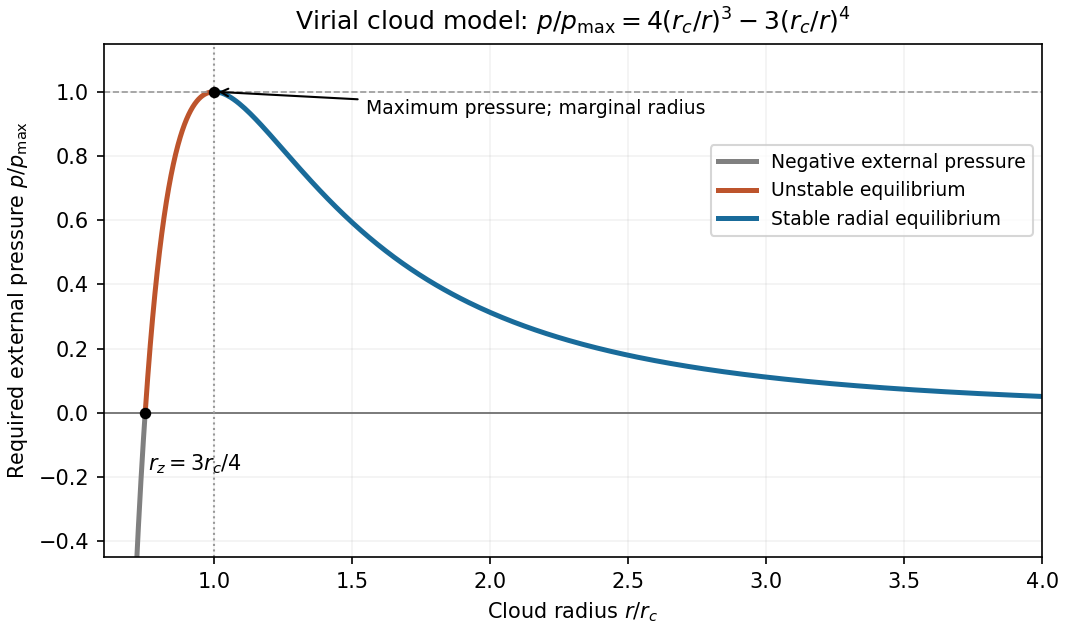
Original pressure-radius curve and stable versus unstable branches of the stipulated virial cloud model
. Details. critical mass from a virial pressure turning point. At the turning point, ; henceUsing the cloud's mean density , the condition becomesUsing the boundary density instead changes the numerical coefficient, not this scaling. The coefficient should not be identified with the exact Bonnor-Ebert sphere threshold because the assumed potential energy is different.
mass and luminosity weighting of a stellar initial mass function. Impose finite birth-mass cutoffs . The stellar birth mass and main-sequence luminosity scale asFor a broad mass interval, the low-mass end controls the first integral and the high-mass end the second. Per logarithmic mass interval the weights are respectively and . Finite lifetimes remove massive stars from an aging population, so the luminosity conclusion applies while those stars remain on the main sequence.
exponential closed-box gas consumption. The gross formation rate is , but the permanent locking rate is . The instantaneous recycling approximation and mass conservation give , . ThereforeHere means surviving locked stellar mass in the galactic gas fraction, not the cumulative gross mass that has passed through star formation.
locked-mass and returned-mass yield conventions. Pre-existing metals are locked at rate ; the stipulated newly produced metal source is . ThusFor and initially pristine gas,The effective yield is per unit permanently locked mass; it is not the source parameter . For , and the direct time equation gives . For , the explicitly stipulated metal source vanishes, so this particular enrichment model gives . Constant yield is a trace-enrichment approximation; the formal logarithmic divergence as gas is exhausted must not be interpreted as a physical metal fraction exceeding one.
backward extrapolation of exponential closed-box star formation. Denote the present age of the universe by . With the last paragraph's ,TODO: a present age of the universe or cosmology is needed for a unique numerical estimate. For the explicitly illustrative choice , this is about , requiring of gas at that epoch in the same model. This is an extreme history for a present Milky-Way-like system, although intense high-redshift star formation by itself is not forbidden.
The extrapolation forces a fixed gas reservoir to decline exponentially over many gas-depletion times. Gas accretion, outflows, evolving gas density and star-formation efficiency, delayed recycling, and galaxy assembly break that assumption. The empirical disk-averaged relation is not a universal constant-efficiency law for all gas: the original measurements combined Balmer series H-alpha, atomic gas, carbon monoxide and infrared data, with tracer calibration and dust corrections entering the inference.[ref]
The Global Schmidt Law in Star Forming Galaxies by Robert C. Kennicutt Jr.. Abstract: observed tracers, sample, and fitted index
Cosmological calculations explicitly support continuing cold-gas supply to rapidly forming high-redshift galaxies, providing a physical alternative to this closed-box backward extrapolation.[ref]Cold streams in early massive hot haloes as the main mode of galaxy formation by Avishai Dekel and others. Abstract: stream-fed galaxies and comparison with observed abundance
Radial epicyclic motion. At fixed specific angular momentum, use and . A circular orbit at obeys . Expanding gives , whereFor the radial epicyclic frequency describes simple harmonic motion. The angular correction follows from conservation of angular momentum, , and describes an epicyclic motion around the guiding circular orbit.
Stabilizing terms. In the given local fluid dispersion relation, is rotational support, important at long wavelength; is random-motion or pressure support, important at short wavelength. The term is destabilizing self-gravity. Although the wording refers to stellar dispersion, this algebra uses the supplied fluid approximation; a collisionless stellar treatment has a reduction factor and a different numerical normalization.[ref]
On the Gravitational Stability of a Disk of Stars by Alar Toomre. Abstract and Sections II–V: collisionless stability threshold and random-motion support
Axisymmetric threshold. For , set . Completing the square givesThus gives local axisymmetric oscillatory stability; gives a growing band, withAt , the minimizing mode has zero frequency and is marginal, not a strictly restoring oscillation. Local axisymmetric stability does not establish stability to every global nonaxisymmetric mode.
long-wave and short-wave branches at marginal Toomre stability. For and ,The long-wavelength branch, using the minus sign, requiresThese endpoints are the inner and outer Lindblad resonance conditions. The stated dispersion relation does not restrict every wave solution to that interval. Its plus-sign short-wavelength branch has even outside it: for example, gives and satisfies the equation. Additional branch selection or resonant absorption physics would be needed for an absolute confinement claim. No such condition is supplied.
Toomre stability radius of a flat-rotation disk. With , . Using ,The supplied local model therefore predicts stable radii below about , marginality at that radius, and axisymmetric instability farther out while its assumed constant surface density and thin-disk approximation remain applicable. An infinite constant-density, flat-rotation disk is an idealization, not a global self-consistent galaxy model.
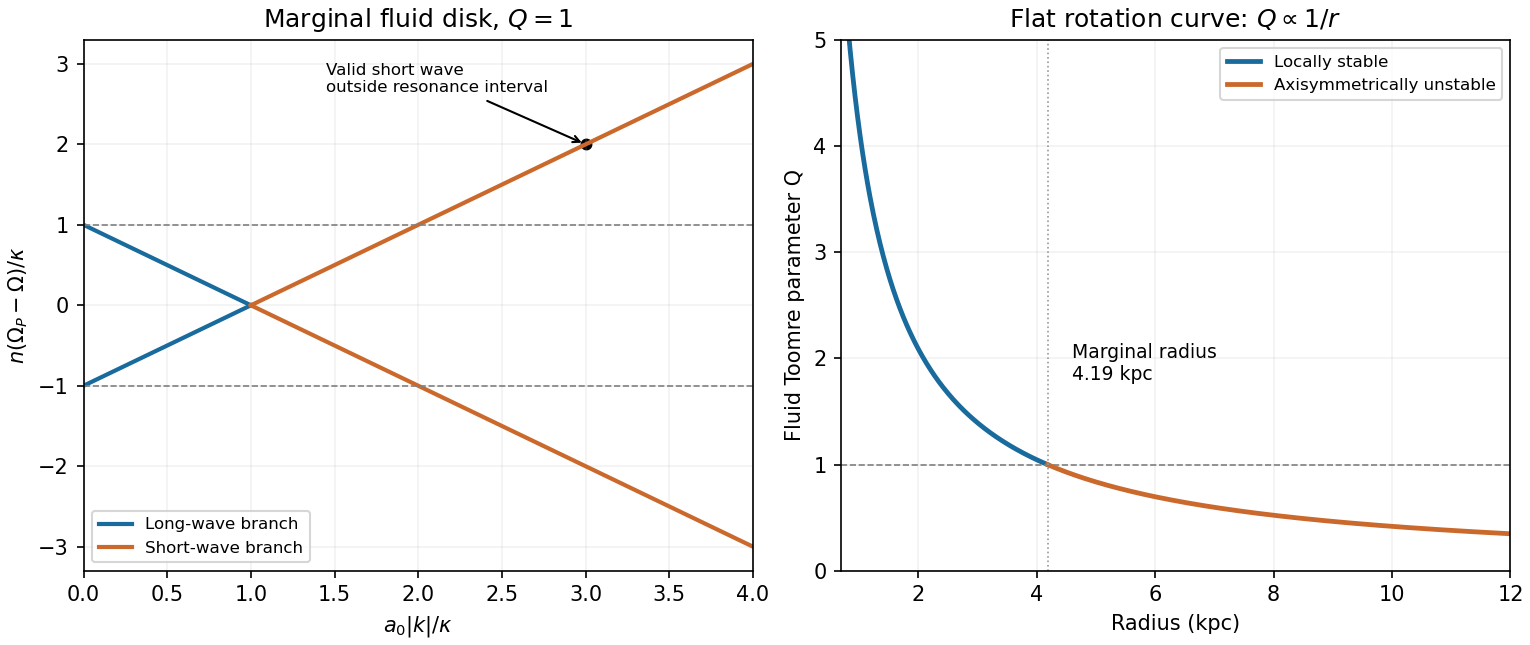
Original marginal-disk dispersion branches and radial Toomre parameter, showing the long-wave restriction and the surviving short-wave branch
. Details. For a monatomic ideal gas, write the thermal energy density as . At low optical depth, radiative loss uses an astrophysical cooling function, often written , while contains heating. At fixed density the net radiative gas cooling time is approximately when the denominator is positive; a cooling flow closer to constant pressure must include enthalpy and compressional work. Comparing this time with the free-fall time of a uniform sphere determines whether pressure can be lost during gravitational contraction.
Hot ionized gas cools by bremsstrahlung and recombination; collisional excitation followed by photon escape supplies atomic and metal-line cooling at lower temperatures. molecular line cooling through rotational or vibrational lines and dust thermal emission become important in cold dense gas. Abundances, ionization state, density-dependent collisional de-excitation, and photon trapping all change the cooling function. Optically thick gas requires radiative transfer, not a simple local density-squared loss law.
Heating comes from photoionization, grain photoelectric heating driven by ultraviolet light, cosmic rays, shocks, turbulent dissipation and compression. photoionization heating deposits the photon energy above the ionization threshold as electron kinetic energy. A thermal equilibrium satisfies ; its stability depends on how the net loss changes under the relevant pressure or density constraint, not merely on equality. Different stable balances permit a multiphase interstellar medium. Spectral-line ratios constrain temperature and ionization, but interpreting them requires density diagnostics, interstellar extinction corrections and a radiation-field model.
A cold self-gravitating core initially contracts on a dynamical scale if cooling prevents pressure from halting collapse. Increasing optical depth eventually traps radiation and forms a pressure-supported first hydrostatic core. Dissociation of molecular hydrogen absorbs compressional energy, softens the equation of state and triggers a second protostellar collapse to a compact protostar. Rotation produces a disk; angular-momentum transport permits continuing accretion, while outflows remove some mass and angular momentum.
An accreting object's luminosity includes a contribution of order , with a coefficient set by where accretion energy is radiated or retained. After accretion subsides, gravitational contraction supplies internal luminosity over the Kelvin-Helmholtz cooling time . Hydrostatic contraction heats the interior even while energy is radiated, as follows from the virial theorem and the negative heat capacity of a virialized gravitational system. accretion luminosity must not be substituted for in the contraction time without an energy-budget justification.
Low-mass, nearly fully convective pre-main-sequence stars contract down a Hayashi track at roughly constant effective temperature and decreasing radius and luminosity. A developing radiative core can lead onto a Henyey track toward higher effective temperature; the route depends on mass and opacity. The deuterium-burning energy-generation rate can temporarily moderate contraction, but sustained core hydrogen burning marks arrival on the main sequence. Massive objects may begin hydrogen burning while still accreting, and substellar objects never establish long-lived hydrogen burning. An infrared spectral class reflects envelope and disk emission as well as inclination and interstellar extinction, so it is not a unique stellar age or interior evolutionary track.
Stellar radiation, stellar winds and supernovae return energy, momentum, mass and metals to surrounding gas. Heating, ionization, turbulent support and gas removal can reduce subsequent star formation; swept-up shells can also compress gas locally. Whether thermal energy drives an outflow depends on its radiative gas cooling time relative to expansion: radiative losses can remove energy while leaving substantial momentum transfer. Thus deposited energy alone does not specify the dynamical effect.
The galactic gas regulator has mass budget , where is the returned fraction and is the mass-loading factor. In a quasi-steady state, . This connects feedback to the available gas supply. A wind's kinetic power and momentum flux must fit the source budget and gravitational binding cost. Gas that fails to escape may form a galactic fountain and later return; preferential metal loss changes chemical evolution.
Absorption against a galaxy's stellar continuum provides a concrete outflow test: compare interstellar sodium absorption with the systemic velocity and stellar absorption spectrum. A primary starburst survey found blueshifted interstellar absorption and an inclination dependence consistent with minor-axis outflows. Its saturated lines also illustrate why velocity detection is more direct than a unique column density or mass flux.[ref]
Absorption-Line Probes of Gas and Dust in Galactic Superwinds by Timothy M. Heckman and others. Abstract: NaD spectra, systemic velocities, viewing angle and optical depth
Deprojection, covering fraction, ionization, radius and the unseen hot phase limit total outflow-rate estimates.An accreting supermassive black hole adds radiation, winds and astrophysical jets. Coupling these to the interstellar or circumgalactic medium can suppress cooling or expel gas, especially in deep potentials where stellar driving alone may be inadequate. Jet cavities, line-emitting gas and multiphase outflows test different channels; coexisting activity and low star formation alone do not prove a causal feedback history.
Small primordial fluctuations seed later structure. For adiabatic cosmological perturbations on scales outside the horizon, the uniform-density curvature perturbation is conserved when the non-adiabatic pressure perturbation and the decaying mode can be neglected. A density contrast outside the horizon is gauge-dependent, so its apparent power-law growth should not be confused with directly measured local collapse.
For subhorizon, pressureless matter, the linearized continuity equation, Euler equation and Poisson equation combine intoHubble expansion damps peculiar motion; self-gravity amplifies overdensities. During radiation domination, radiation pressure drives acoustic oscillations and cold dark matter growth after horizon entry is only logarithmic. During matter domination the growing and decaying solutions are and . Dark-energy domination later suppresses growth relative to the matter-era law.
For a pressure-supported fluid the Fourier-mode equation also contains , giving a Jeans length separating acoustic support from gravitational growth. Before recombination, baryons are tightly coupled to photons and oscillate rather than freely following dark matter. Silk damping from photon diffusion damps small-scale photon-baryon fluctuations; after decoupling, baryons can fall into dark-matter potential wells. free streaming smooths species-dependent scales and distinguishes cold from warm or hot dark matter.
Schematically, the linear matter power spectrum can be written under the usual primordial-curvature normalization. The cosmological transfer function records horizon entry, matter-radiation equality, acoustic physics and damping; the linear growth factor records later amplification. density contrasts approaching unity require nonlinear collapse and halo formation beyond this approximation. cosmic microwave background anisotropies and galaxy clustering test the same initial perturbations through different transfer histories; galaxy bias, redshift-space distortions and observational selection enter the galaxy comparison.
[ref]
https://www.whatdotheyknow.com/request/natural_science_tripos_physics_e_2/response/2340776/attach/2/FOI%202023%20399%20Zahid%20materials.pdf?cookie_passthrough=1. Original public PDF, physical pages 575–577
heating and cooling balance in the interstellar medium depends on density, ionization, radiation and shielding. Write net cooling per volume as . Ultraviolet grain photoelectric heating is important in diffuse neutral gas; photoionization heats ionized regions, cosmic rays penetrate shielded gas, and shock waves from stellar winds and supernovae supply hot gas. Cooling includes collisionally excited atomic lines, fine-structure metal lines at lower temperatures, molecular lines in shielded clouds, and continuum radiation and dust emission where appropriate. The heating efficiency and cooling abundances matter as much as a nominal temperature.
A multiphase interstellar medium can contain a cold neutral medium near , a warm neutral medium and warm ionized medium near , a hot ionized medium near , and still colder molecular clouds. Cold and warm atomic equilibrium branches can coexist at similar thermal pressure over a finite pressure interval; this is a calculated heating/cooling balance, not a requirement that all galactic gas have the same pressure.[ref]
The Neutral Atomic Phases of the ISM in the Galaxy by Mark G. Wolfire and others. Abstract: cold and warm neutral equilibrium temperatures and coexistence between minimum and maximum pressures
For net cooling per unit mass , an isobaric perturbation at equilibrium obeys . Thus a negative constant-pressure cooling derivative is thermally unstable: a cool perturbation cools further and condenses. Sound crossing must be fast enough to maintain pressure balance; thermal conduction suppresses sufficiently short wavelengths. Supernova-driven motions, magnetic pressure, finite cooling times and interfaces make the actual medium dynamic, so equilibrium branches describe useful phases rather than a static collection of perfectly separated components.
differential rotation winds a material arm because . A spiral density wave instead has a pattern speed different from the material speed: stars and gas can pass through its crests. Collective self-gravity, orbital resonances and shear can sustain or repeatedly amplify non-axisymmetric patterns; a visible spiral need not be a single permanent rigid material structure.
For a razor-thin gas disk, local tightly wound disturbances satisfyRotation stabilizes long wavelengths and pressure stabilizes short ones. Minimizing the axisymmetric right-hand side over gives andfor local axisymmetric stability. A collisionless stellar disk instead has ; the radial random velocity dispersion is not literally a gas sound speed.[ref]
On the Gravitational Stability of a Disk of Stars by Alar Toomre. Abstract: collisionless axisymmetric threshold and coefficient 3.36
Local axisymmetric stability does not guarantee global disk stability. Gas and stars gravitate together, thickness modifies the short-scale force, and a disk with may still have spiral or bar responses. Dissipation in gas can generate shock waves and concentrate star formation near a spiral crest; stellar random motions tend to reduce the collective response.
Galactic star formation is limited by how much gas becomes cold, shielded and self-gravitating, and by how long it remains in that state. A useful local estimate isThe star-formation efficiency per free-fall time absorbs the fact that turbulence, magnetic support and stellar feedback prevent all eligible gas from collapsing in one free-fall time of a uniform sphere. Rotation and disk stability influence the supply of dense clouds, while gravitational collapse and gravitational fragmentation operate inside them.
For galaxy-averaged measurements, the Kennicutt–Schmidt law has , with the classic mixed spiral/starburst sample giving . This empirical relation was obtained using H-alpha and far-infrared star-formation tracers together with atomic-hydrogen and CO gas measurements.[ref]
The Global Schmidt Law in Star Forming Galaxies by Robert C. Kennicutt Jr.. Abstract: sample, tracer combination and fitted index 1.4 plus or minus 0.15
Dust attenuation, contamination by older stellar heating, the stellar initial mass function and the CO-to-molecular-gas conversion must be controlled. A disk-averaged total-gas exponent is not automatically a small-scale cloud law.Young stars then photoionize gas, drive winds and eventually inject supernova energy and momentum. These processes can disrupt clouds, sustain random motions or expel gas; radiative cooling and fresh inflow rebuild the cold supply. Large-scale star formation is a regulated conversion of gas, rather than unimpeded free fall of the entire disk. A long gas-depletion time is compatible with short galactic dynamical times in the dense fraction.
A dense cloud core first collapses when self-gravity overwhelms its effective support. While radiation escapes readily, compression can remain approximately isothermal and the Jeans mass decreases as density rises, encouraging gravitational fragmentation. Angular momentum usually leads to a disk rather than unrestricted spherical infall.
As the central optical depth increases, cooling becomes slower than compression and pressure produces a first hydrostatic core. molecular hydrogen dissociation near absorbs compressional energy and lowers the effective adiabatic response, permitting a second collapse of a protostar. After dissociation the gas stiffens and a much more compact stellar core forms. An accretion shock and surrounding disk then convert infall energy into radiation. A small central core forms before most of the envelope arrives, as demonstrated in radiation-hydrodynamic collapse calculations.[ref]
Numerical Calculations of the Dynamics of a Collapsing Proto-Star by Richard B. Larson. Abstract: nonhomologous central core formation, subsequent envelope accretion and infrared reprocessing
The isothermal inside-out collapse of a singular isothermal sphere model provides one idealized supply law, , but rotation, magnetic fields and an unsteady reservoir modify real accretion. Its luminosity scale is . Dust can absorb the emerging short-wavelength radiation and re-emit it in the infrared, so an embedded source need not have a directly visible stellar photosphere.
As envelope accretion declines, gravitational contraction becomes important on the Kelvin-Helmholtz cooling time . deuterium-burning energy-generation rate can temporarily influence the radius; sustained core hydrogen burning eventually establishes the main sequence if the final mass is sufficient. A low-mass convective object approaches along a Hayashi-like track, while more massive objects need not share that track. accretion, contraction and nuclear burning are distinct energy sources, and a protostar is not generally a fixed-mass object.
mass and energy signs. The enclosed mass is , so . The negative sign printed in that equation cannot describe positive enclosed mass. Use the physical sign and define gravitational potential energy by
Boundary-pressure virial theorem. Multiply hydrostatic equilibrium by and integrate. The left side is , while the right side is . The central boundary contribution vanishes when and the outer pressure is . ThusA finite external pressure is compatible with a gravitationally self-contained cloud, but is not the zero-surface-force notion of isolation. External ram stress or mass flow would require additional terms.
radiation budget of monatomic cloud collapse. For an ideal gas with fixed , the specific internal energy is . Therefore the pressure integral is . Cold monatomic hydrogen has when only translational degrees of freedom matter. With negligible final surface pressure, , so . If the initial cloud is sufficiently extended and cold that , the emitted energy isBeing initially at rest alone does not set its binding energy to zero. If the initial total energy is appreciable, retain ; a different equation of state also changes the half-energy result.
Inside-out accretion. The combination of and with dimensions of mass per time iswhere dimensional analysis leaves the dimensionless coefficient undetermined. An isothermal gas keeps constant, giving constant supply in the self-similar idealization. A front at radius and an isothermal mass scale give the same scaling. The front's swept mass is not automatically the accreted central mass; the coefficient requires a dynamical similarity solution.[ref]
Self-Similar Collapse of Isothermal Spheres and Star Formation by Frank H. Shu. Inside-out similarity model; only the dimensional scaling is required here
constant-radius accretion energy budget. If all available accretion power is radiated at the fixed radius, . Neglecting the seed mass,This equals precisely whenThe positive sign in the final printed energy condition is inconsistent with the earlier use of negative gravitational potential energy. Equivalently its positive right side must denote the binding-energy magnitude . A general structural coefficient leaves a mismatch unless under these other idealizations. Radiation trapped in the object, outflows or release over a different radius also change the budget.
Which temperature? With and fixed , . If this power emerges thermally from area , the accretion-powered effective-temperature scaling iswhen the seed mass is negligible. This is the radiating surface's effective temperature. A homologous ideal-gas interior instead has virial temperature . TODO: the word temperature does not specify surface versus interior. The luminosity argument gives ; an interior temperature requires a structural and transport model, with the corresponding virial scaling only under the stated homology assumptions.
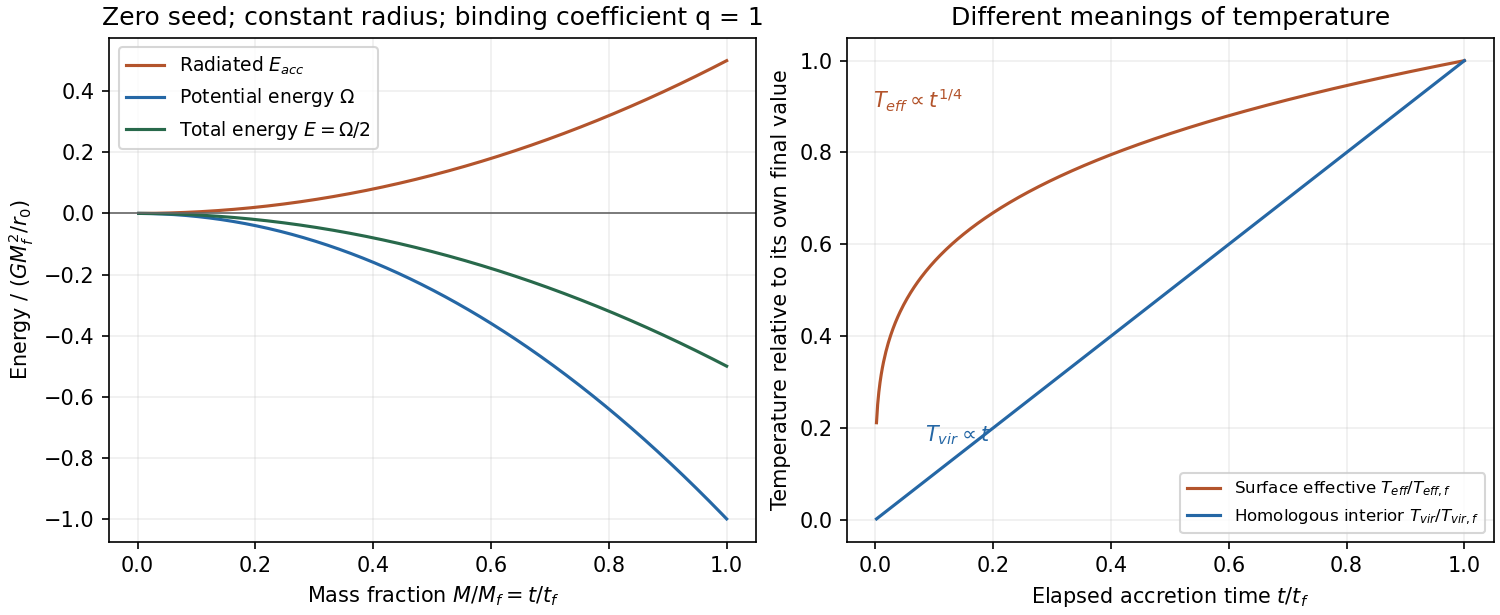
Original constant-radius accretion energy budget and distinct surface-effective and virial temperature scalings
. Details. Growing and decaying modes. Neglect pressure and insert the Einstein-de Sitter background. A trial givesThereforeThe quoted growth law selects the growing mode; arbitrary initial data can also contain the decaying one. In a static homogeneous Jeans model, , so an unstable mode grows exponentially, . Expansion introduces the damping term and a falling background density, yielding power-law growth instead. If the wavevector in the supplied pressure term is comoving, that term would need ; the pressureless result does not depend on this convention.
Amplitude problem. Using the stated recombination epoch, matter-era growth from then until today is only about . A baryonic density perturbation of order would reach merely , far below the order-unity regime needed for nonlinear collapse. photon coupling also prevents baryons from freely collapsing before recombination. The observed microwave temperature contrast is not an exact direct measurement of baryon density contrast at every scale: acoustic transfer and gravitational redshift matter. The estimate expresses the insufficient growth of tiny photon-coupled baryonic seeds, not an exact conversion between the two observables.
Coupled gravitational response. Both pressureless components respond to the same perturbed potential. The equations areTheir difference obeys , where . Thus and, in Einstein-de Sitter, .
Catch-up branch and its condition. With dark matter dominating the source and in its growing mode, write . The full baryon solution isTODO: an initial relative growth velocity is not specified. The requested baryon catch-up approximation after recombination neglects the relative decaying mode, . Defining then givesThis branch applies at and after and has and matched baryon/dark-matter growth velocities at that epoch. It does not follow uniquely from vanishing initial baryon density contrast alone. If both and its initial time derivative vanish at , the zero-initial-baryon-velocity catch-up transient instead givesBoth approach unity for . The displayed target therefore needs its stated no-relative-decaying-mode assumption; a finite baryon fraction modifies the transient further.
Physical consequence. cold dark matter is not held to the radiation by Thomson scattering, and can build gravitational wells before baryon decoupling, with appreciable matter-era growth after equality. Its growing perturbations then attract baryons once pressure and radiation drag become unimportant. The relative offset stays constant or decays while the common mode grows, so baryons catch up. Nonlinear structure need not grow solely from the tiny baryonic perturbation inferred at decoupling. cold dark matter growth during radiation domination is slower than the matter-era law, and the stated formula is neither a radiation-era nor a nonlinear-collapse solution.


Articles by others on the same topic
There are currently no matching articles.