Original source: physical PDF pages 471–473; paper pages 1–3. All optional notes and all three questions are answered. The temperature estimate in Solution 3 retains an unspecified mean particle mass.
gas heats when compression, shocks or absorbed radiation increase its internal energy. Important sources include accretion shocks, stellar winds, supernovae, photoionization, photoelectric emission from interstellar dust, cosmic rays and energy deposited by active galactic nuclei. photoionization heating uses the photoelectron energy above the ionization threshold; compression contributes mechanical work rather than photon absorption.
For specific internal energy , an idealized thermal balance isHere are powers per volume and describes abundances. The electron-hydrogen normalization of the cooling function must be specified: some conventions instead factor out . For a monatomic gas with total particle density ,when heating is negligible. Compare this with the dynamical time: rapid cooling permits loss of pressure support, whereas long cooling times allow a hot atmosphere to persist.
collisional excitation followed by spontaneous emission cools partially ionized gas; radiative recombination also produces continuum cooling. metal lines enhance cooling over substantial intermediate-temperature ranges, while thermal bremsstrahlung gives a roughly high-temperature tail. Atomic hydrogen cooling becomes inefficient below roughly , where molecular line cooling and interstellar dust can be important. inverse Compton scattering cools hot electrons against a colder radiation field. A tabulated cooling curve assumes a composition and ionization model; photoionization or nonequilibrium ionization can change it.[ref]
Thermal radiation processes by Jelle S. Kaastra and others. 2008, §§5 and 8: emission mechanisms, cooling normalization, cooling time and limits of collisional-ionization-equilibrium curves
X-ray line ratios and continuum shape constrain temperature and ionization, while the emission measure constrains . Turning that into a density and radiative gas cooling time also requires a geometry; unresolved clumping, foreground absorption and multiphase gas are important controls.
inside-out collapse of a singular isothermal sphere starts from an idealized static envelope,with constant isothermal sound speed . Collapse begins centrally after formation of a central mass. An expansion wave moves outward through the initially static envelope at the sound speed:“Expansion” describes the outward-moving information front; the gas behind it moves inward. The exterior remains close to its original equilibrium until the wave reaches it.
In the inner region, the central mass dominates and pressure becomes less important:The self-similar accretion scale is , where the dimensionless coefficient follows from the dynamical similarity solution, not from counting material swept by the front. Indeed, the initial mass enclosed by the front grows at , and some of that material remains in the infalling envelope. For fixed mean particle mass, . The original similarity calculation establishes the static outer and free-fall inner regimes.[ref]
Self-Similar Collapse of Isothermal Spheres and Star Formation by Frank H. Shu. 1977, pp. 488–497: expansion-wave collapse after central-core formation and the two radial density asymptotes
The model assumes spherical symmetry, isothermality and negligible rotation or magnetic stresses. An asymmetric optically thick spectral line alone does not establish infall: an optically thin systemic-velocity tracer and spatial maps help distinguish inward motion from rotation, foreground absorption and outflow.
galactic feedback couples star formation and black-hole accretion back to the gas supply. Stellar radiation, winds, supernovae and cosmic rays inject energy and momentum; active-galactic-nucleus feedback adds radiation, jets and winds powered by accretion. Heating, turbulence or gas ejection can suppress later star formation, while compression can sometimes promote it. Negative feedback permits self-regulation rather than unrestricted gas consumption.
Define the mass-loading factor . If the launch speed scales with the escape speed and the injected energy per stellar mass is fixed, conservation of energy suggests ; fixed injected momentum instead suggests . Coupling efficiencies, radiative losses and recycling change these ideal scalings. Thermal energy injected into dense gas can radiate away before driving an outflow, so an energy budget alone does not demonstrate effective feedback.
Radio-filled X-ray cavities provide a mechanical diagnostic. For a cavity containing a relativistic fluid with , its enthalpy is ; dividing by an estimated age gives a mechanical-power estimate. Chandra X-ray Observatory observations of the Perseus cluster revealed fronts and ripples associated with radio bubbles, interpreted as weak shocks and pressure waves that can transport jet energy into the cooling atmosphere.[ref]
A deep Chandra observation of the Perseus cluster: shocks and ripples by A. C. Fabian and others. 2003, abstract: radio bubbles, weak-shock fronts, ripples and the proposed heating/cooling balance
The test requires ambient density and temperature estimates, radio/X-ray spatial comparison, projected cavity volumes and an age model. Brightness edges must be distinguished from absorption and cool rims; wave energy is not automatically thermalized locally. These controls determine whether inferred mechanical heating can actually offset radiative cooling.
cold dark matter is nonrelativistic and effectively collisionless on the scales of interest. Its small velocity dispersion limits free streaming, allowing small-scale gravitational wells to survive. baryons coupled to photons undergo acoustic motion and damping before recombination; dark matter does not share that photon pressure, and provides potential wells into which baryons can later fall.
For a subhorizon pressureless perturbation, once a Newtonian treatment is applicable,During radiation domination the matter contribution to the background gravity is small; neglecting it gives . This slow subhorizon growth is the Mészáros effect. During matter domination,in an Einstein-de Sitter universe. Once approaches unity, linear theory fails and collapse, virialization and merging become important.
Modes entering the horizon during radiation domination therefore grow less before equality than longer modes entering later. This scale dependence is encoded in a transfer function, with a schematic linear matter power spectrum . cold dark matter supports hierarchical assembly; a sufficiently large warm- or hot-dark-matter free-streaming length suppresses small-scale structure. Superhorizon density contrasts change under a gauge transformation in cosmological perturbation theory, so the subhorizon growth laws should not be applied indiscriminately outside the horizon. The original cold-dark-matter formation model explicitly connects weak free streaming to the spectrum that seeds galaxies and clusters.[ref]
Formation of galaxies and large-scale structure with cold dark matter by George R. Blumenthal and others. 1984, Nature 311, pp. 517–525, abstract: collisionless cold particles, retained fluctuations and the post-recombination spectrum
For the radial epicyclic frequency, introduce the effective potential at fixed specific angular momentum : . A circular orbit at satisfies . A small radial displacement obeys . Differentiate at fixed before inserting the circular-orbit relation:For a flat rotation curve, , so .
In a perturbation proportional to , is the integer azimuthal mode number, giving arms for a nonaxisymmetric pattern. Its angular pattern speed is for a real frequency and ; is the unperturbed gas sound speed, or the specified effective fluid pressure-response speed. For growing patterns the angular phase speed uses . Axisymmetric modes have : their pattern speed is undefined, and one must use , not set the pattern-speed expression to zero.
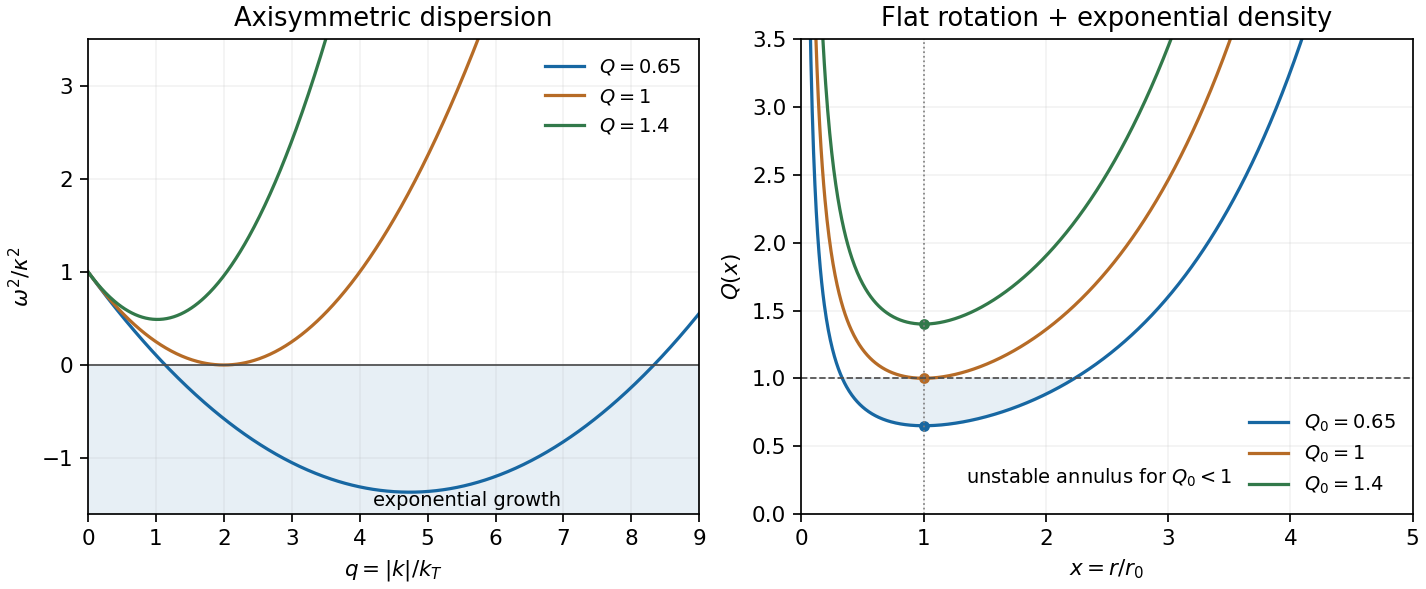
Define the Toomre parameter and Toomre wavenumber byThen givesFor , the minimum is negative precisely when . Thus this condition is necessary and sufficient for an exponentially growing axisymmetric mode within the given local razor-thin fluid model; is marginal. It is not a guarantee against global or nonaxisymmetric instabilities, and the collisionless stellar-disk criterion has a different pressure-response normalization.
The Toomre unstable band and fastest growth follow by minimizing :Here the growing branch has under the stated Fourier convention. Both signs of the radial wave number have the same growth rate. The unstable band is , where .
For the minimum Toomre parameter in an exponential flat-rotation disk with constant , put :The logarithmic derivative is , so the unique minimum occurs at . Both as and as . Hence inner and outer regions are stable within this idealized rotation law, even when an intermediate annulus is unstable. The whole disk is strictly stable in this local axisymmetric test ifEquality makes the ring at marginal. The central conclusion uses the assumed flat rotation curve all the way inward; real central rotation laws need not retain that limit.
The normalized cycloid hasThe initially expanding perturbation reaches maximum radius at , , then formally collapses to zero radius at , . A finite virialized object is assigned the conventional formation epoch ; random motions replace the pressureless point-collapse singularity. The cycloid alone does not describe that relaxation.
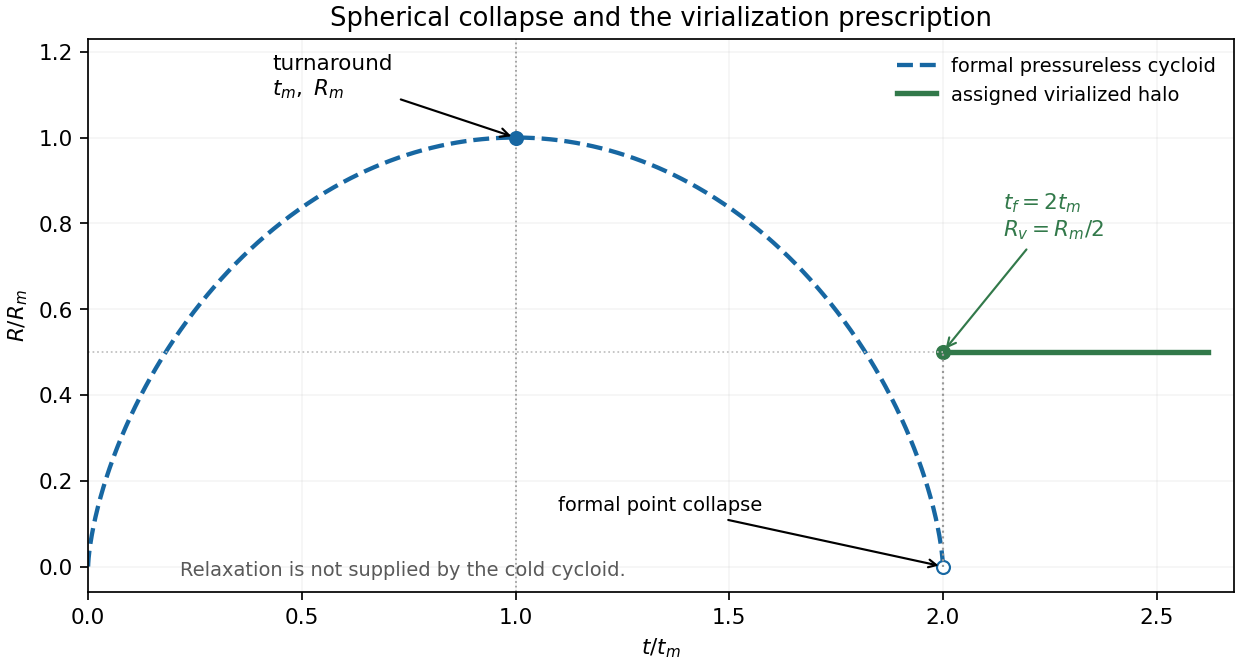


For the standard top-hat virialization estimate, write and retain the same gravitational structure factor at turnaround and final equilibrium. The coherent kinetic energy vanishes at turnaround, whereas the virial theorem gives in the final isolated equilibrium. conservation of energy givesThe final density is eight times the turnaround density. Meanwhile , so . The Einstein-de Sitter virial overdensity follows by combining these factors with the supplied turnaround contrast:The value 200 is a convenient rounded overdensity convention, not exactly the Einstein-de Sitter result.
The virial radius of a dark-matter halo follows from :The hydrostatic temperature of an inverse-square halo follows from hydrostatic equilibrium and the ideal gas law:Since and , cancellation of gives . ThereforeHere is a dimensionful mean particle mass, as specified in the paper; a dimensionless mean molecular weight would need multiplication by a particle-mass unit. The isothermal interior is a further halo idealization, not an exact continuation of the uniform top-hat profile used in the virial-overdensity estimate. Changing its gravitational structure factor in a literal energy comparison would change the turnaround-radius relation.
The formation redshift from halo mean density uses the cluster data, which imply . Thus, using the requested rounded convention,Using instead gives . In the Einstein-de Sitter time scaling the rounded-convention result is . Directly from the mass and radius,For the estimate, take mean particle mass , appropriate approximately to a hydrogen-helium mixture with complete ionization. This gives , or . The composition choice is additional input, not a value supplied by the examination; the boxed expression retains the result for any .
Articles by others on the same topic
There are currently no matching articles.