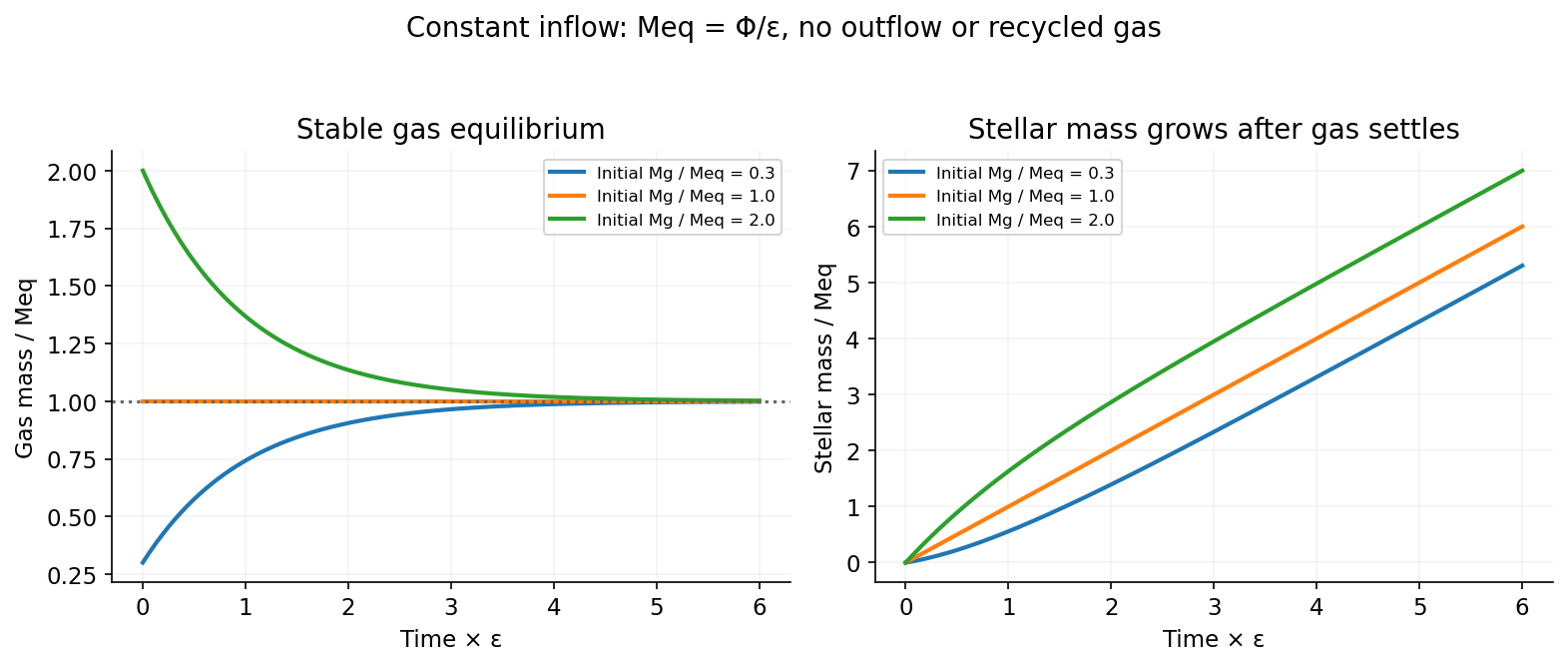
For constant inflow and efficiency , with no recycling or outflow, mass conservation gives the constant-inflow gas regulator solution:The equilibrium is stable: a gas-mass perturbation obeys . At late times the star formation rate approaches , while the gas reservoir approaches a constant.
Integrating with gives the stellar mass in a constant-inflow gas regulator:It also follows immediately from . The gas mass equilibrates; the stellar mass generally keeps growing. With , these reduce to exponential gas depletion and .
A constant inflow is implicit in the requested steady asymptote, not automatic for an arbitrary prescribed rate. For time-dependent the exact integrating-factor result isa constant late-time gas mass then requires a corresponding asymptotically steady supply. Both printed mark groups remain in this single unlettered continuation of part(a).

Let be the separation of galaxy centres and a small displacement from the satellite centre along the line of centres. Expanding the central point-mass field gives the radial differential accelerationInside a uniform-density satellite, the restoring self-gravity isComparing the two at the same displacement yields the differential-gravity disruption limit of a uniform satellite:The satellite radius cancels because both accelerations are linear in . This is the instantaneous tidal-gravity estimate requested by the given criterion, not a full rotating Roche calculation. Including centrifugal terms for a circular corotating orbit replaces the radial coefficient two by three, giving while preserving the required scaling. An eccentric orbit requires checking the stronger tide near periapsis, and extended density profiles require a more detailed restoring-force calculation.
Put and let , be constant background matter fractions. Define the total matter perturbation and the relative mode . Adding with the background weights and subtracting the two given equations respectively givesThe total and relative density modes of two pressureless matter fluids are consequentlyThese are the general consequences of the supplied equations; a single ratio additionally needs initial-mode assumptions.
For the usual dark-matter-dominated growing-mode approximation, take , neglect the decaying modes, and set the relative-velocity mode . Then . With at recombination, , so the baryon catch-up approximation after recombination isAt redshifts , replacing by gives the printed . The printed relation is a high-redshift approximation with a specified relative mode, not an exact identity for arbitrary solutions of the two-fluid equations.
For example, retaining a finite baryon fraction with a growing total mode and constant relative mode gives, with ,Alternatively, if initially both and while the dark-matter growing mode is already present, then in the dark-matter-dominated limit the relative transient is not zero andThis shows why the missing initial-velocity convention matters. TODO: the source does not supply the initial relative velocity or a baryon-fraction approximation; those inputs are needed to select the quoted special case uniquely. The general solution and conditional specializations above remain valid.
The physical conclusion is robust: after decoupling, baryonic gas can fall into pre-existing dark-matter potential wells and its fractional density perturbation catches up. The absolute constant offset need not vanish; it becomes small relative to the growing common mode. The pressureless approximation applies on scales above the baryonic Jeans scale and while perturbations remain linear; subsequent collapse requires nonlinear treatment.[ref]
Cosmology by David Tong. Sections3.1–3.3: matter growth, decoupling, Jeans support and dark-matter seeds
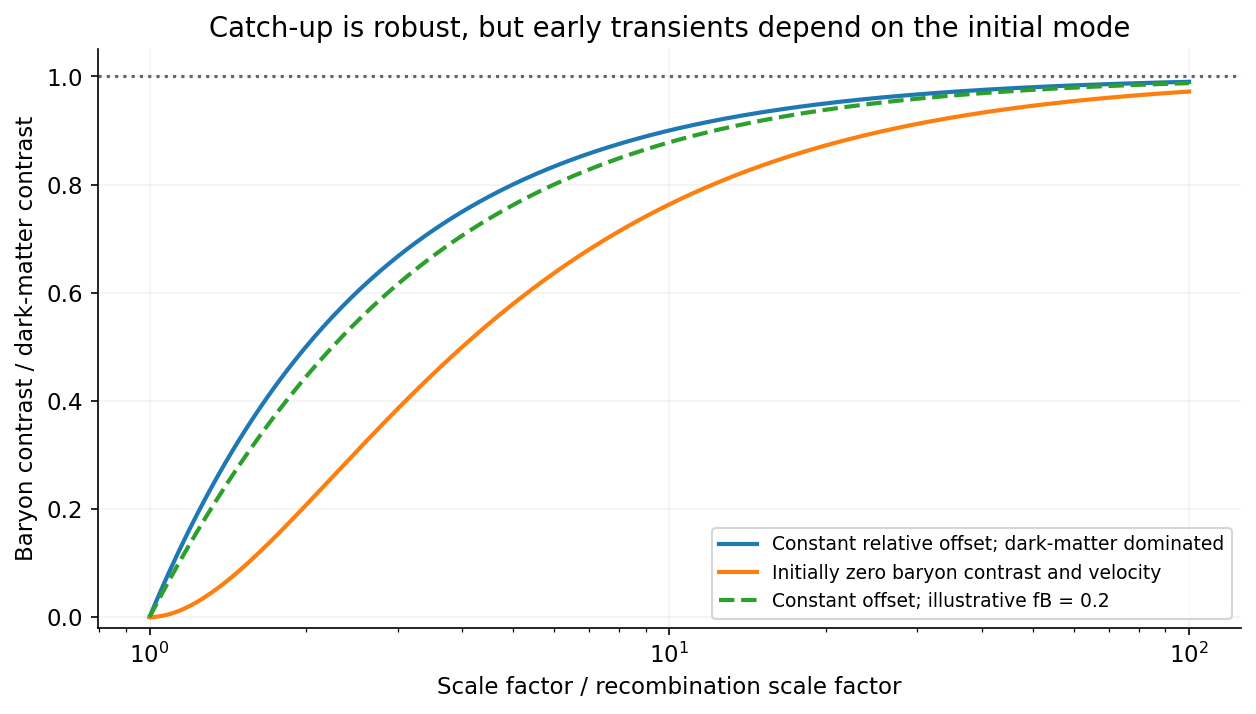
Baryons approach the dark-matter density contrast, with transient behaviour set by the initial relative velocity
. Source. Details. 
Articles by others on the same topic
There are currently no matching articles.