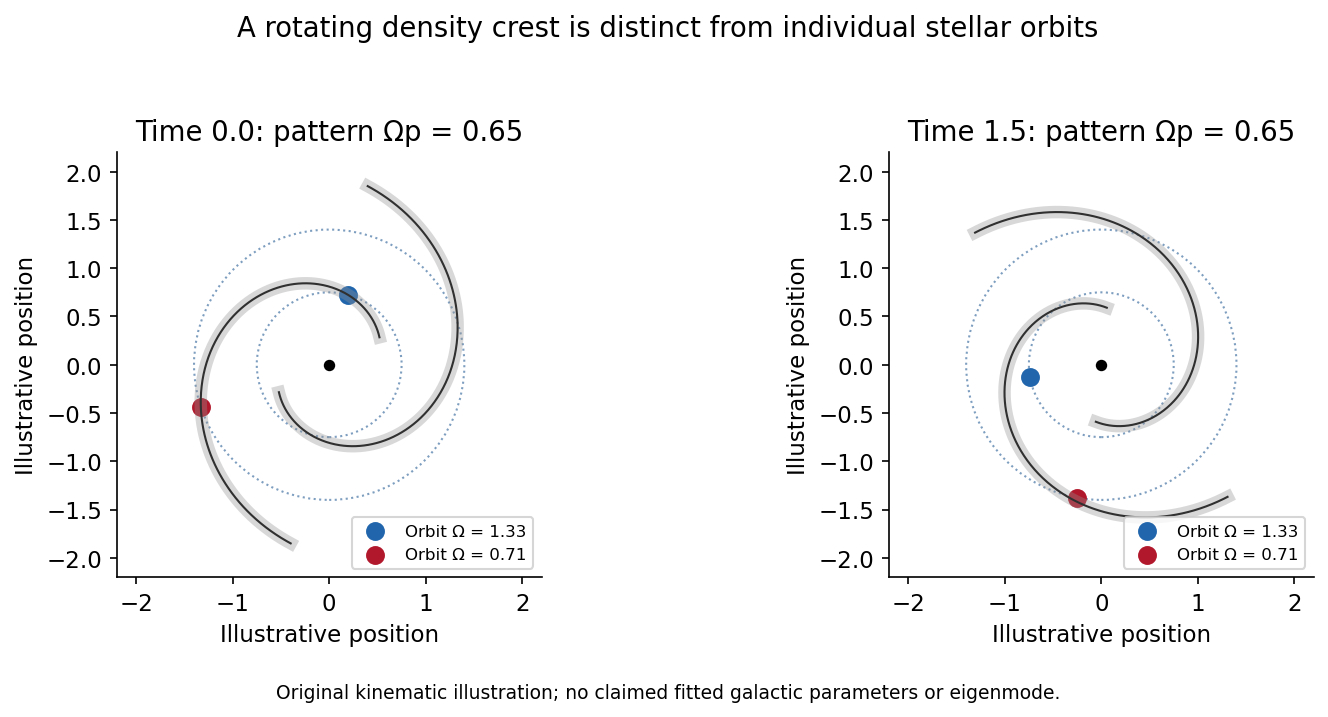
A spiral density wave is an organized density and gravitational-potential perturbation through which stars and gas can move; it is not generally a permanently labelled set of stars. Differential rotation winds a material arm rapidly. In a wave description, a perturbation has phase , with pattern speed distinct from the local stellar angular speed.
For a thin fluid disk the local tightly wound dispersion relation isRotation and pressure resist self-gravity. A collisionless stellar disk requires its stellar response function instead of simply replacing by a dispersion; the familiar local axisymmetric stability parameter is . This is distinct from the gas .
Waves exchange angular momentum at Lindblad resonances and near corotation radius. Swing amplification can strengthen a leading disturbance as shear turns it into a trailing one. Bars or companions can force a coherent spiral; recurrent self-excited disturbances also occur. Thus a single indefinitely steady wave is one model, not a description established for every spiral galaxy. Gas compression and shocks along arms can organize star formation, while gravitational torques redistribute angular momentum. Arm brightness, recent star formation and stellar mass density need not trace precisely the same pattern.[ref]
Spirals in Galaxies by Jerry A. Sellwood and Karen L. Masters. Sections4–6: wave dynamics, recurrent versus quasi-steady patterns, and gas response
Supermassive black holes are compact galactic nuclei with masses typically of millions to billions of solar masses. Their gravitational influence is measured from the motion of surrounding matter; accretion luminosity is evidence of feeding, not a necessary property of every black hole. Keplerian stellar orbits near the Galactic Centre and molecular-maser rotation curves in other nuclei provide particularly direct compact-mass constraints. A rough black-hole sphere of influence is ; resolving it helps dynamical mass estimates.
Accretion converts binding energy into radiation,The latter is the Eddington luminosity for isotropic radiation opposed by electron-scattering opacity, not an absolute luminosity ceiling for every geometry. The retained black-hole mass grows at . Sustained feeding can produce an active galactic nucleus, whereas gas-poor nuclei may be faint. Loss of gas angular momentum is a central feeding problem.
Black-hole mass correlates with classical-bulge stellar velocity dispersion through the M-sigma relation. Accretion-powered radiation, winds and jets can heat or remove gas, linking nuclear growth to galaxy evolution. Such correlations do not establish one universal feedback history, and disks and pseudobulges do not follow the same tight relations as classical bulges. Seed formation, accretion and mergers all contribute; seed masses and feeding histories remain model dependent.[ref]
Coevolution (Or Not) of Supermassive Black Holes and Host Galaxies by John Kormendy and Luis C. Ho. Dynamical evidence, bulge-dependent correlations and different feedback regimes
Galactic star formation requires gas to collect into cold dense regions that can become self-gravitating. Disk-scale gravity, turbulent motions, shear, pressure and magnetic fields affect this collection; formation then proceeds within molecular clouds. A useful local parametrization iswhere the star-formation efficiency per free-fall time summarizes inefficient conversion rather than requiring every cloud to collapse at once.
Across galactic disks the empirical Kennicutt–Schmidt law relates star formation rate surface density to gas surface density, . A slope near is a familiar integrated total-gas fit, while molecular-gas relations in ordinary disks can be closer to linear; the slope and normalization depend on tracer, averaging scale and environment. The gas-depletion time is the corresponding fuel-consumption scale, not a prediction that inflow and recycling cease.
Massive stars supply ionizing radiation, winds and supernova energy and momentum. This stellar feedback can disperse clouds, sustain turbulence and drive outflows, regulating rather than simply extinguishing all future star formation. Fresh accretion and recycled gas replenish the reservoir. UV and recombination-line emission trace young stars, while infrared emission traces absorbed and re-radiated light; extinction, stellar populations and the assumed initial mass function affect inferred rates. A galactic rate reflects supply, cloud formation and feedback together, rather than only the free-fall time of its densest gas.[ref]
Star Formation in the Milky Way and Nearby Galaxies by Robert C. Kennicutt Jr. and Neal J. Evans II. Sections3–6: diagnostics, gas relations and physical interpretation
In a matter-dominated Einstein-de Sitter universe, the growing linear density contrast is proportional to the scale factor. When , linear evolution no longer describes collapse. An overdense region initially expands more slowly than the background, reaches cosmological turnaround, and then contracts under self-gravity.
The spherical top-hat collapse model supplies a useful idealization: pressureless shells obey . At formal collapse, the linearly extrapolated growing mode isThis is a linear extrapolation, not the true finite nonlinear density at that instant. In the ideal energy-conserving spherical model, virial equilibrium gives a virial radius about half the turnaround radius; its mean density at the collapse time is times the cosmic matter density.
Real perturbations are nonspherical: tides and anisotropic collapse produce sheets, filaments and haloes. Collisionless dark matter develops shell crossing and phase mixing rather than radiatively losing its orbital energy. Baryonic gas can shock, cool and collect within the resulting potential wells. Hierarchical merging then assembles larger systems where small-scale fluctuations have sufficient initial power. Press-Schechter formalism connects a collapse threshold with the statistics of the smoothed initial field, but halo abundances and internal structure need more than the single spherical model. These ideas apply after perturbations become nonlinear; one must not extend pressureless subhorizon equations through all radiation-era or horizon-scale conditions.[ref]
With constant isothermal sound speed , the equation of state is . Spherical hydrostatic equilibrium and mass continuity requireTry . With no central point mass, , and hydrostatic balance becomes . The positive-density branch is thereforeThe constant external pressure fixes the truncation radius through , givingThis is the pressure-truncated singular isothermal gas sphere, one hydrostatic solution, not a claim that every isothermal cloud has a singular centre. Its central density diverges, but its enclosed mass tends to zero as .
For inside-out collapse of a singular isothermal sphere, the expansion front is at . The original mass swept by this front isThus the only time-independent accretion scale is . The front-sweeping estimate has coefficient two, but gas takes time to fall from the front to the object; it is not an exact central accretion coefficient. Writefor fixed mean particle mass . Determining the dimensionless coefficient requires the collapse solution; it is not fixed by front propagation alone and is not needed for the requested temperature scaling.[ref]
Self-Similar Collapse of Isothermal Spheres and Star Formation by Frank H. Shu. 1977 expansion-wave solution: central accretion and the free-falling envelope
Well inside the front, where the point mass dominates and infall is approximately pressureless and locally steady, . Conserving the radial mass flux gives the free-fall density profile around a growing point mass:The inner slope is , versus in the undisturbed outer cloud. For constant and negligible initial object mass, and the inner normalization varies as . These are inner asymptotes, not an assertion of an abrupt exact power-law join at the front.
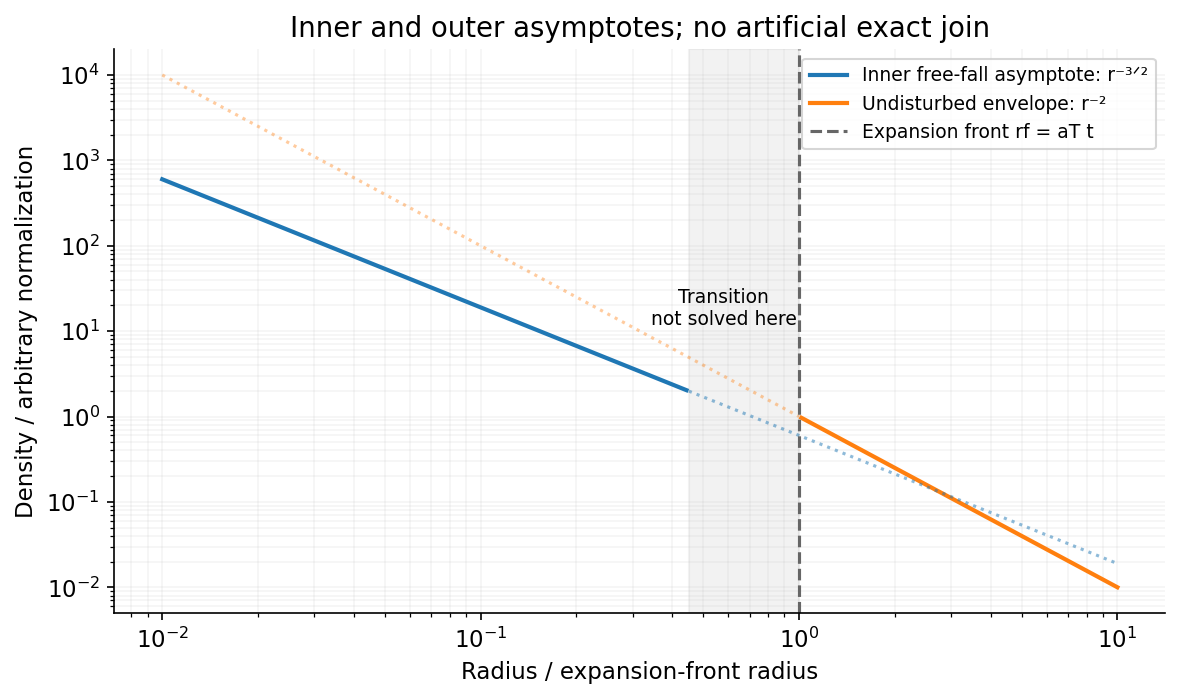
An inside-out collapse has a freely falling inner density slope distinct from the undisturbed isothermal envelope
. Source. Details. At distance , one grain intercepts power through its projected area and emits through its full surface:The blackbody dust sublimation radius follows by setting :Here the supplied luminosity is . The grain radius cancels because both cross-sections scale as . The temperature exterior to this boundary scales as . This estimate assumes isotropic illumination, no shielding, and unit absorption/emission efficiency as specified; real grain emissivities can change it. The numerical evaluation uses the external conversion values and .[ref]
CODATA recommended values of the fundamental physical constants 2014 by National Institute of Standards and Technology. Stefan-Boltzmann constant, rounded at the precision relevant here
The dust-cooled equilibrium is thermally stable under the stated constant irradiation, with fixed dust properties and dust-to-gas ratio. At a fixed position, absorbed power per grain is independent of its temperature, while emission is . A positive temperature perturbation increases cooling, causing a restoring energy loss; a negative perturbation reduces cooling, allowing reheating.
For heat capacity of a grain together with its thermally coupled gas,so the perturbation decays. The thermal stability of externally heated blackbody dust relies on remaining below sublimation with the grain population intact; destruction, variable illumination or finite dust-gas equilibration can change the response. An isobaric parcel with a fixed grain-to-gas ratio has the same restoring sign when heating and cooling are compared per particle.
First specify the perturbation: take fixed gas density, fixed ionic abundance and the same temperature-independent heating, so thermal stability requires at an equilibrium. Let , be the collider density and the atomic density. A two-level optically thin balance isThe critical density of an atomic transition is approximately . At low density, each rare collisional excitation is followed by an escaping photon, soThe isochoric thermal stability of a collisionally excited line therefore givesAt the linear restoring coefficient vanishes; the cooling maximum is marginal to first order and is not robust two-sided stability.
At high density, collisional de-excitation competes successfully with radiative decay, and collisions establish local thermodynamic equilibrium level populations. Detailed balance gives , where . The cooling is thenThus the high-density fixed-density branch is stable for finite , becoming weakly restoring as the upper fraction saturates at high temperature. It is incorrect to retain the low-density factor in the radiative cooling law once populations are thermalized.[ref]
AGN Emission Lines by Hagai Netzer. Section2.2: collisional excitation, critical density and the high-density Boltzmann limit
The isobaric thermal stability of a two-level coolant is a distinct question. If the intended heating is a fixed rate per particle, then and stability tests the cooling per particle. The low-density boundary becomes ; the high-density cooling per particle remains proportional to , so remains stable. If instead heating is constant per volume, the isobaric low-density boundary is , and the high-density stability condition is . The source gives no pressure constraint or explicit heating normalization: the boxed result is the fixed-density answer, with these conditional alternatives stated to avoid asserting a universal boundary.
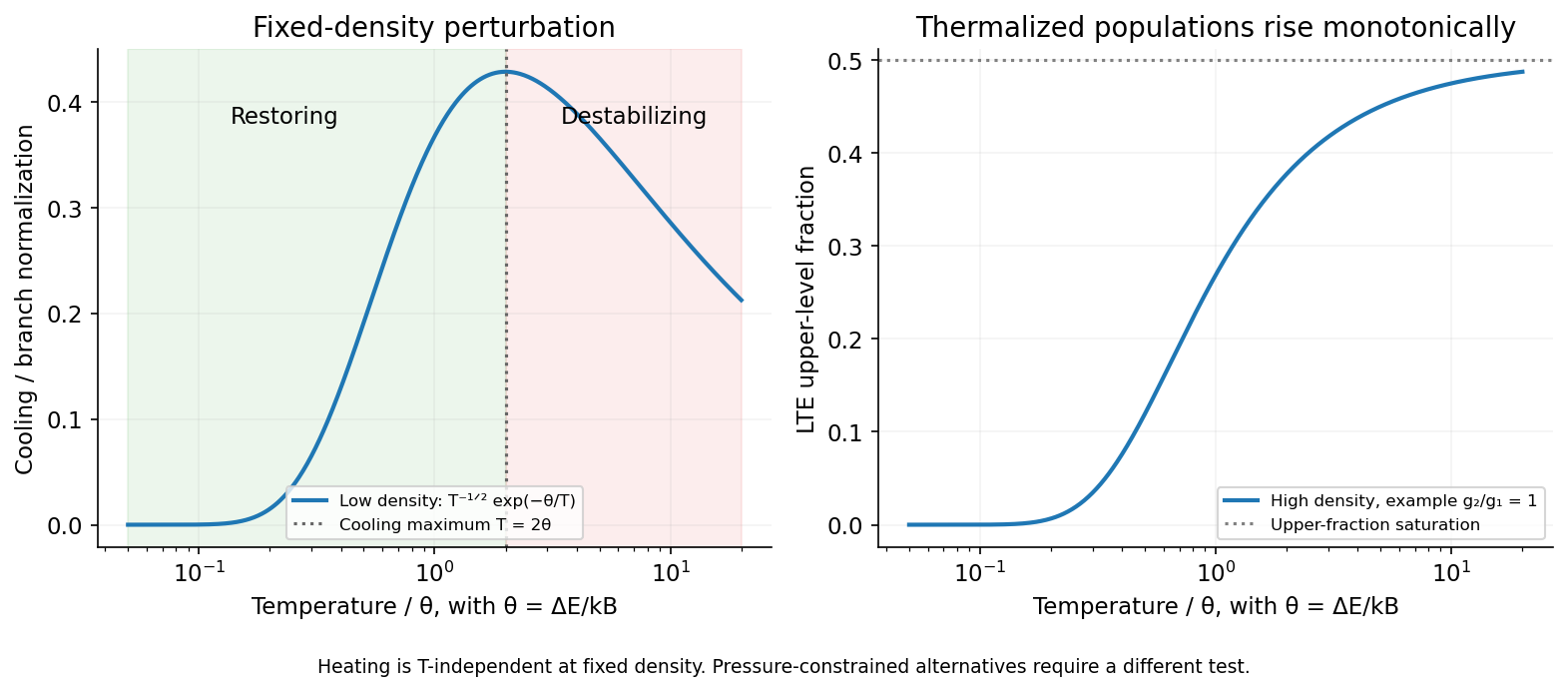
Low-density collisional line cooling has a temperature maximum, whereas high-density LTE emission rises toward saturation
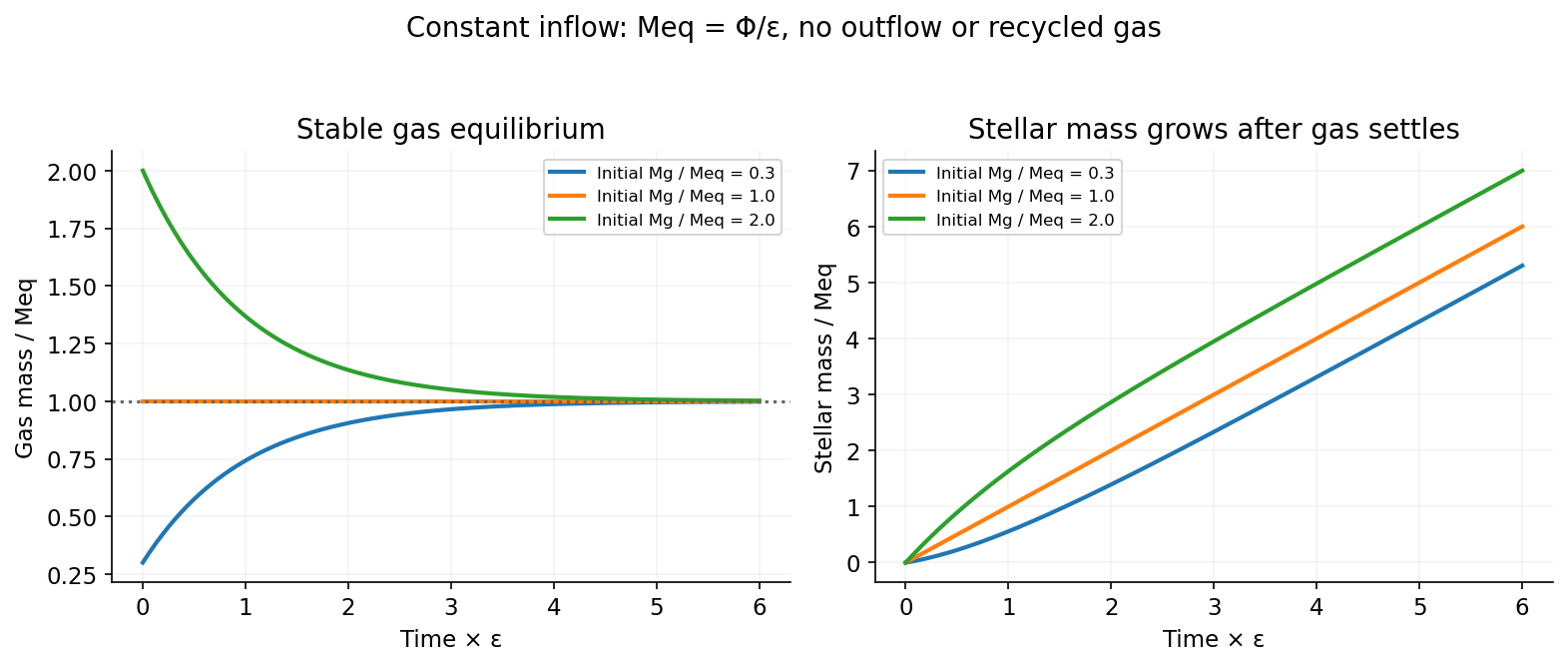
. Source. Details. For constant inflow and efficiency , with no recycling or outflow, mass conservation gives the constant-inflow gas regulator solution:The equilibrium is stable: a gas-mass perturbation obeys . At late times the star formation rate approaches , while the gas reservoir approaches a constant.
Integrating with gives the stellar mass in a constant-inflow gas regulator:It also follows immediately from . The gas mass equilibrates; the stellar mass generally keeps growing. With , these reduce to exponential gas depletion and .
A constant inflow is implicit in the requested steady asymptote, not automatic for an arbitrary prescribed rate. For time-dependent the exact integrating-factor result isa constant late-time gas mass then requires a corresponding asymptotically steady supply. Both printed mark groups remain in this single unlettered continuation of part(a).


Let be the separation of galaxy centres and a small displacement from the satellite centre along the line of centres. Expanding the central point-mass field gives the radial differential accelerationInside a uniform-density satellite, the restoring self-gravity isComparing the two at the same displacement yields the differential-gravity disruption limit of a uniform satellite:The satellite radius cancels because both accelerations are linear in . This is the instantaneous tidal-gravity estimate requested by the given criterion, not a full rotating Roche calculation. Including centrifugal terms for a circular corotating orbit replaces the radial coefficient two by three, giving while preserving the required scaling. An eccentric orbit requires checking the stronger tide near periapsis, and extended density profiles require a more detailed restoring-force calculation.
Put and let , be constant background matter fractions. Define the total matter perturbation and the relative mode . Adding with the background weights and subtracting the two given equations respectively givesThe total and relative density modes of two pressureless matter fluids are consequentlyThese are the general consequences of the supplied equations; a single ratio additionally needs initial-mode assumptions.
For the usual dark-matter-dominated growing-mode approximation, take , neglect the decaying modes, and set the relative-velocity mode . Then . With at recombination, , so the baryon catch-up approximation after recombination isAt redshifts , replacing by gives the printed . The printed relation is a high-redshift approximation with a specified relative mode, not an exact identity for arbitrary solutions of the two-fluid equations.
For example, retaining a finite baryon fraction with a growing total mode and constant relative mode gives, with ,Alternatively, if initially both and while the dark-matter growing mode is already present, then in the dark-matter-dominated limit the relative transient is not zero andThis shows why the missing initial-velocity convention matters. TODO: the source does not supply the initial relative velocity or a baryon-fraction approximation; those inputs are needed to select the quoted special case uniquely. The general solution and conditional specializations above remain valid.
The physical conclusion is robust: after decoupling, baryonic gas can fall into pre-existing dark-matter potential wells and its fractional density perturbation catches up. The absolute constant offset need not vanish; it becomes small relative to the growing common mode. The pressureless approximation applies on scales above the baryonic Jeans scale and while perturbations remain linear; subsequent collapse requires nonlinear treatment.[ref]
Cosmology by David Tong. Sections3.1–3.3: matter growth, decoupling, Jeans support and dark-matter seeds
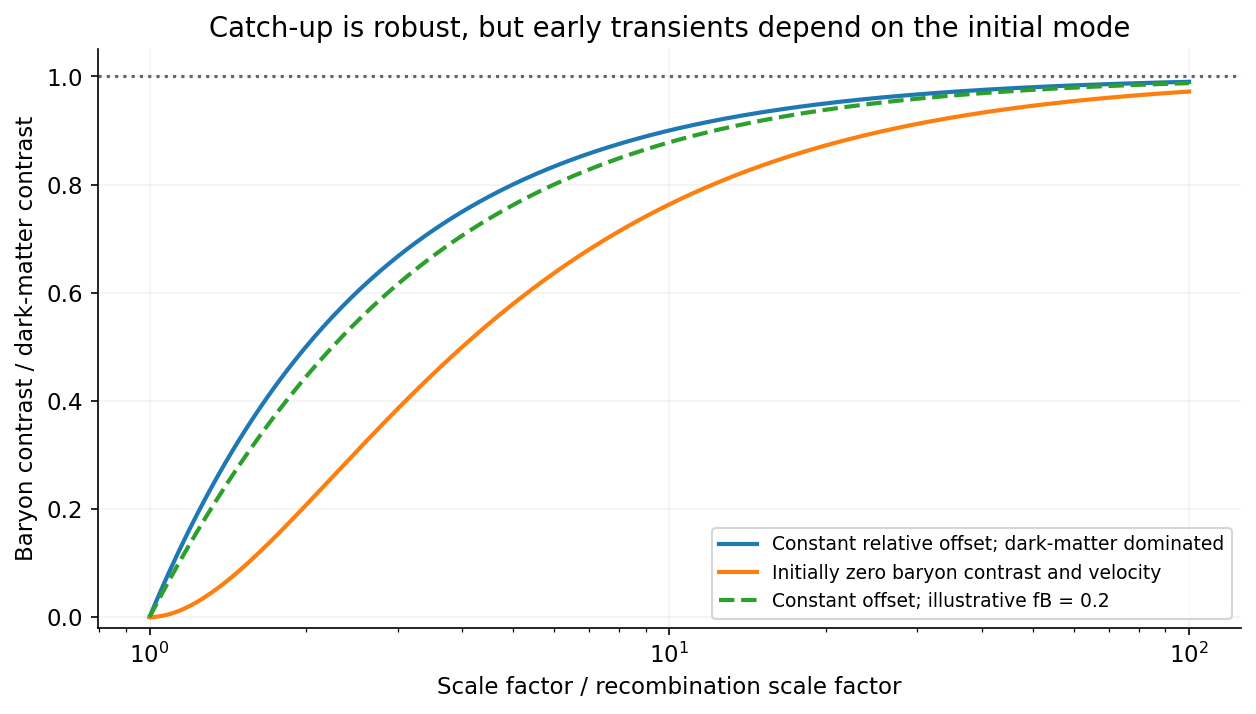
Baryons approach the dark-matter density contrast, with transient behaviour set by the initial relative velocity
. Source. Details. 
Articles by others on the same topic
There are currently no matching articles.