To test radial stability of an axisymmetric circular orbit, let be the time-independent gravitational potential per unit stellar mass in the midplane. Axial symmetry conserves the specific angular momentum . The radial equation isA circular orbit at obeys . Choose the guiding circular orbit with the same conserved angular momentum as the perturbed star. Setting and expanding at fixed giveswhere the radial epicyclic frequency isHere and refer to the family of circular orbits. They are differentiated as functions of radius only after the perturbation equation has been expanded at conserved stellar .
For a radially stable circular orbit, , so to linear orderThus the orbit performs small simple harmonic radial oscillations about its guiding radius.
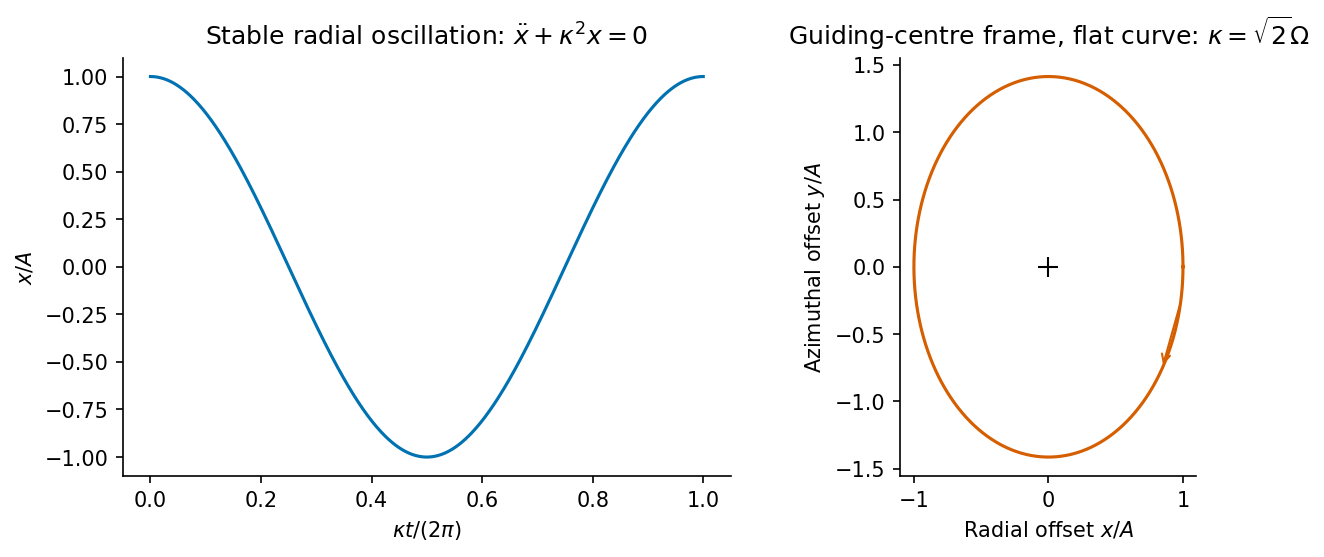

Symmetry alone is insufficient to guarantee stability: gives exponentially growing displacement, and is marginal. The intended statement assumes a stable unperturbed orbit.
For a Kepler potential ; for a flat circular-speed curve ; for solid-body rotation . Conservation of also gives , explaining the accompanying azimuthal epicycle rather than a purely radial motion in the inertial plane.
Articles by others on the same topic
There are currently no matching articles.