Take initially; real solutions for follow by . Put . Approaching the real phase velocity from the upper half-plane, the Landau contour and the Sokhotski–Plemelj formula give the following Cauchy principal value decompositionThe real frequency condition therefore requires . This is possible in the interior of the velocity plateau and outside the occupied velocity range:These are candidate intervals, not yet solutions of the real dispersion relation. The endpoints have jumps in and logarithmic singularities in the response; they are not finite- undamped modes. At the cusp , the slope is also discontinuous and the real response diverges, so it supplies no additional mode.
The physical condition is absence of net resonant energy exchange with particles moving at the wave's phase velocity. Outside the support there are no such particles. Within a velocity plateau, the equal populations on either side of the resonance cancel Landau damping.
Let , , and . Use the Debye length convention of the paper, . On the candidate intervals in a, the Landau contour contributes no imaginary part. The piecewise constant slopes giveSince , setting the dielectric function to zero yieldsThe absolute values express the real response on the allowed intervals. Solving this real equation inside a sloping portion of would not satisfy the imaginary part of the dielectric function.
An exact algebraic form will also make the number of undamped branches clear. DefineOn each allowed interval, the quantity inside the logarithm equals . Exponentiating and usinggives the cubic equationFor every , the logarithm runs from to on , from to on , and from to on . The intermediate value theorem supplies a root in each interval, and the cubic equation permits at most three. Thus there is exactly one undamped branch in each interval.
For , the logarithm in b must be large and positive. In each allowed interval this happens near a denominator zero, approached from the undamped side:The constants hidden by have velocity units. Consequently,The two outer modes have phase velocities just outside the occupied range and therefore have no resonant particles. The middle electron acoustic wave lies just inside the lower edge of the velocity plateau, where . All three escape Landau damping in this collisionless model. The stated neglect of ion response remains necessary for the middle mode as well.
For the two outer branches, at small . An integration by parts and a large- expansion giveThere is no boundary contribution because the phase-space distribution function vanishes at both endpoints. Direct area integration givesThus the exact small- cutoff, retaining the paper's definition , is . To leading order in the narrow-velocity plateau approximation this isThese are Langmuir waves. The difference between and the reference is only first order in , so it does not alter the requested leading-order result.
For the finite-phase velocity branch put , with . To leading order in and , the real dispersion relation becomesAt long wavelength set to leading order. Then , andFor comparison, the exact phase velocity from the cubic equation in b is ; expanding it gives precisely at fixed .
A single Maxwell-Boltzmann velocity distribution has a nonzero slope at every finite nonzero and has no velocity plateau. The would-be electron acoustic wave is therefore subject to strong Landau damping, so there is no corresponding completely undamped acoustic branch in a single Maxwellian electron population with immobile ions. At its only stationary point , a Maxwellian has , making the static dielectric function positive rather than zero. This statement does not exclude acoustic modes of suitably distinct electron populations or an ion-supported mode when ion dynamics is retained.
Retain while making the same narrow-velocity plateau expansion as in d. With , the factor that varies rapidly across the plateau is . The other factors vary slowly and may be evaluated at , givingThereforeAt , the denominator tends to , recovering d. At ,recovering the exponentially close approach to the plateau edge in c. The phase velocity remains strictly inside the velocity plateau for every finite .
As an asymptotic expansion, the formula takes at fixed . If the plateau also approaches the outer edge, so that is comparable to , the factors treated as slowly varying need not be slowly varying. In that additional limiting regime, use the exact dispersion relation in b instead.
For , the upper Langmuir wave starts at and approaches the line from above. The lower Langmuir wave starts at and approaches from below. The electron acoustic wave starts at the origin with slope and approaches from above; it stays inside . These are the only completely undamped branches, as shown by the cubic equation in b.
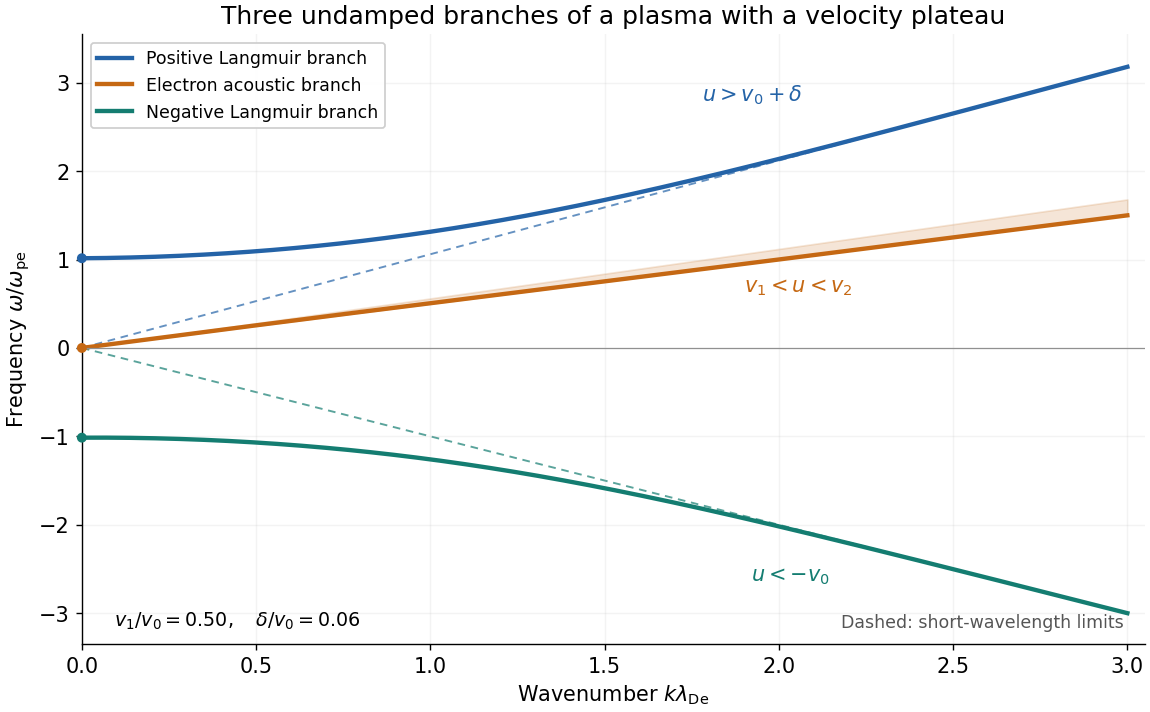

The small asymmetry between the outer branches reflects the extra positive-velocity population introduced by the velocity plateau. The negative- sketch follows by rotating the displayed branches through the origin, since on these undamped solutions. One should not impose symmetry about the axis at fixed positive .
Articles by others on the same topic
There are currently no matching articles.