The Hadamard gate H and T gate form a universal quantum gate set for single-qubit operations: finite sequences approximate any target single-qubit unitary arbitrarily well, up to a physically irrelevant global phase. Universality is not a claim that every arbitrary rotation has a finite exact H,T word. With products acting right to left, exact Pauli constructions areIndeed , , and .
Initialize the search register in and the output qubit in , then apply H to all three. The search state becomes , and the output becomes . The oracle obeysThis phase kickback leaves the output qubit factored out, so subsequent analysis can use the phase oracle on the two search qubits alone. Apply one Grover diffusion operator , then measure the search register.
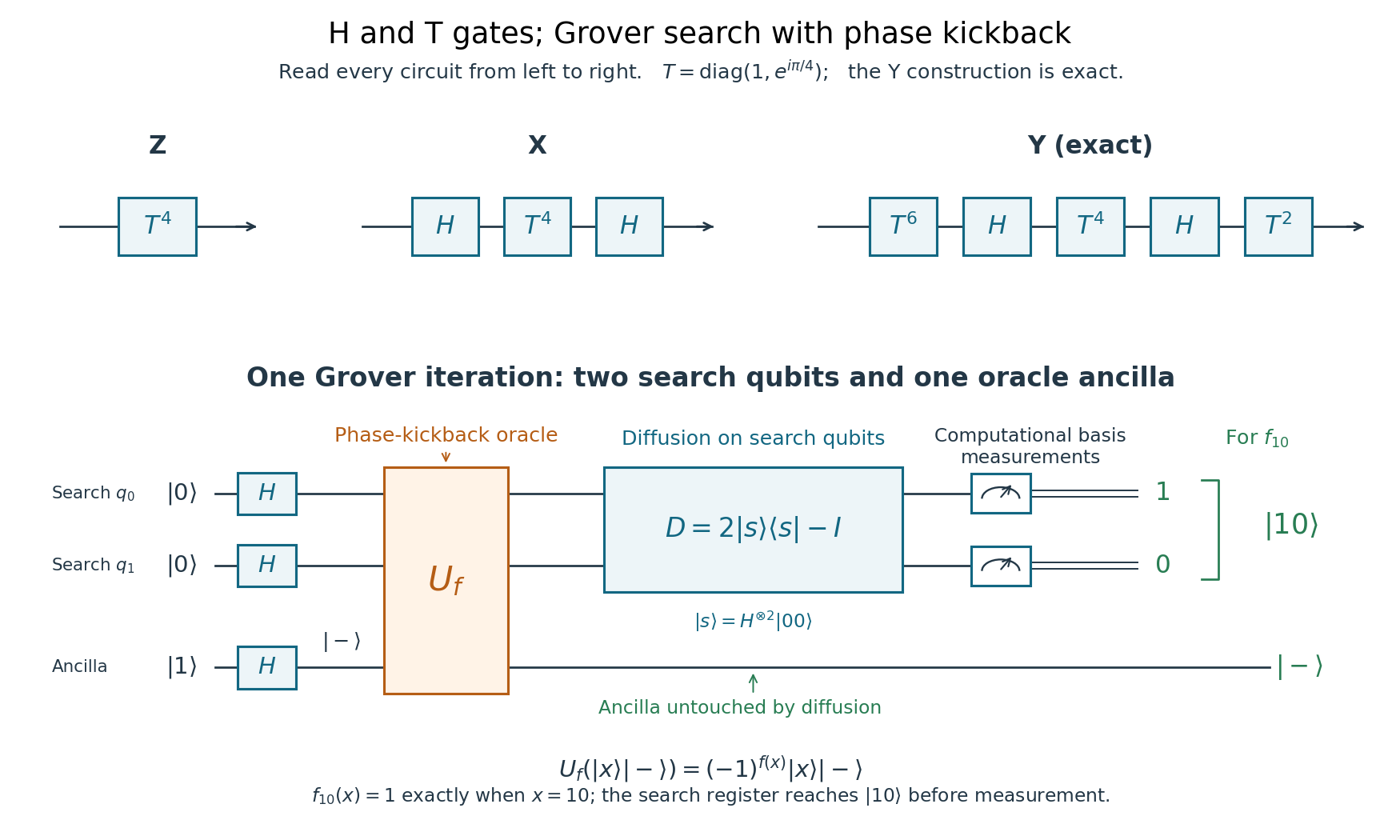
Exact Pauli circuits from H and T, and a two-search-qubit Grover network with a factored output ancilla
. Details. 
A promise restricts which Boolean functions may be supplied. For the exact one-iteration four-entry search here, promise exactly one marked input. The four functions are precisely when , for . Other known numbers of marked entries require a correspondingly chosen iteration count; uniqueness is the promise for this particular exact circuit.
In basis order , the requested explicit calculation isThus the promised marked entry is found with probability one.
For two weakly coupled spin-half nuclei in nuclear magnetic resonance, a useful rotating-frame Hamiltonian iswhere is in hertz and , . Resonant pulses and refocusing separate local rotations from the scalar coupling. For positive , evolution for supplies . Combining it with local Z phases gives the phase oracleThe scalar global phase is immaterial. Local pulses interchange zero and one, soThis implements the desired change of marked input without an additional output qubit.
Articles by others on the same topic
There are currently no matching articles.