Applying Itô's formula to gives the geometric Brownian motionThe Gaussian exponential moment then yieldsThis expectation is under the physical measure and therefore uses drift .
Under the risk-neutral measure, the same second-moment formula uses drift . Discounting the power option payoff therefore givesLet and . The delta hedging portfolio holdsIts wealth is . To verify self financing, Itô's formula givesAt maturity the wealth is , completing replication.
The stochastic differential computed above isThus this positive no-dividend traded claim behaves as a new geometric Brownian motion asset withThe transformed drift need not be positive, even though the three original market parameters were assumed positive. Under the risk-neutral measure it becomes , as it must for a non-dividend traded asset.
Let be the ordinary Black-Scholes price of the terminal claim . Denote the new asset by . Since it is strictly increasing in , invert it as and write . Its derivative isThe replicating portfolio in the new asset and bank account therefore holdsThe wealth is . The diffusion coefficient of is , agreeing with that of . Its drift together with the bank holding iswhich equals the drift of by its Black-Scholes equation. This verifies self financing and terminal replication. Thus the square-payoff claim has nonzero volatility and can replace the original stock as the traded risky asset.
The terminal put payoff obeys . If the put cost more than the zero-coupon bond paying , sell the put and buy that bond. Invest the strictly positive initial difference in the bank account. At maturity the bond covers every possible put liability and the extra investment remains positive. This arbitrage is excluded, so
A stock share plus a put has terminal value . If , buy that package and borrow the price of a bond paying . The package covers the debt at maturity, while the strictly positive initial surplus can be invested. This would be an arbitrage. ConsequentlyTogether with payoff nonnegativity, the lower bound can be strengthened to the maximum of this expression and zero.
The difference between the high-strike and low-strike put payoffs satisfiesIf its price were negative, buying the nonnegative-payoff spread would generate an arbitrage. If its price exceeded the discounted maximum payoff, selling it and buying a bond for that maximum would generate an arbitrage. Thus the sharper inequality isFor the positive-rate convention of the paper this implies the printed upper bound . If rates were allowed to be negative, the undiscounted upper bound need not hold; the discounted bound is the correct rate-independent statement. This distinction is about the stated financial assumptions, not a change to the transcribed inequality.
The call spread in the hint has payoffIt is between zero and one and converges to as . In the Black-Scholes model with positive volatility and , the conditional terminal stock distribution has no atom at . The strict and non-strict indicator therefore have the same discounted expectation. The dominated convergence theorem in the risk-neutral pricing formula givesEquivalently this is . The no-atom condition explains the endpoint subtlety: the displayed spread has value zero at , whereas the printed digital pays one there. At maturity the strike derivative can be one-sided or undefined, so the smooth pricing identity is understood before expiry.
A self-financing replicating strategy must fund both the claim's price change and its outgoing cash flow:Apply Itô's formula to . Matching the diffusion gives . Matching drift and eliminating gives the Black-Scholes equation with claim dividendsThe physical drift cancels because stock risk is hedged. The cash-flow term has a plus sign because it is a payment to the holder.
Invest each cash payment received at time in the bank account until . Its accumulated terminal amount is , so the entire future stream is equivalent, path by path, to the terminal payment .
The risk-neutral pricing formula, including this reinvested payoff, iswhere . Equivalently, discount each cash flow directly to time . This is the discounted-gains martingale principle underlying the PDE in part (a).
Use the auxiliary diffusion , started at . Under sufficient regularity and integrability for the Feynman-Kac formula,To verify the signs, apply Itô's formula to . Its drift is . Adding the accumulated source integral makes a martingale; taking expectations through proves the formula.
Here the auxiliary drift is the printed , rather than automatically : this part is a general terminal-value PDE, whose diffusion must match its generator.
Linearity separates the terminal call payoff from the running payment stream. The first contributes the supplied European call price. Under the risk-neutral measure, , so the stream contributesConsequentlyThis is the claim dividends proportional to the underlying stock identity. The underlying itself is still non-dividend-paying; the cash flow belongs to the derivative.
The risk-neutral one-step mean multiplier must equal the bank growth factor:Thus the risk-neutral probability in a binomial market isIt lies strictly between zero and one, consistent with the no-arbitrage inequality .
At maturity a shout has payoff , while no shout gives . If , shouting creates a negative payoff and is strictly worse. If , the two choices give exactly the same payoff, so shouting is optional and gives no improvement.
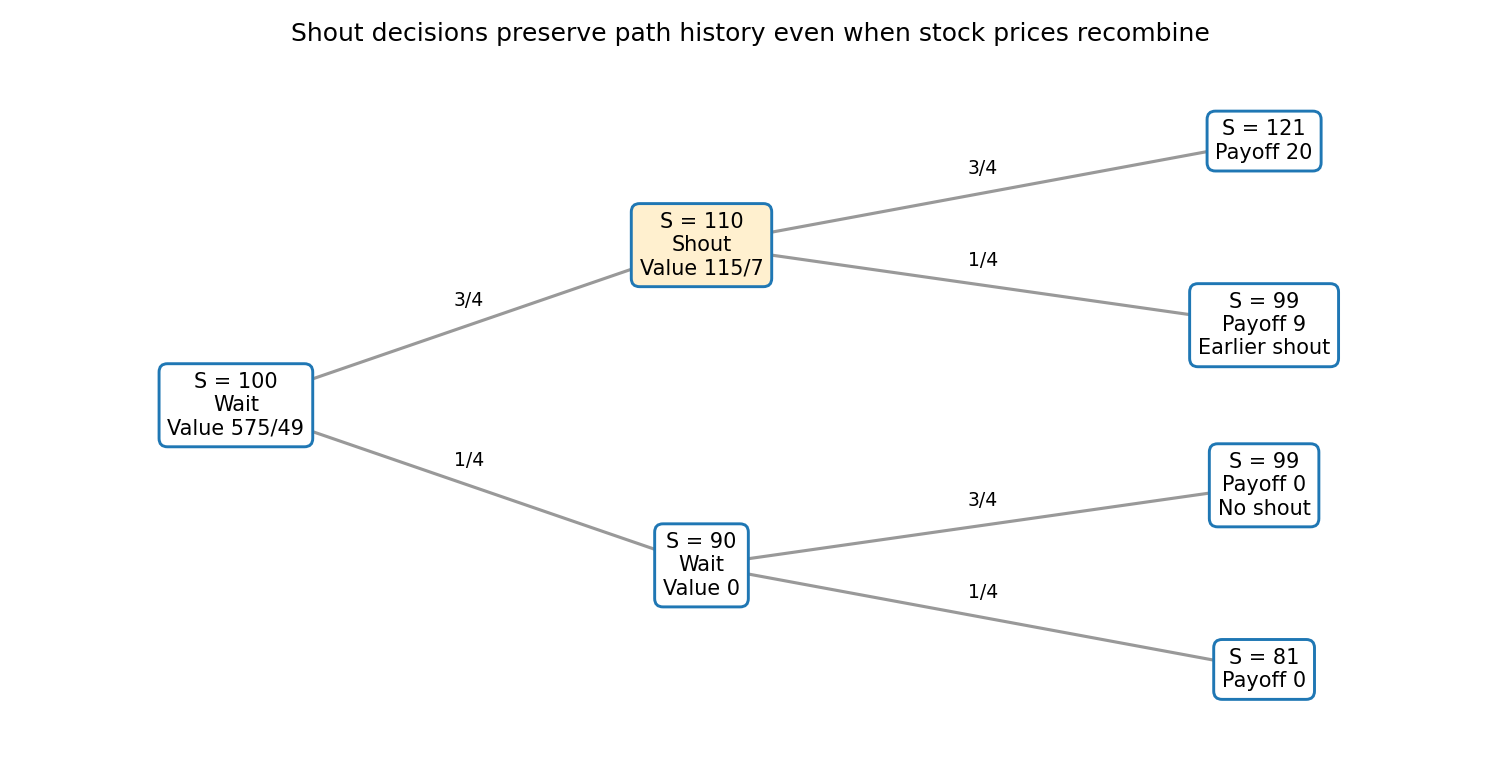
Thus do not shout when out of the money; be indifferent when at or in the money. The terminal stock values are 121, 99, and 81, so only the up-up node permits an indifferent shout with the given strike.
If the first move is up, and can be 121 or 99. A shout now gives , hence payoffs 20 and 9. Waiting until maturity or never shouting gives 20 and 0. The first policy is no worse on either branch and strictly better on the down branch, so shout after the first up move.
If the first move is down, and the terminal prices are 99 or 81. A shout would give or , while waiting gives zero. Thus do not shout after the first down move. These comparisons use terminal payoffs directly, so no intermediate discounting can change their ordering.
Shouting at zero locks in , producing terminal payoff . Its pathwise values are 20 on and on each other path. Waiting and applying part (c) instead gives values 20 on , 9 on , and zero on . Therefore waiting dominates shouting now, strictly on events of positive probability.
Under the optimal binomial shout option with signed lock-in, discount the latter terminal payoffs using independent risk-neutral transitions:The time-one option value is after an up move and zero after a down move. These values also reproduce the price by one-step backward induction.

Articles by others on the same topic
There are currently no matching articles.