The risk-neutral one-step mean multiplier must equal the bank growth factor:Thus the risk-neutral probability in a binomial market isIt lies strictly between zero and one, consistent with the no-arbitrage inequality .
At maturity a shout has payoff , while no shout gives . If , shouting creates a negative payoff and is strictly worse. If , the two choices give exactly the same payoff, so shouting is optional and gives no improvement.
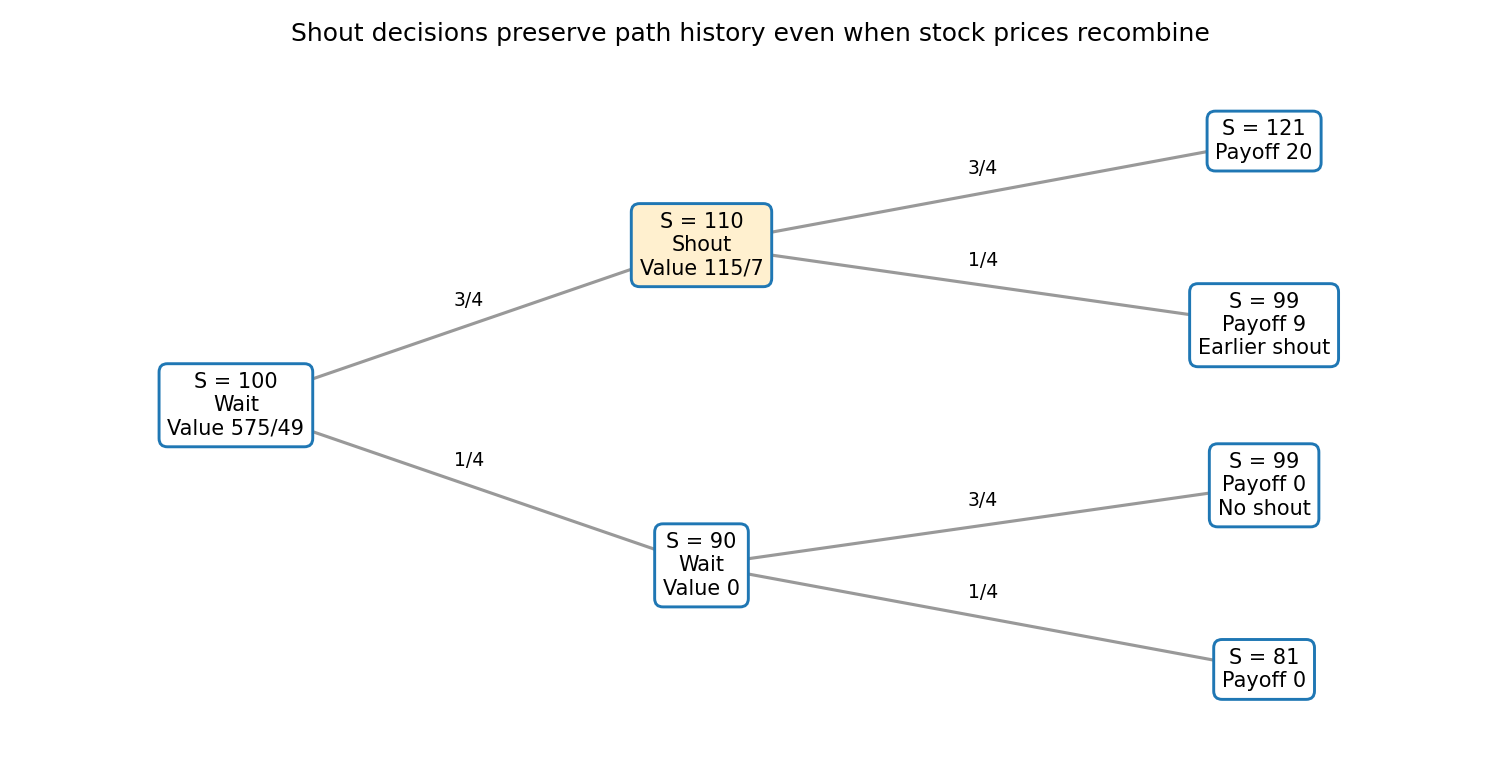
Thus do not shout when out of the money; be indifferent when at or in the money. The terminal stock values are 121, 99, and 81, so only the up-up node permits an indifferent shout with the given strike.
If the first move is up, and can be 121 or 99. A shout now gives , hence payoffs 20 and 9. Waiting until maturity or never shouting gives 20 and 0. The first policy is no worse on either branch and strictly better on the down branch, so shout after the first up move.
If the first move is down, and the terminal prices are 99 or 81. A shout would give or , while waiting gives zero. Thus do not shout after the first down move. These comparisons use terminal payoffs directly, so no intermediate discounting can change their ordering.
Shouting at zero locks in , producing terminal payoff . Its pathwise values are 20 on and on each other path. Waiting and applying part (c) instead gives values 20 on , 9 on , and zero on . Therefore waiting dominates shouting now, strictly on events of positive probability.
Under the optimal binomial shout option with signed lock-in, discount the latter terminal payoffs using independent risk-neutral transitions:The time-one option value is after an up move and zero after a down move. These values also reproduce the price by one-step backward induction.

Articles by others on the same topic
There are currently no matching articles.