Use fractional coordinates in a conventional cubic cell with an atom at the origin. The diamond cubic structure consists of an FCC Bravais lattice with the two-atom basisThe FCC translations within the conventional cell are , , and . Adding the basis gives eight atoms per conventional cell. Equivalently, two identical FCC sublattices are displaced by . It is not a monatomic close-packed arrangement: every atom has four tetrahedrally arranged nearest neighbors rather than twelve.
In the projection, label each atom by its fractional height. The and columns have height0; and have height1/2. The additional four columns are and at height1/4, and and at height3/4. Boundary columns repeat periodically; they must not be counted as full extra atoms.
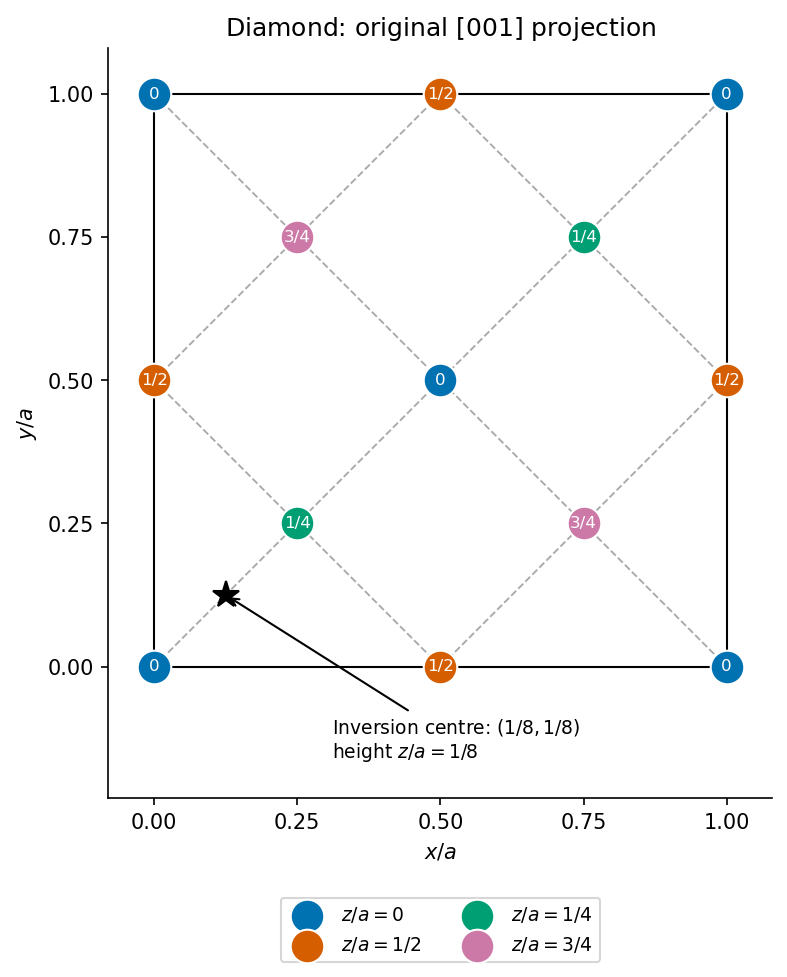
Original fractional-coordinate projection of diamond silicon, with atom heights, vertical mirror traces and a bond-centred inversion point
. Details. 
The vertical mirrors of the diamond cubic structure have the required orientation: their normals lie in the plane. In the chosen atomic-origin convention, their traces satisfywith expressed as fractions of . These are the two orientations of vertical mirrors and their translated copies. For example, the plane interchanges the first two coordinates and leaves every diamond site in an equivalent site. Reflection in sends to , which also preserves the full three-dimensional motif.
The projected traces alone do not test a mirror: the atom heights must also agree under reflection. In particular, a vertical trace can appear plausible in an unlabelled projection but does not preserve all heights as a pure mirror; glide operations are different symmetry elements.
Bond-centred inversion in diamond cubic gives one inversion centre at the midpoint of a nearest-neighbor bond:Mark its projected point and label its height . Inversion about this point sends to . It exchanges the two identical FCC sublattices and therefore preserves the crystal. An individual atom at the chosen origin is not an inversion centre.
The nearest-neighbor displacement is , of length . Touching hard spheres therefore obeyThere are eight atoms per conventional cubic cell, givingFor monatomic FCC close packing, four atoms per cell touch along a face diagonal, so andThus the diamond packing fraction is much smaller. The tetrahedral network leaves substantial open volume. Although its Bravais lattice is FCC, the two-atom motif and the shorter hard-sphere contact distance prevent it from inheriting the FCC close-packing fraction.
The four FCC translations give a lattice structure factor that is nonzero only when are all even or all odd. The identical two-atom motif then multiplies it byFor the FCC part is allowed, but the motif factor is . HenceIn the projection, equal numbers of atoms occur at . Their phases are respectively . The paired layers cancel exactly for equal silicon scattering amplitudes. This diamond-basis diffraction extinction is additional to the FCC centring rule; it is not evidence that no atoms lie on the nominal reflecting planes.
For indexing a diamond-cubic powder pattern, and Bragg's law gives . Using half of each printed scattering angle, the ratios to the first peak are approximatelyMultiplying by3 gives the allowed sequence . ThusThe numerical calculation, expressed without assuming a historical Data Book wavelength, isTherefore . As a separately identified reference convention, choosing Cu K with givesThat wavelength follows from the copper transition near in the NIST transition database, using .[ref]
X-Ray Transition Energies Database by National Institute of Standards and Technology. Copper, experimental KL3 transition energy
The paper says Cu K but does not give the line-selection convention or an explicit wavelength. A rounded unresolved-doublet wavelength, for example , would instead give about . These are conditional wavelength evaluations, not claims about the unavailable historical Data Book. The angles are internally consistent with one cubic parameter; they should not be replaced by literature peak positions simply to obtain a familiar silicon value.
Articles by others on the same topic
There are currently no matching articles.