The original diagram is a Kelvin-Voigt model: a spring and a dashpot act in parallel. The spring is an ideal elastic element, ; under its own sinusoidal stress its strain is in phase with stress and energy is stored reversibly. The dashpot is viscous, ; its strain under an oscillating stress lags by90degrees and mechanical energy is dissipated.
In parallel the strain is common and the branch stresses add:For imposed harmonic stress, the strain amplitude and phase lag areThe short- and long-timescale limits follow under the printed roman labels below.
A sudden constant stress gives delayed, bounded creep:The strain is initially zero because an instantaneous change would require an infinite dashpot stress. Initially the dashpot carries the load, with finite strain rate ; the spring gradually carries more of it as the rate decays. On unloading, the strain recovers exponentially to zero. The network does not produce the instantaneous strain jump or unbounded constant-stress creep of a series Maxwell element.
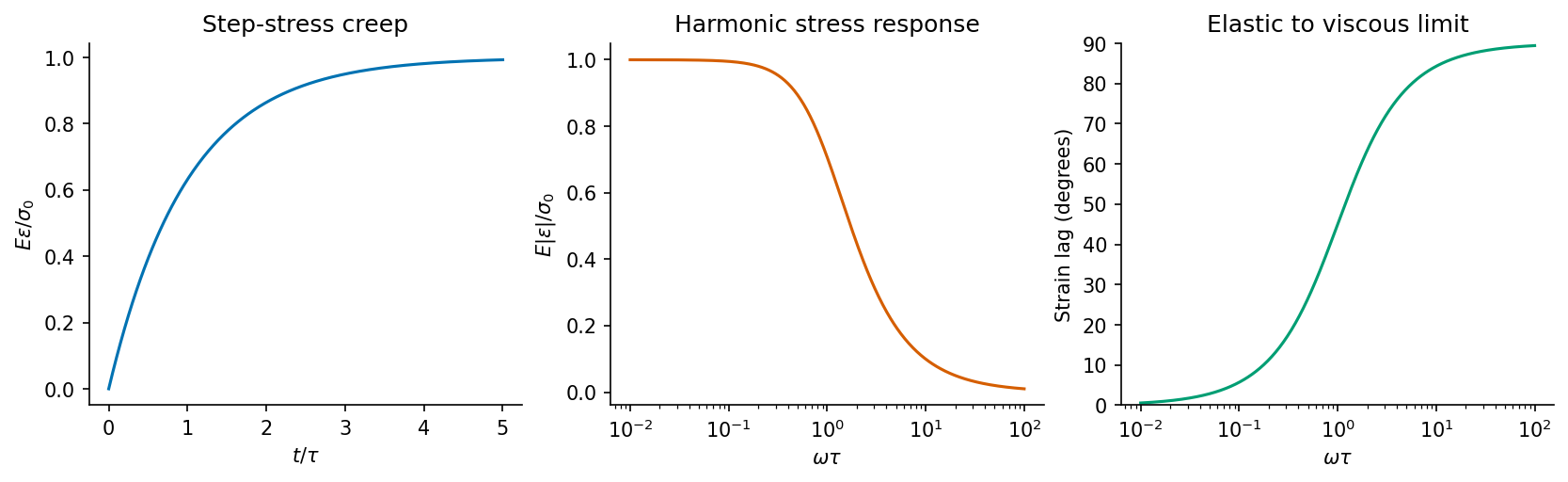
Original Kelvin-Voigt predictions for step-stress creep, frequency-dependent compliance and stress-strain phase lag
. Details. 
On a timescale short compared with , or for , the dashpot strongly resists rapid deformation. The imposed oscillating stress produces a small strain, of amplitude approximately , nearly90degrees behind the stress. The network appears stiff and predominantly viscous in this stress-controlled high-frequency limit. It is not an ideal perfectly rigid body at finite frequency.
For a slowly varying load with , the dashpot stress is small relative to the spring stress. The strain approaches almost in phase, so the low-frequency response is predominantly elastic. A constant load approaches the finite equilibrium strain ; it does not sustain steady viscous flow in this parallel network.
Articles by others on the same topic
There are currently no matching articles.