The original diagram is a Kelvin-Voigt model: a spring and a dashpot act in parallel. The spring is an ideal elastic element, ; under its own sinusoidal stress its strain is in phase with stress and energy is stored reversibly. The dashpot is viscous, ; its strain under an oscillating stress lags by90degrees and mechanical energy is dissipated.
In parallel the strain is common and the branch stresses add:For imposed harmonic stress, the strain amplitude and phase lag areThe short- and long-timescale limits follow under the printed roman labels below.
A sudden constant stress gives delayed, bounded creep:The strain is initially zero because an instantaneous change would require an infinite dashpot stress. Initially the dashpot carries the load, with finite strain rate ; the spring gradually carries more of it as the rate decays. On unloading, the strain recovers exponentially to zero. The network does not produce the instantaneous strain jump or unbounded constant-stress creep of a series Maxwell element.
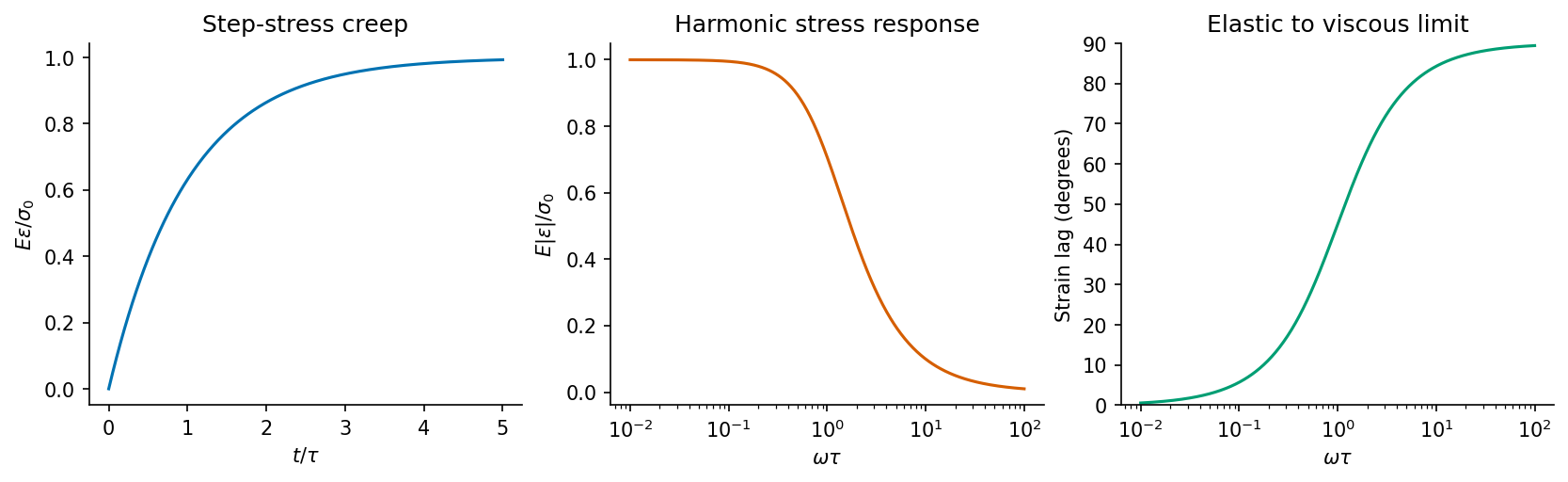
Original Kelvin-Voigt predictions for step-stress creep, frequency-dependent compliance and stress-strain phase lag
. Details. 
On a timescale short compared with , or for , the dashpot strongly resists rapid deformation. The imposed oscillating stress produces a small strain, of amplitude approximately , nearly90degrees behind the stress. The network appears stiff and predominantly viscous in this stress-controlled high-frequency limit. It is not an ideal perfectly rigid body at finite frequency.
For a slowly varying load with , the dashpot stress is small relative to the spring stress. The strain approaches almost in phase, so the low-frequency response is predominantly elastic. A constant load approaches the finite equilibrium strain ; it does not sustain steady viscous flow in this parallel network.
For a rubber-like solid, a spring is a first model of recoverable elasticity, while a viscous element can represent rate-dependent loss and delayed recovery. An immediate extension followed by bounded delayed material creep is represented by series spring and Voigt-branch creep, a standard linear solid model:The first term is immediate and recoverable; the second is delayed and also recoverable. For a load held until , recovery after a finite-duration stress load predicts an immediate drop of on unloading, followed byThis supplies a direct comparison with a loading-and-unloading observation: the model returns completely to its original length, with separate immediate and delayed recovery. A single Kelvin-Voigt model misses the immediate compliance, while a free series dashpot would predict unbounded flow that an intact crosslinked rubber need not show. A spring alone suffices over a timescale on which the measured response is effectively immediate and elastic.
These are local small-strain analogues. Large-strain rubber elasticity is nonlinear, nearly incompressible and sensitive to temperature, loading history and internal damage. A small set of linear springs and dashpots cannot reproduce every amplitude, timescale or hysteresis loop.
No numerical rubber trace or fitted constants are supplied, so these are explicit qualitative model predictions for comparison with the practical observations.
A physical mechanics model of wood must at least acknowledge anisotropy: stiffness and creep depend on loading direction. Direction-dependent elastic elements can represent different small-strain moduli, and delayed elastic branches can approximate time-dependent strain. A linear-solid network can therefore be a local fit under specified direction, moisture and temperature, rather than a universal scalar constitutive law.
An immediate strain followed by delayed material creep is captured locally by a spring plus a Kelvin-Voigt model branch. If residual deformation remains after unloading, a Burgers material adds a free series dashpot . Under a constant load,After a hold time , the two elastic contributions recover and the dashpot retainsThus immediate recovery, delayed recovery and a residual set identify different roles for the components; an observed permanent set would rule out a purely recoverable linear-solid fit. A viscous dashpot does not itself model a yield threshold or structural damage. Strength loss, splitting, moisture-dependent response and nonlinear compression cannot be represented by one fixed linear Kelvin-Voigt model. No direction-specific measured trace is supplied, so selecting numerical parameters requires the practical data; the constitutive predictions and their limitations are the model comparison that can be made from the paper.
Articles by others on the same topic
There are currently no matching articles.