With , the curve isIt rises linearly from zero, bends downward and approaches the plateau . Its half-height occurs at .
For , the dashpot contributes the larger strain and dominates the compliant response. For , dashpot deformation during a cycle is small relative to spring strain, and the response is spring-dominated. The crossover separates these regimes rather than a discontinuous transition.
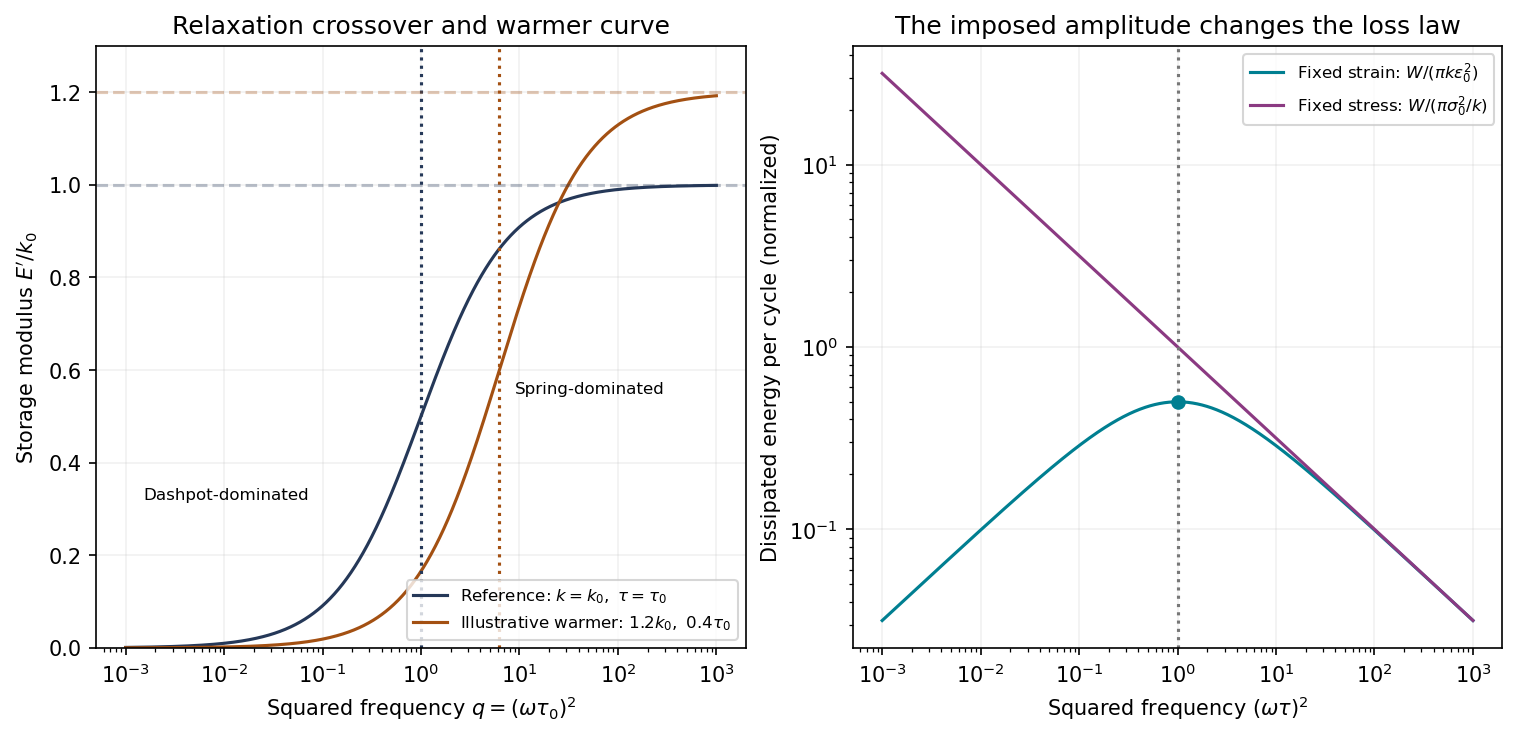
Original Maxwell storage curves versus squared frequency and the distinct dissipation laws at fixed strain and fixed stress amplitudes; axes use logarithmic spacing to show both regimes
. Details. 
The conventional relaxation-loss peak near applies to fixed strain amplitude, not to fixed stress amplitude. This distinction matters because the question explicitly describes oscillating stress.
The full complex modulus of the series Maxwell element isFor imposed strain , the energy dissipated per volume per cycle isSince has its maximum at , fixed-strain loss per cycle peaks at . At that scale the imposed cycle time is comparable with the relaxation time, and substantial viscous flow occurs while stress remains appreciable.
For the literally stated comparison with fixed stress amplitude, use the complianceThe dashpot strain rate is . Its dissipation integrated over a period givesThis decreases monotonically with frequency; there is no finite-frequency maximum at fixed stress amplitude in the ideal Maxwell model. Its mean dissipated power is , independent of frequency. The formal low-frequency divergence in energy per cycle accompanies very large strain excursions and cannot be extrapolated beyond the linear model's range. The graph identifies both results rather than assigning the fixed-strain peak to the wrong loading condition.
Articles by others on the same topic
There are currently no matching articles.