The fluorite structure has Ce on the corner and face-centre sites of a face-centered cubic lattice. Oxygen occupies all eight positions with each coordinate independently or . In projection, there are four oxygen positions , each representing two heights. Accounting for shared boundary sites gives four Ce and eight O per conventional unit cell.
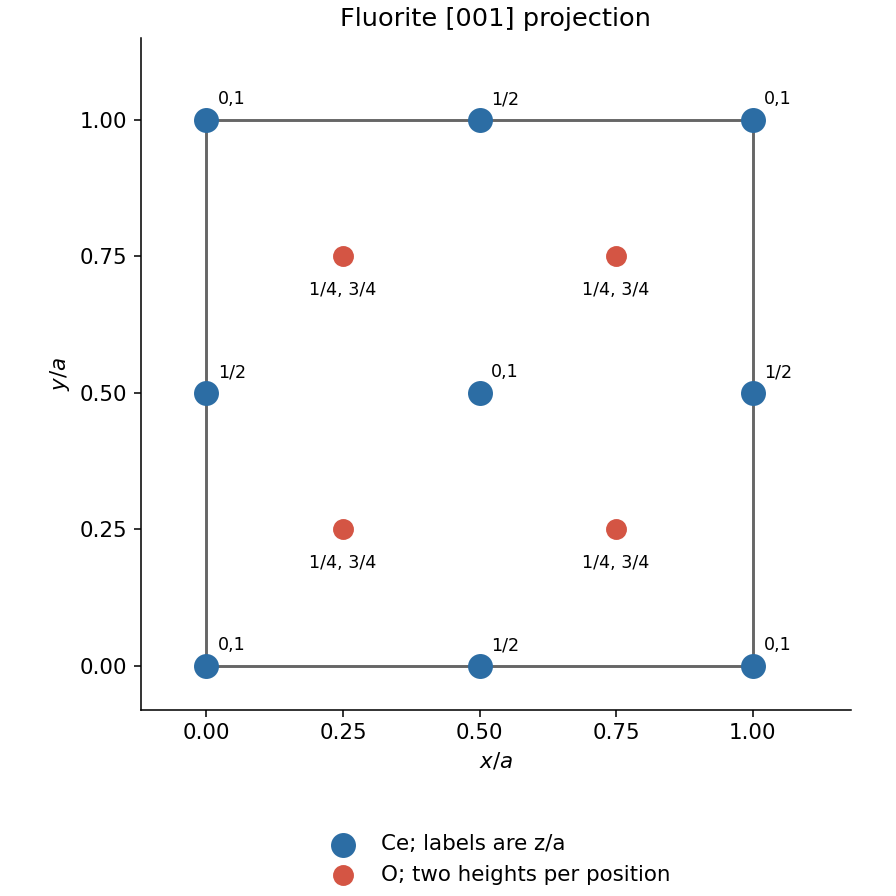

There are four cation sites per conventional unit cell, hence Gd substitutions per cell on average. Two substitutions of Gd for Ce require one oxygen vacancy for charge neutrality, so the cell contains vacancies. Equivalently, the composition is . ThereforeThis uses the supplied lattice parameter literally and treats it as the conventional fluorite-cell edge.
An oxygen vacancy has effective carrier charge . Combining its density with its own diffusion coefficient in the Nernst-Einstein relation givesat . The oxygen ions move oppositely to the vacancies and carry the same conventional current. This estimate assumes independently migrating vacancies, negligible correlation corrections, and negligible electronic contribution to the reported ionic conductivity.
Write the Arrhenius equation as . Eliminating the prefactor with two temperatures givesUse absolute temperatures and . Because the input is a vacancy diffusion coefficient, this is a migration activation energy inferred from that diffusivity; an additional vacancy-formation energy should not automatically be added.
Each missing oxide ion leaves two units of excess positive effective charge, compensated by reducing two Ce ions to Ce. For oxygen vacancies per conventional unit cell, of its four cerium ions must be trivalent: 10% Ce. This assumes the same number of cation sites per unit volume as in the doped calculation and that oxygen loss is compensated entirely by this cerium-valence change. If reduction changes the cell volume appreciably, matching the absolute vacancy density requires correcting the percentage for that change.
Articles by others on the same topic
There are currently no matching articles.