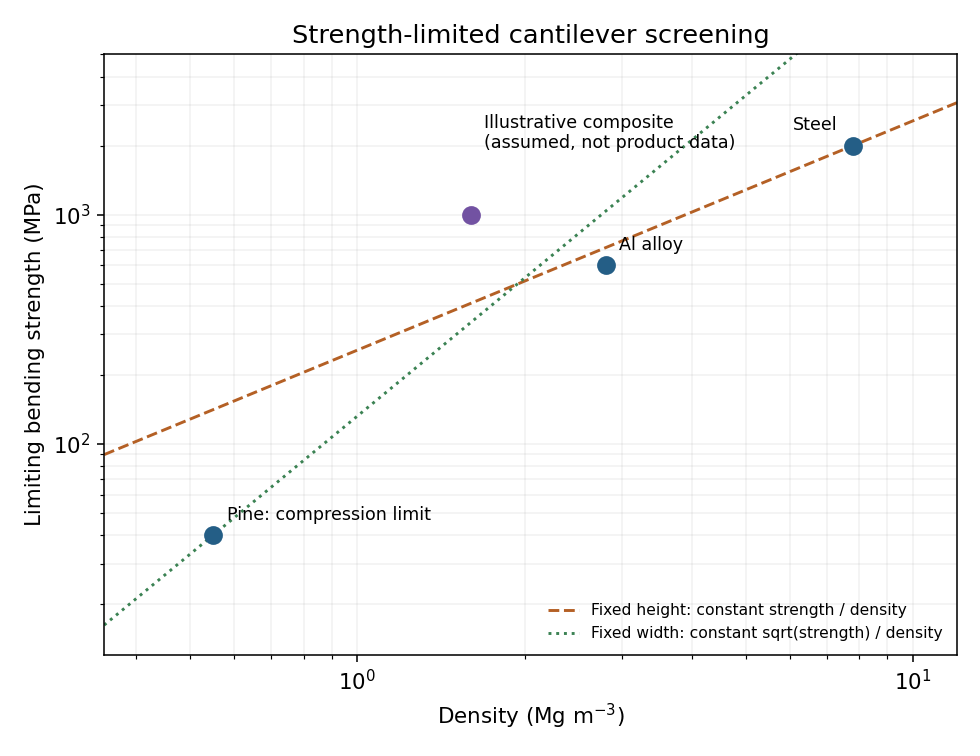
Both outer faces of the cantilever are loaded, so use the pine's lower longitudinal compressive strength, , rather than its tensile strength. Consistent SI units give values for steel, aluminium and pine respectively. Their values are . Hence Design A: steel best, pine worst; Design B: pine best, steel worst. Aluminium is intermediate in both cases. These rankings concern the stated strength constraint; a toughness or deflection constraint could change feasibility.
At identical applied load and fixed geometric constraints, minimum mass is inversely proportional to the appropriate material performance index. ThereforeThe same percentages apply to weight under the same gravitational acceleration. It would be incorrect to compare densities alone, since the required beam dimensions also change.
On a logarithmic strength–density materials selection chart, constant gives , a guideline of slope one; constant gives , of slope two. Moving each guideline upwards selects better candidates. A suitably qualified longitudinal carbon-fibre-reinforced polymer is a promising candidate for both designs. Composite families occupy favourable high-strength/low-density regions in published course selection charts, but a beam must meet its compressive as well as tensile allowable.[ref]
Examples of Materials Selection by Wright State University. Unit 5, strength–density charts and composite selection examples; family comparisons are screening evidence, not universal longitudinal compression data

Articles by others on the same topic
There are currently no matching articles.