The fixed support supplies the end shear force and the largest bending moment, . In elementary beam bending, the greatest longitudinal tensile and compressive stresses lie on opposite outer faces of the section at the fixed end, with zero longitudinal bending stress on the neutral axis. For a downward tip load on a horizontal cantilever, the upper face is in tension and the lower face in compression. Transverse shear stress has a different distribution, largest near the neutral axis for a rectangular section; “highest force” should therefore be interpreted with the stress component specified.
The rectangular second moment of area is . The maximum bending stress in the cantilever is . If is fixed, choose the minimum allowed width . Its mass is thenThus the material performance index to maximize isFor unequal tensile and compressive strengths, use the smaller permissible stress in this symmetric section. The derivation assumes bending-strength control, not a separate deflection, shear, buckling or existing-crack constraint.
With fixed, bending strength requires . Substitution into the cantilever mass givesThe material performance index to maximize is thereforeChanging the free geometric variable changes the strength exponent. A stiffness-limited problem would instead involve Young's modulus; the supplied modulus does not enter this strength-only index.
Both outer faces of the cantilever are loaded, so use the pine's lower longitudinal compressive strength, , rather than its tensile strength. Consistent SI units give values for steel, aluminium and pine respectively. Their values are . Hence Design A: steel best, pine worst; Design B: pine best, steel worst. Aluminium is intermediate in both cases. These rankings concern the stated strength constraint; a toughness or deflection constraint could change feasibility.
At identical applied load and fixed geometric constraints, minimum mass is inversely proportional to the appropriate material performance index. ThereforeThe same percentages apply to weight under the same gravitational acceleration. It would be incorrect to compare densities alone, since the required beam dimensions also change.
On a logarithmic strength–density materials selection chart, constant gives , a guideline of slope one; constant gives , of slope two. Moving each guideline upwards selects better candidates. A suitably qualified longitudinal carbon-fibre-reinforced polymer is a promising candidate for both designs. Composite families occupy favourable high-strength/low-density regions in published course selection charts, but a beam must meet its compressive as well as tensile allowable.[ref]
Examples of Materials Selection by Wright State University. Unit 5, strength–density charts and composite selection examples; family comparisons are screening evidence, not universal longitudinal compression data
For scale, an explicitly illustrative candidate with in both required loading senses and would have and , exceeding the best supplied materials. These are assumed screening values, not measured properties of a specified product.
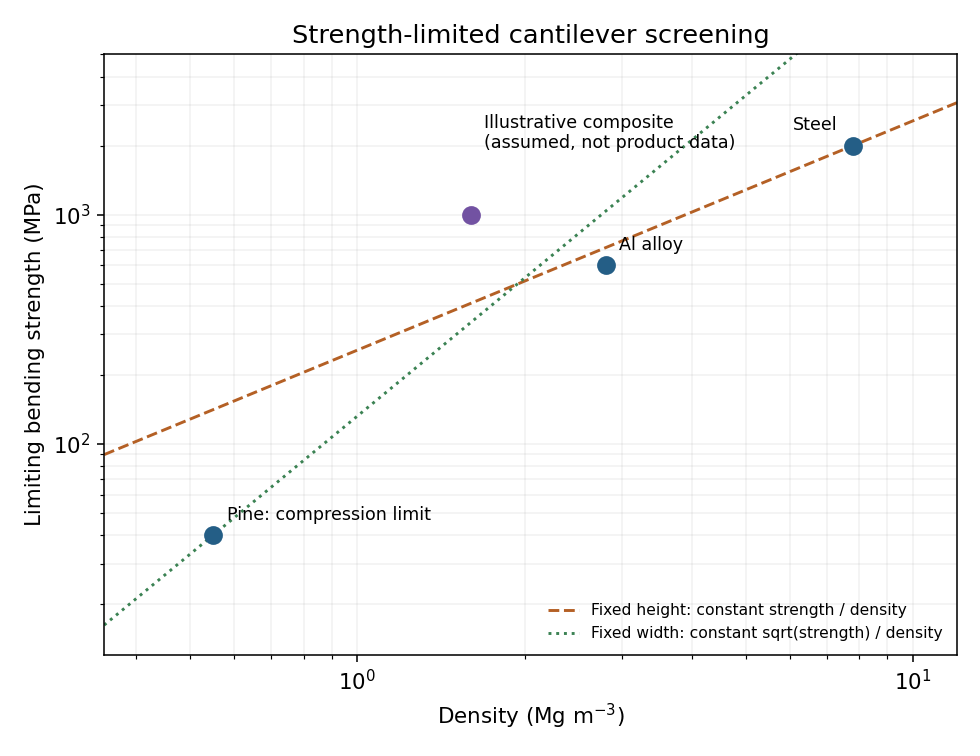
Strength–density selection with the two cantilever merit-index guidelines
. Original chart of the three supplied candidates and one explicitly assumed composite design point. Pine uses its compression limit; the figure is not a complete material-family database. Details.
Check stiffness and tip deflection using Young's modulus, failure from existing cracks using fracture toughness or the supplied critical energy-release rate, local crushing at supports, shear failure, buckling, fatigue and joint design. In a simple linear-elastic crack model, , so toughness cannot be inferred from strength alone. Wood also has grain-direction dependence, moisture sensitivity, natural defects, property scatter and time-dependent creep; the design must control grain alignment and compression-side stability. Metals raise issues of corrosion, mass, joining, machining, residual stress and heat-treatment state. Cost, availability, reproducibility, service temperature and end-of-life treatment can decide between otherwise feasible designs. A high merit index is a screening result, not a complete safety specification.
Articles by others on the same topic
There are currently no matching articles.