De Moivre's theorem states that, for real and integer ,It follows from and exponent multiplication. Negative integers are allowed because this unit-modulus complex number is nonzero. For a general polar number , its integer power also has the factor .
Take the imaginary part of the eighth-power binomial expansion in De Moivre's theorem. With and ,Substitute and collect powers:Therefore the requested leading coefficient isThe other coefficients, if retained as an algebraic check, are . No division by or is needed, so the identity remains valid when either vanishes.
Set . The required sine sum is the imaginary part of a finite geometric series:The denominator is . The numerator's imaginary part isDividing and multiplying numerator and denominator by provesFor real , , so there is no exceptional angle requiring a limiting interpretation. At the expression reduces to .
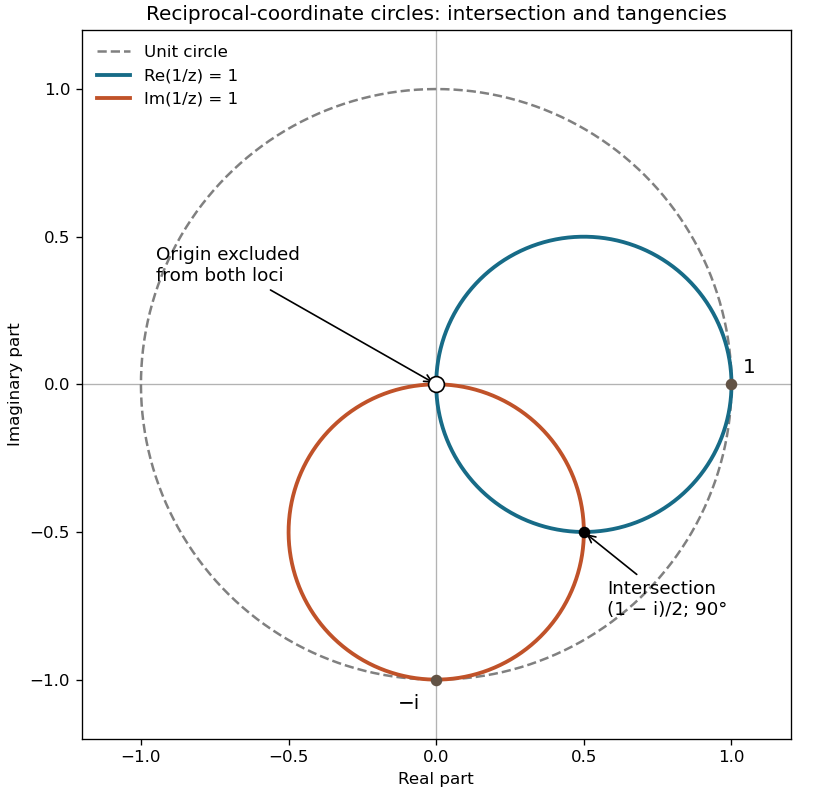
For , . The first constraint is and the second is . Completing the squares givesThese circles have centres and and radius . Their algebraic intersections satisfy and , giving zero and . Zero is excluded from both original loci, so their only actual intersection isAt the two circle normals are and , so the tangent directions are perpendicular. The intersection angle is . This is also an instance of the orthogonality of reciprocal-coordinate circles under complex inversion.
The first small circle touches the unit circle at , and the second at . On the first, ; on the second, . Thus each lies entirely within , attaining equality only at its stated point. They are internally tangent to the unit circle and do not cross it. The original sketch marks the excluded common origin with an open symbol and the genuine intersection with a filled symbol.

Articles by others on the same topic
There are currently no matching articles.