Source paper: www.whatdotheyknow.com/request/physics_preliminary_examinations/response/1162943/attach/3/Twain.7z?cookie_passthrough=1
The cover identifies the ordinary sitting on 5 June 2013. All questions and all Section B alternatives are covered, including the nested Roman subparts.
Rationalizing the denominator givesHence its real part, imaginary part, complex modulus, and principal argument are respectivelyThe quadrant matters: the real part is positive and the imaginary part negative. For the exponential expression, Euler's formula gives , so the same four quantities areGeneral complex arguments are obtained from each stated principal argument by adding , .
Let satisfy and put . The exponential definition of the complex sine givesThe quadratic formula therefore gives . Taking the complex logarithm yields the multivalued complex inverse sine formulaThe two quadratic roots have product , so neither is zero and their logarithms exist as multivalued quantities. If is one local inverse value, the complete set of values is and , with .
Branch qualification: the source's formula describes the branches of the complex inverse sine, not two interchangeable expressions for a single chosen inverse branch. At , the plus sign with the usual local choices gives , whereas the minus sign with gives . Thus both signs cannot simultaneously equal the principal inverse at zero. A principal complex inverse sine requires compatible square-root and logarithm branches, normalized to at zero and continued on the chosen cut domain.
Write all vectors in Cartesian components. The first component of the nested cross product isThe missing terms cancel as . Computing the and components by cyclic permutation gives the same form, proving the vector triple product identityApply this expression to the three cyclic terms. Their sum isEach coefficient cancels because the dot product is symmetric. This is the Jacobi identity for the cross product.
Let with and . Taking the conjugate of the scalar givesSince , it follows thatThus every nonzero eigenvalue of an anti-Hermitian matrix is purely imaginary; zero is allowed as well.
For and , compute the same mixed scalar in two ways:Using gives . ThereforeThe relevant orthogonality uses the complex inner product, not the unconjugated bilinear dot product. Repeated eigenvalues do not force every possible pair of eigenvectors within that one eigenspace to be orthogonal.
The original basis matrix has columns and determinant . Evaluating the defining cross products givesFor instance, , which must be divided by the negative denominator . These vectors satisfy , the defining reciprocal basis relations.
Dotting the desired expansion with the reciprocal vectors yieldsIndeed . The original basis is not orthonormal, so taking dot products with the original vectors would not give these expansion coefficients.
Here the dependent variable is and the independent variable is . Multiplying the equation by and setting gives a linear equation:An integrating factor is , soThus . The initial point fixes , and the positive branch through that point isEquivalently, inverting this branch givesThe source equation contains in the denominator. The endpoint with is therefore excluded even though the inverse expression has a finite limit there. A negative- branch cannot be joined through that endpoint to produce a solution of the original equation. The interval shown is the maximal real positive branch containing the initial point.
The characteristic polynomial of the homogeneous equation factors as , giving the complementary function . For a particular solution take . Comparing cosine and sine coefficients gives and , hence . ThereforeThe initial conditions imply and , so . The required solution isIt has and , and direct differentiation verifies .
The second coordinate is already an eigenvector with eigenvalue . On the first and third coordinates the characteristic polynomial isThus the full eigenvalues are . A corresponding orthonormal eigenbasis isTheir pairwise dot products vanish and each has norm one. Substitution checks and . The two-dimensional repeated eigenspace permits any orthonormal pair spanning the same plane; the displayed choice is convenient because it separates the second coordinate.
For an ordinary real quadratic form, split the matrix into its symmetric part and skew-symmetric part:The scalar equals its transpose , so it is zero. ConsequentlyThis uses transpose because the source form is bilinear. A complex Hermitian form would instead require the conjugate-transpose decomposition.
The symmetric part of the displayed matrix isIt equals the matrix of 8 plus , so the same orthonormal eigenbasis gives eigenvalues . In coordinates along , respectively, the level set isAll three eigenvalues are positive, so this is an ellipsoid with semi-axis lengths . The short axis is along , and the plane of the longest axes is .
A natural longest-axis direction in the plane is . The angle of a unit vector to the plane has , givingfor that choice. Degeneracy qualification: the two longest semi-axes are equal, so “the longest axis” does not specify a unique direction. The equally valid longest axis lies in and has angle zero. Generally is a longest-axis unit vector, withThis is the principal-axis freedom in a repeated ellipsoid eigenspace; a unique answer needs an extra axis-selection convention.
The coefficient matrix and right-hand side areFor an LU decomposition with unit diagonal in the lower factor, subtract row 1 from row 2, add twice row 1 to row 3, and then add the new row 2 to row 3. The elimination multipliers are , , and . ThusMultiplication verifies . Forward substitution in gives , , and . Back substitution then gives , , and :Every pivot is nonzero, so no row permutation is needed and the linear system has a unique solution.
De Moivre's theorem states that, for real and integer ,It follows from and exponent multiplication. Negative integers are allowed because this unit-modulus complex number is nonzero. For a general polar number , its integer power also has the factor .
Take the imaginary part of the eighth-power binomial expansion in De Moivre's theorem. With and ,Substitute and collect powers:Therefore the requested leading coefficient isThe other coefficients, if retained as an algebraic check, are . No division by or is needed, so the identity remains valid when either vanishes.
Set . The required sine sum is the imaginary part of a finite geometric series:The denominator is . The numerator's imaginary part isDividing and multiplying numerator and denominator by provesFor real , , so there is no exceptional angle requiring a limiting interpretation. At the expression reduces to .
For , . The first constraint is and the second is . Completing the squares givesThese circles have centres and and radius . Their algebraic intersections satisfy and , giving zero and . Zero is excluded from both original loci, so their only actual intersection isAt the two circle normals are and , so the tangent directions are perpendicular. The intersection angle is . This is also an instance of the orthogonality of reciprocal-coordinate circles under complex inversion.
The first small circle touches the unit circle at , and the second at . On the first, ; on the second, . Thus each lies entirely within , attaining equality only at its stated point. They are internally tangent to the unit circle and do not cross it. The original sketch marks the excluded common origin with an open symbol and the genuine intersection with a filled symbol.
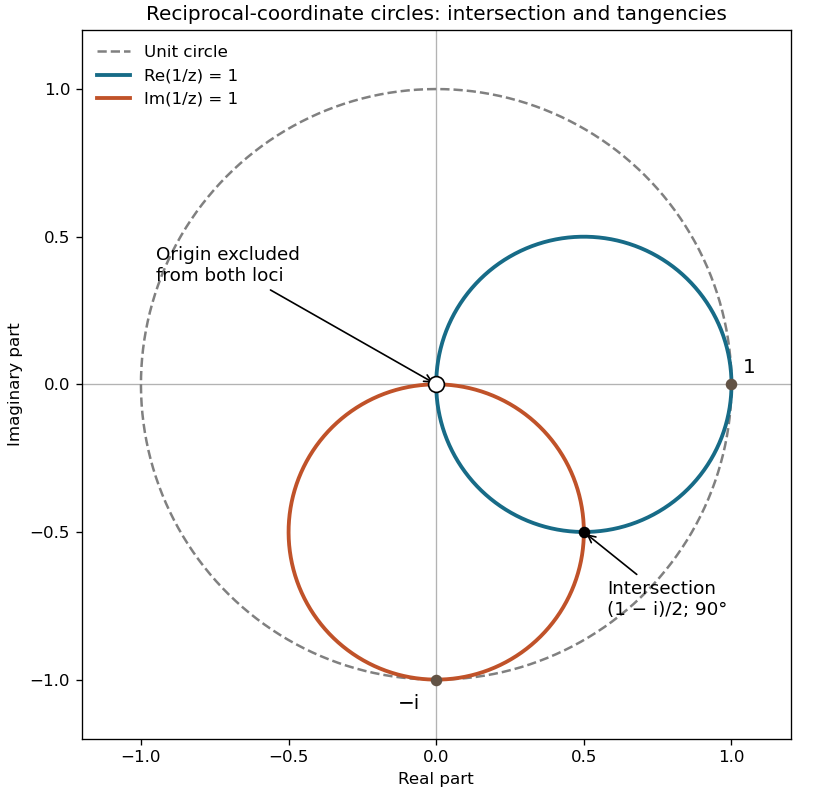
Original Argand diagram of reciprocal-coordinate circles, their orthogonal intersection, and tangency to the unit circle
. Details. 
Each Pauli matrix has zero diagonal sum and determinant . Direct multiplication gives . Thus all requested quantities, for each , areFor example, , checking that its imaginary entries do not introduce a minus sign in the square.
The cyclic products obtained by direct matrix multiplication are , , and . Reversing any two distinct indices changes the sign; equal-index products are . Therefore every pair is covered byHere is the anticommutator and the commutator. Explicitly the three diagonal anticommutators are , all six off-diagonal ones are zero, and all three diagonal commutators vanish. The cyclic commutators are , respectively, with their reversed partners negative. The convention is .
Combine the diagonal and cyclic products from b into . Distribute the coefficients in the two Pauli-vector factors:The inner sums are precisely the components of , soInterchanging the two factors shows that their commutator is . The three Pauli matrices are linearly independent: the entries of are , which vanish together only when . ThusFor nonzero real vectors, this means parallel or antiparallel directions. The dot and cross products here are bilinear; no complex conjugates are inserted if complex coefficients are considered.
Setting in i removes the cross product term and gives . Repeated multiplication therefore yields, for nonnegative integers ,The zeroth power is . If negative powers are intended, they require , and the same parity formulas then follow from . Every nonzero real vector meets that condition; a nonzero complex null vector need not. For example, has and no inverse.
For a real unit vector , let . Then , so even powers are and odd powers are . Split the absolutely convergent matrix exponential into its even and odd series:The result holds for every real , not merely small angles. Its two scalar series are the ordinary cosine and sine series.
The second equation gives . Differentiating it gives . Substitution into the first equation cancels the terms and the constant forcing, leaving . HenceThis has two independent constants, as expected for the first-order linear system of differential equations. At zero, the conditions give and . Thus the required particular solution isChecking directly, , while . This also verifies the signs introduced during elimination.
On an interval with , an integrating factor is . Multiplication givesIntegration therefore yieldsThe polynomial formula has a smooth continuation at , but the original coefficient is undefined there. Solution intervals for the stated equation must avoid that point, and the constants on its two sides need not agree.
The logarithm requires for real-valued solutions. Put . Since , the equation becomes . For a nonzero branch, separation givesRenaming the constant and restoring givesDividing by would omit the equilibrium , so the full solution set also includes . The nonzero branches are defined on connected intervals with and . A regular solution cannot switch from a nonzero branch to zero at an ordinary point, because the right-hand side is locally Lipschitz in there. These domain restrictions are part of the full real solution.
Articles by others on the same topic
There are currently no matching articles.