The right-hand side has modulus two and argument . Its fifth roots therefore haveThey are the vertices of a regular pentagon on the circle of radius , beginning at angle . These five roots are distinct, and a degree-five polynomial has no further complex roots.
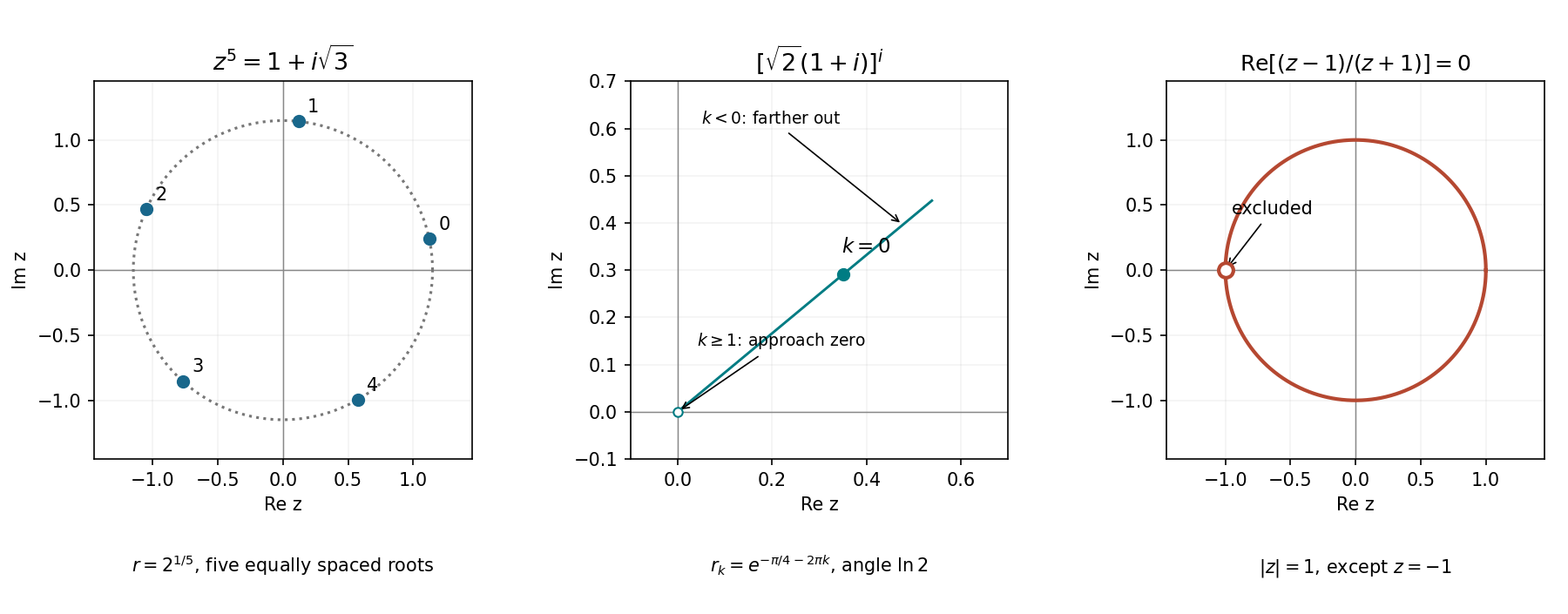
The fifth roots, the discrete ray of values of a complex power, and the unit-circle locus with its excluded point
. Details. 
The base is . Its complex logarithms are , . Exponentiating times each logarithm gives all values of the multivalued power:The values form a discrete geometric sequence along the Argand ray of angle . Consecutive radii differ by . The origin is an accumulation point but is not itself a value. If the power is instead defined using the principal logarithm, only is retained. The phrase “all values” requires this branch distinction.
For , multiply numerator and denominator by . The real part isThus its zero locus isIt is the unit circle with the point removed. That point cannot be restored by the zero numerator obtained after clearing a denominator: the original expression is undefined there.
Articles by others on the same topic
There are currently no matching articles.