The first Saint-Venant equation conserves water volume. The second balances material acceleration against downslope gravity, bed friction and the free-surface pressure gradient. With length scale , depth scale , slope and velocity scale , the conventional gravity-friction scaling has and Froude number . The pressure-gradient/downslope-gravity ratio is , and the inertia/downslope-gravity ratio is .
The uniform steady solution obeys and , hence . In the constant-flux river momentum relaxation reduction, substitute and . Since and , the resulting quasilinear partial differential equation isA downstream boundary at supplies data into precisely when , equivalent to . Although water flows out there, the relevant characteristic curves carry information upstream in this subcritical regime.
Along a characteristic curve, and . Positive relaxes toward ; near , its displacement decays at rate . Boundary-generated deviations therefore become small after a time of order and, while the characteristic speed stays bounded away from zero, within a distance of order . The outer state is the initial uniform solution. A jump between initial and boundary values at their corner can produce a weak solution or a thin initial adjustment; a globally smooth corner solution requires compatible data.
For the moving boundary put . The characteristic speed relative to it is , while the outer speed isFor the intended tidal slowing , is decreasing in and hence throughout the relaxation. Thus leaves an incoming family and an attached thin boundary layer. The diagram shows numerical characteristics of this scalar reduction, with a slower boundary velocity. When , the tidal boundary overtakes the unperturbed characteristic family; an attached smooth relaxation layer is no longer appropriate, and a tidal bore or shock wave can arise in a fuller river model.
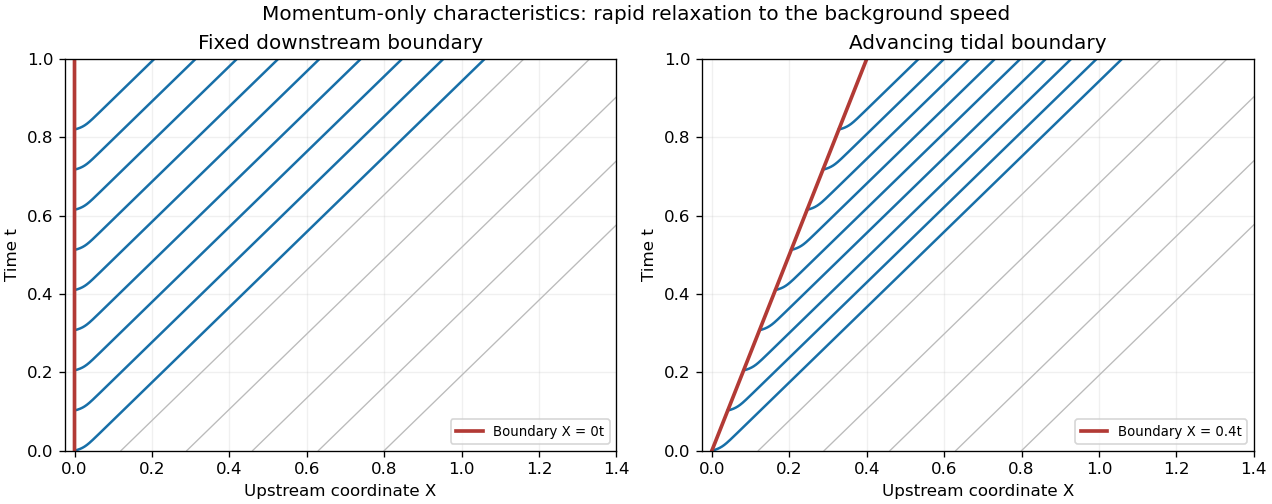
Characteristics leaving a slowly advancing tidal boundary
. Original calculation for the scalar momentum reduction, with , , , and . Curves approach the background characteristic speed after a short relaxation; this is not an exact solution of the full mass-and-momentum system. Details.
There are two qualifications to the printed reduction. First, without the physical slowing assumption, alone need not make the boundary incoming: for , also require . Second, imposing exactly everywhere in the original continuity equation gives , and consequently . The time-dependent characteristics above solve the requested momentum-only approximation, rather than the complete Saint-Venant equation system with an exactly constant flux.
Articles by others on the same topic
There are currently no matching articles.