Put . The NFW profile becomes . Integrating spherical shells givesDefine . The spherical circular speed is thereforeAt small , the bracket is , givingAt large , the bracket is , givingThus the curve rises from zero, reaches one broad maximum, and eventually falls as . The untruncated NFW profile has logarithmically divergent mass, but its circular speed still tends to zero.
Differentiating shows that its stationary point satisfiesThe numerator of has derivative : it increases up to one and decreases thereafter, crossing zero once at positive . Numerical bisection gives and . HenceEquivalently . This is the NFW mass and circular-speed profile.
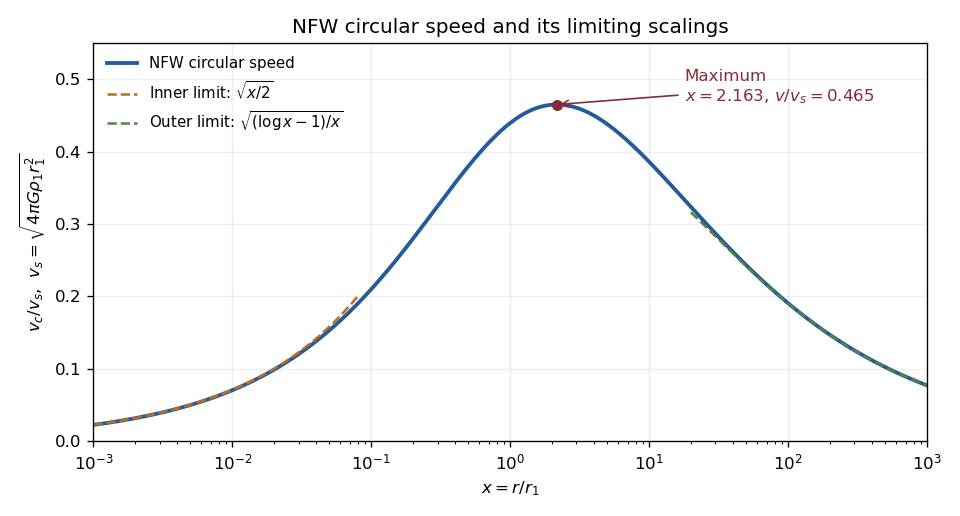
NFW circular speed, its maximum and inner and outer asymptotic scalings
. Details. 
Observed galaxy rotation curves commonly remain approximately flat across much of the measured outer luminous disk. A pure NFW profile is not an exactly flat curve: it rises in the inner cusp and ultimately declines. Nevertheless, its broad maximum can look nearly flat over a finite radial range, so observing a flat segment does not by itself exclude an NFW halo.
The measured circular speed responds to the total gravitational potential, including stars and gas as well as dark matter. For components in the same plane,For spherical components this reduces to ; a disk contribution must instead be computed from its actual disk potential. Baryonic mass can supply much of the inner rotation and modify the halo through slow contraction or more impulsive evolution. Thus the appropriate comparison is with the combined mass model, not an isolated halo-only curve. At arbitrarily large radius a finite isolated galaxy must eventually have a declining circular speed; an observed flat segment is not a claim of flat rotation to infinity.
Use the usual spherical circular-shell adiabatic contraction approximation: initial dark-matter orbits are circular, slow accumulation keeps them circular, and dark shells do not cross. Angular momentum is conserved in a spherical potential, and the vanishing radial action stays zero as an adiabatic invariant. For a circular shell,Here is the initial shell radius and its final radius. The final flat circular speed gives .
For an initial shell in the inner NFW profile, write , so . The invariant givesConservation of dark shell mass yieldsand differentiation givesTo express the requested ratios, set and , so . Since the original cusp has ,The total density of the final spherical flat-rotation model is . Its dark fraction isSubtracting dark matter from the total gives the added-matter density, , and thusThese expressions describe the leading inner approximation, not an extension to radii where the denominator becomes negative or the initial shell is outside the NFW cusp. As , dark matter is enhanced relative to its original density while its fraction of the even steeper total density tends to zero. This is inner NFW contraction to a flat rotation curve.
The orbital assumptions matter. An initial density profile does not specify the phase-space distribution function. For eccentric orbits, slow evolution conserves their actions, but at an instantaneous radius is not generally their invariant. The above ratios are the intended circular-shell estimate; their numerical coefficients cannot be uniquely inferred from the density profile and slow accumulation alone.
Articles by others on the same topic
There are currently no matching articles.