Build the spherical system by adding shells from the centre outwards. The shell theorem says that a shell of mass at radius interacts with the already assembled interior mass through potential . Thus its contribution is . Each pair is counted when its outer member is added, so no further factor of one half is needed:Integration by parts givesFor an isolated finite-mass system without a singular central point mass, the endpoint term vanishes provided the central cusp has finite binding energy. ConsequentlyThis is the spherical binding-energy mass integral. If a central singularity makes the endpoint or integral divergent, the finite-energy assumption must be checked rather than silently discarding that term.
Work in the centre-of-mass frame and define , . Differentiation givesFor each gravitational pair, the two contributions combine toSumming pairs therefore gives the exact scalar virial theoremIn a stationary equilibrium, or a bounded long-time average with vanishing average , . With , the stated gravitational radius gives , henceThe rms speed itself is . This is a three-dimensional mean-square speed; for an isotropic system the one-component velocity dispersion is smaller by a factor of three in its square. No assumption about a uniform spatial density was used.
Take the gravitational potential to vanish at infinity. At the position of star , excluding its own point-mass field, the instantaneous test-particle escape velocity obeys . The factor of one half in the total gravitational potential energy is important:Therefore the equal-mass average isThus the rms escape speed is twice the equilibrium rms speed. This is the virial mean escape speed relation, using the same three-dimensional averaging convention as the preceding part. It concerns escape in the instantaneous system potential, rather than a subsequent collective rearrangement of the cluster.
At rest with all separations initially infinite, both initial kinetic and gravitational energies vanish, so the conserved total energy is zero. During an isolated collapse, , rather than the equilibrium relation . Hence at the stated instantaneous gravitational potential energy,The rms collapse speed is times the rms equilibrium speed for the same instantaneous and mass. For a perfectly radial cold infall this mean-square motion includes coherent inward streaming; it need not equal a local random velocity dispersion after subtracting that streaming. The quoted comparison follows the question's global mean-square convention.
Put . The NFW profile becomes . Integrating spherical shells givesDefine . The spherical circular speed is thereforeAt small , the bracket is , givingAt large , the bracket is , givingThus the curve rises from zero, reaches one broad maximum, and eventually falls as . The untruncated NFW profile has logarithmically divergent mass, but its circular speed still tends to zero.
Differentiating shows that its stationary point satisfiesThe numerator of has derivative : it increases up to one and decreases thereafter, crossing zero once at positive . Numerical bisection gives and . HenceEquivalently . This is the NFW mass and circular-speed profile.
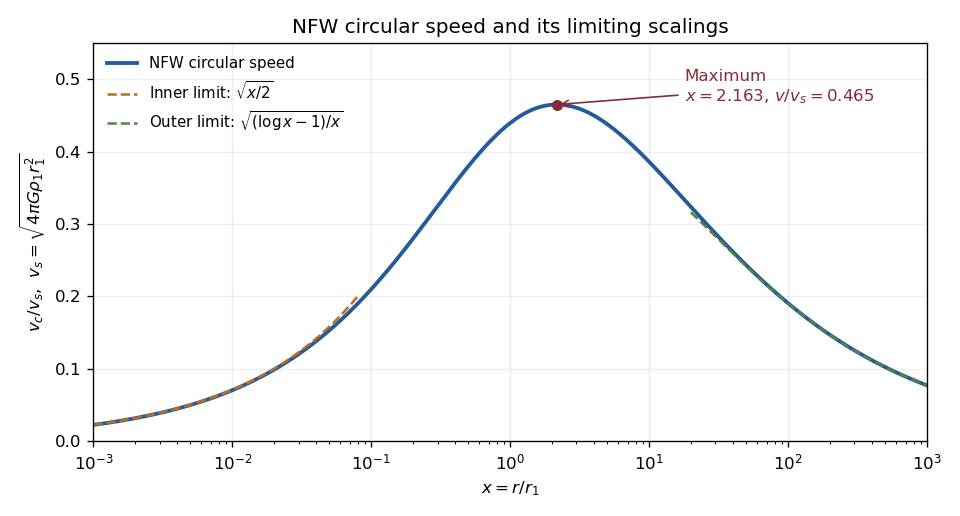
NFW circular speed, its maximum and inner and outer asymptotic scalings
. Details. 
Observed galaxy rotation curves commonly remain approximately flat across much of the measured outer luminous disk. A pure NFW profile is not an exactly flat curve: it rises in the inner cusp and ultimately declines. Nevertheless, its broad maximum can look nearly flat over a finite radial range, so observing a flat segment does not by itself exclude an NFW halo.
The measured circular speed responds to the total gravitational potential, including stars and gas as well as dark matter. For components in the same plane,For spherical components this reduces to ; a disk contribution must instead be computed from its actual disk potential. Baryonic mass can supply much of the inner rotation and modify the halo through slow contraction or more impulsive evolution. Thus the appropriate comparison is with the combined mass model, not an isolated halo-only curve. At arbitrarily large radius a finite isolated galaxy must eventually have a declining circular speed; an observed flat segment is not a claim of flat rotation to infinity.
Use the usual spherical circular-shell adiabatic contraction approximation: initial dark-matter orbits are circular, slow accumulation keeps them circular, and dark shells do not cross. Angular momentum is conserved in a spherical potential, and the vanishing radial action stays zero as an adiabatic invariant. For a circular shell,Here is the initial shell radius and its final radius. The final flat circular speed gives .
For an initial shell in the inner NFW profile, write , so . The invariant givesConservation of dark shell mass yieldsand differentiation givesTo express the requested ratios, set and , so . Since the original cusp has ,The total density of the final spherical flat-rotation model is . Its dark fraction isSubtracting dark matter from the total gives the added-matter density, , and thusThese expressions describe the leading inner approximation, not an extension to radii where the denominator becomes negative or the initial shell is outside the NFW cusp. As , dark matter is enhanced relative to its original density while its fraction of the even steeper total density tends to zero. This is inner NFW contraction to a flat rotation curve.
The orbital assumptions matter. An initial density profile does not specify the phase-space distribution function. For eccentric orbits, slow evolution conserves their actions, but at an instantaneous radius is not generally their invariant. The above ratios are the intended circular-shell estimate; their numerical coefficients cannot be uniquely inferred from the density profile and slow accumulation alone.
Integrate the reduced vertical phase-space distribution function over . The Gaussian velocity integral cancels its normalization, givingHere the constant vertical velocity dispersion is , and fixes the potential reference. Neglecting the radial derivatives in the Poisson equation for Newtonian gravity leavesWith , and , this becomesThus the stated dimensionless equation follows with its factor of two.
For a direct solution, multiply by and integrate from the midplane. The initial conditions giveFor take the increasing branch and put . Then , whose smoothly increasing solution consistent with the second-order equation is . Reflection about the midplane supplies the negative- branch. ThereforeSubstitution verifies and both boundary conditions. The smooth second-order equation has a unique solution for those initial data, so no extra constant branch from the first-integral square root is admissible.
This is the self-gravitating isothermal slab. Its scale convention matters: if its profile is instead written , then . Its surface density is . The force approaches , consistent with the field of a plane sheet. These checks fix both the scale-height and Poisson factors.
Work at in the region where the central black hole dominates the gravitational potential. Let be a star's specific angular momentum. Near its very small pericentre, the centrifugal term balances the deep gravitational potential. For an approximately parabolic passage with capture pericentre ,At radius , a velocity making angle with the inward radial direction has . Therefore the loss cone half-angle isTaking the characteristic speed to be the circular speed giveswith Newtonian circular-speed normalization . The inward cap occupies solid angle , or a fraction of an isotropic velocity sphere. Counting low-angular-momentum trajectories in both radial directions changes only an order-one factor; each such orbit is removed at its next pericentre.
The capture occurs in the strong-field region, so this Newtonian pericentre estimate is not an exact relativistic capture coefficient. The Schwarzschild capture calculation alters an order-one constant, while retaining the small-angle scaling for these characteristic Keplerian speeds.
A small loss cone does not by itself specify its supply rate. Introduce a characteristic orbital radius , an orbital period , the number of stars on the relevant energy range, and their local number density . Weak encounters of impact parameter give velocity kicks of order . Summing their squared kicks over encounter rate givesHere is the Coulomb logarithm in stellar dynamics. This derives the stellar relaxation time relevant to angular-momentum scattering, up to the velocity-averaging constants.
Let and define the dimensionless cone size . In one period, two-body relaxation changes by order , so the refilling parameter isIf refilling is sufficiently rapid to keep the cone populated, an isotropic fraction of order reaches its absorbing pericentre each orbit. The full-cone rate isIf , the cone is depleted and capture is diffusion-limited. At fixed orbital energy, the two transverse angular-momentum coordinates have an approximately two-dimensional diffusion equation. Its steady radial solution between the absorbing boundary and the reservoir satisfiesThe gradient supplies a constant inward flux. With diffusion coefficient of order and reservoir population , this givesConstants of two depend on using or and on the definition of . A rough interpolation uses the slower of the orbital draining and diffusion-supply rates; an accurate transition requires an orbit-averaged diffusion calculation. These are the empty and full loss-cone capture rates. In particular, multiplying by the cone's tiny solid-angle fraction would incorrectly treat diffusive feeding as independent isotropic redraws.
For a one-zone black-hole-dominated cluster with , and ,The mass ingestion rate is . A radially extended cluster requires summing the energy-dependent fluxes, not replacing every radius by the same . No numerical capture rate follows from alone: its radius/density, orbital distribution and refilling regime are required. The displayed relations are the requested estimates with those physical scales explicit.
The sign of cluster evolution depends on the orbital energy of the captured stars, not just on their small angular momentum. Let the instantaneous capture rate be , so the remaining stellar mass has , while . A captured star has negative specific orbital energy measured outside the absorbing region. Removing it increases the energy of the surviving stars by ; growth of the central black hole instead deepens their potential.
To turn this balance into a radius estimate, assume the surviving cluster evolves slowly through homologous virial equilibria of scale . Write its stellar self-energy and black-hole interaction energy aswhere positive depend on the density shape. The virial theorem givesAt the instant of capture, the stellar-system energy budget, excluding feedback and energy carried by other escaping stars, isThe second term is the work of the changing central potential; it must not be confused with the change in the number of stars. Differentiating the virial expression and using givesThis estimates the radius response of a general homologous cluster once its structure and capture energies are specified.
For a simpler locally Keplerian subsystem, neglect its stellar self-gravity, so . Put , with measuring how tightly bound a captured star is relative to the average orbital energy. The preceding balance reduces toThis is Keplerian cluster radius evolution under stellar capture. Removing representative-energy stars, , leaves unchanged the characteristic orbits if is fixed; with black-hole growth it contracts them at rate . Preferential removal of more tightly bound stars drives expansion if . In that heating-dominated case,so inserting the empty-cone flux gives for the one-zone estimate. Growth-dominated contraction instead has timescale .
For a Kepler orbit of semimajor axis , and . Reaching does not imply that the orbit had binding energy of order : a nearly parabolic star can reach that pericentre with almost zero orbital energy. Therefore expansion is expected when strongly bound central stars are preferentially swallowed, but the supplied information does not uniquely fix the sign or rate for the entire remaining cluster. Captured-energy selection, the density profile and any energy feedback must be specified. The balances above give both the conventional expansion estimate and the contraction case without assuming missing data.
Articles by others on the same topic
There are currently no matching articles.