In an Einstein-de Sitter universe, a slightly overdense spherical region initially expands nearly with the Hubble flow, with its early physical radius proportional to . Its extra self-gravity gradually slows its expansion relative to the background. The radius reaches a maximum at spherical-collapse turnaround, where the coherent radial velocity is zero; it then contracts. The ideal pressureless top-hat would collapse to a point, but real collisionless matter undergoes crossing and relaxation into a bound system with random motions and virial equilibrium.
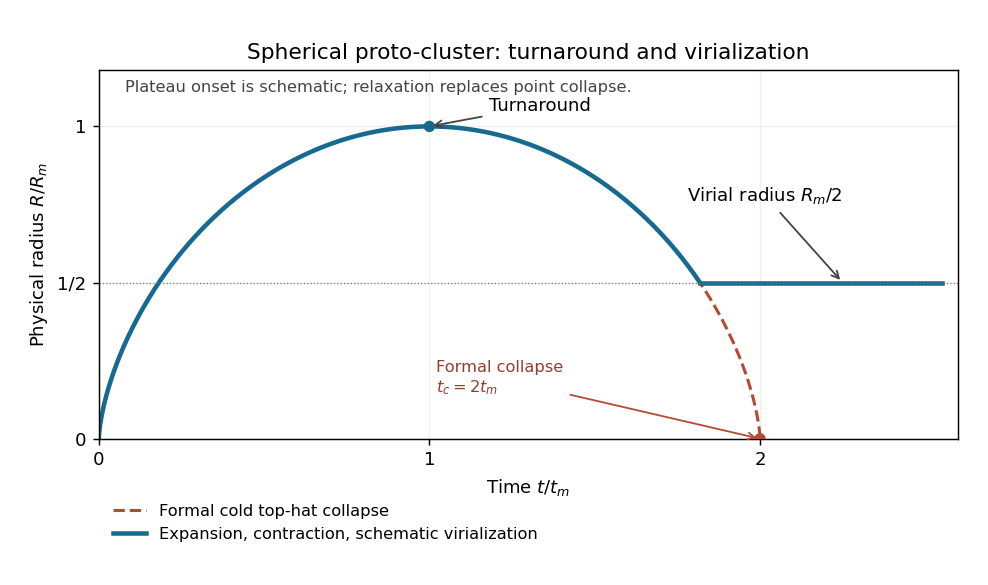
The bound-shell solution illustrates the stages:At , and ; the formal cold collapse occurs at , . For a uniform isolated sphere, let . At turnaround , whereas the final virial theorem gives . Conservation of energy gives , henceThe usual spherical-collapse prescription associates virialization with roughly the formal collapse epoch, not with a literal instantaneous halt of the cold shell. The sketch distinguishes the formal point collapse from the schematic settling at the virial radius:

Articles by others on the same topic
There are currently no matching articles.