In an Einstein-de Sitter universe, a slightly overdense spherical region initially expands nearly with the Hubble flow, with its early physical radius proportional to . Its extra self-gravity gradually slows its expansion relative to the background. The radius reaches a maximum at spherical-collapse turnaround, where the coherent radial velocity is zero; it then contracts. The ideal pressureless top-hat would collapse to a point, but real collisionless matter undergoes crossing and relaxation into a bound system with random motions and virial equilibrium.
The bound-shell solution illustrates the stages:At , and ; the formal cold collapse occurs at , . For a uniform isolated sphere, let . At turnaround , whereas the final virial theorem gives . Conservation of energy gives , henceThe usual spherical-collapse prescription associates virialization with roughly the formal collapse epoch, not with a literal instantaneous halt of the cold shell. The sketch distinguishes the formal point collapse from the schematic settling at the virial radius:
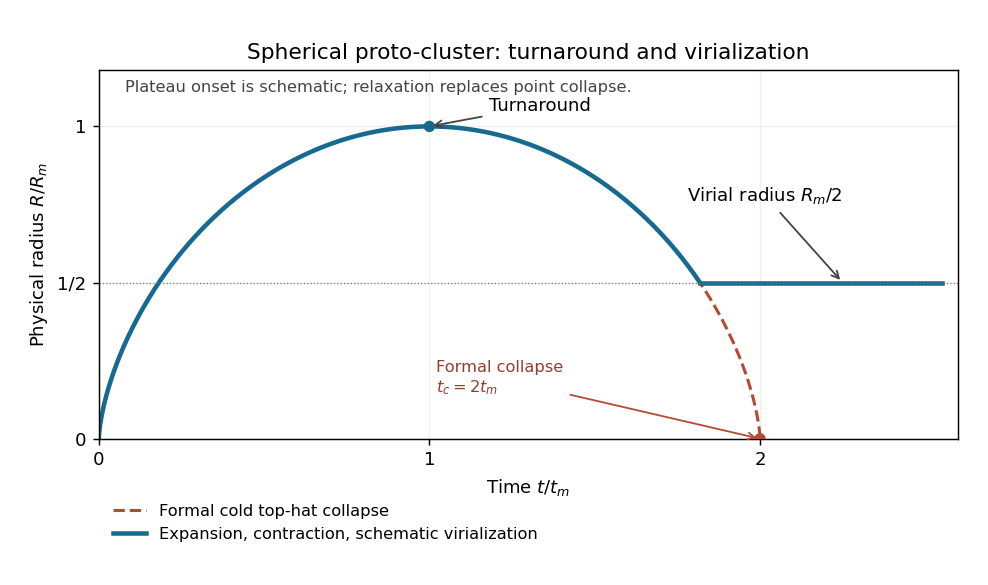
Spherical proto-cluster radius: expansion, turnaround, formal collapse and schematic virialization
. Details. 
The plateau onset is illustrative. A real cluster's relaxation, ongoing accretion and nonuniform density profile replace the cold solution, and surface pressure or energy exchange can change the half-radius estimate. The radius here is physical, not comoving.
For a uniform sphere of radius , write and . The self-gravitational potential energy is assembled by adding shells:The cosmological constant produces the external potential per unit mass , since in units . Its energy isThere is no additional factor for this fixed external potential, unlike the pair-counting factor for gravitational self-energy. At the maximum radius , the kinetic energy vanishes, soThis is the turnaround energy in uniform-sphere collapse with a cosmological constant. The original PDF's shell kinetic term is , not the produced by the TeX transcription.
For a homogeneous potential contribution of degree , the scalar virial theorem follows from the moment of inertia identity . Time averaging in equilibrium gives . Gravitational self-energy has degree , whereas has degree . Apply the theorem to the sum of the two contributions:With the uniform-sphere expressions this isThe cosmological-constant force is repulsive, so its virial contribution reduces the kinetic support required at a fixed radius. One must not apply the inverse-radius gravitational relation to the whole potential: the two terms have different homogeneity degrees.
Assume fixed mass, constant , no energy loss or surface work, and the same uniform-sphere structure coefficient at turnaround and virialization. Set and define the density in to be the mean turnaround density,It cannot be the background or final density if the displayed cubic is to hold with these coefficients. Put and . The turnaround energy is . At virialization, the relation in part (c) givesEquating the two energies and dividing by yields . Multiplication by givesThis derivation also fixes the density convention that the printed statement leaves implicit.
Differentiating the shell energy, or using its force, gives . At a genuine finite turnaround, and the acceleration must be inward. ThusEquivalently the turnaround radius is smaller than . The effective potential has its maximum at and second derivative . An initially expanding shell on the inner branch can turn around when its energy lies below this maximum; energy above it allows expansion over the barrier. The local inequality on is the turnaround bound with positive cosmological constant.
At the force vanishes at an unstable static radius. A shell approaching the maximum-energy separatrix reaches this radius only asymptotically, not at a finite expansion-to-collapse maximum. If it arrived there with zero velocity at finite time, uniqueness of the smooth radial equation would force it to have been the static solution already. Hence the inequality is strict for the turnaround used in the collapse calculation.
Use the physical root of the cubic which tends to as . For , the cubic has value at and value at , and its derivative is negative throughout that interval. Thus it has exactly one root there. Implicit differentiation givesThe smallest limiting value occurs as , since larger cannot have a finite turnaround. At the equation factors:The continuation of the collapsing root is thereforeThe lower endpoint is an infimum, not an attained minimum for a shell that turns around in finite time. This is the minimum virial-radius ratio with positive cosmological constant. The separate root at describes the limiting static situation and is not the collapse branch.
The smaller ratio does not mean vacuum repulsion makes turnaround easier. At fixed turnaround data, is more negative than for . If one tried , the virialized energy would be , which is not negative enough to equal . Extra contraction is necessary to increase the magnitude of the gravitational binding energy. Thus vacuum repulsion inhibits formation of a bound shell, while the shell that does form has a smaller idealized final-to-turnaround ratio under the stated energy and profile assumptions.
Optical cluster observations give galaxy positions and line-of-sight redshifts. Subtract the mean recession to obtain the line-of-sight velocity dispersion . If the tracers are in approximate virial equilibrium with isotropic velocities, and . Write the gravitational energy as , with determined by the density profile and radius convention. The virial theorem givesFor a uniform sphere , this becomes . Projected separations are commonly used to estimate a gravitational radius rather than literally assume a uniform sphere. Interlopers, substructure, anisotropy, tracer bias and a nonzero surface term affect the estimate. The inferred mass is total gravitating mass, not merely the galaxies' stellar mass.
For X-ray observations, the hot intracluster gas emits thermal bremsstrahlung and atomic lines. Spectroscopy determines its temperature, and the surface brightness, after deprojection, determines a gas-density profile. Under spherical hydrostatic equilibrium with thermal gas pressure, and . ConsequentlyThe order-of-magnitude virial version is . X-ray gas temperature is therefore a second measure of the depth of the gravitational potential. Nonthermal pressure, mergers, clumping and temperature gradients must be considered before equating the thermal estimate to the true mass.
For dense clusters the vacuum force is small compared with their internal gravity. If retained in the hydrostatic equation, it changes to and adds to the mass formula above. The optical virial relation likewise uses the separate vacuum contribution derived in part (c). Comparing optical and X-ray estimates tests the dynamical assumptions and exposes a gravitating mass much larger than the luminous stellar component.
Articles by others on the same topic
There are currently no matching articles.