Write , and for , so near the double-zero point. The six open regions are:
- I: . The origin is the only equilibrium and is attracting; there is no periodic orbit.
- II: . The origin is repelling and is surrounded by an attracting periodic orbit, born at its supercritical Hopf bifurcation.
- III: . The origin is a saddle equilibrium and the two nonzero equilibria are sink equilibria. Its stable manifold separates their basins; there is no periodic orbit.
- IV: . There are two sink equilibria and the saddle equilibrium, an unstable periodic orbit surrounding all three, and a larger attracting periodic orbit. Initial conditions inside the unstable periodic orbit go to one of the sink equilibria, according to the saddle equilibrium's basin boundary; those outside it approach the attracting periodic orbit.
- V: . The saddle equilibrium and two sink equilibria remain, but each sink equilibrium is surrounded by its own unstable periodic orbit. A larger attracting periodic orbit surrounds the entire configuration. Each unstable inner periodic orbit bounds its sink equilibrium's basin.
- VI: . The two nonzero equilibria are repelling. The saddle equilibrium's stable manifold still leads to the saddle equilibrium, while generic trajectories approach the attracting outer periodic orbit.
The changes III–IV, IV–V and V–VI are respectively a fold of periodic orbits, the double homoclinic event, and the two subcritical Hopf bifurcations. Thus the unstable periodic orbits from the subcritical Hopf bifurcations, the expanding saddle equilibrium passage, and the attracting periodic orbit from the other Hopf bifurcation fit into one consistent portrait.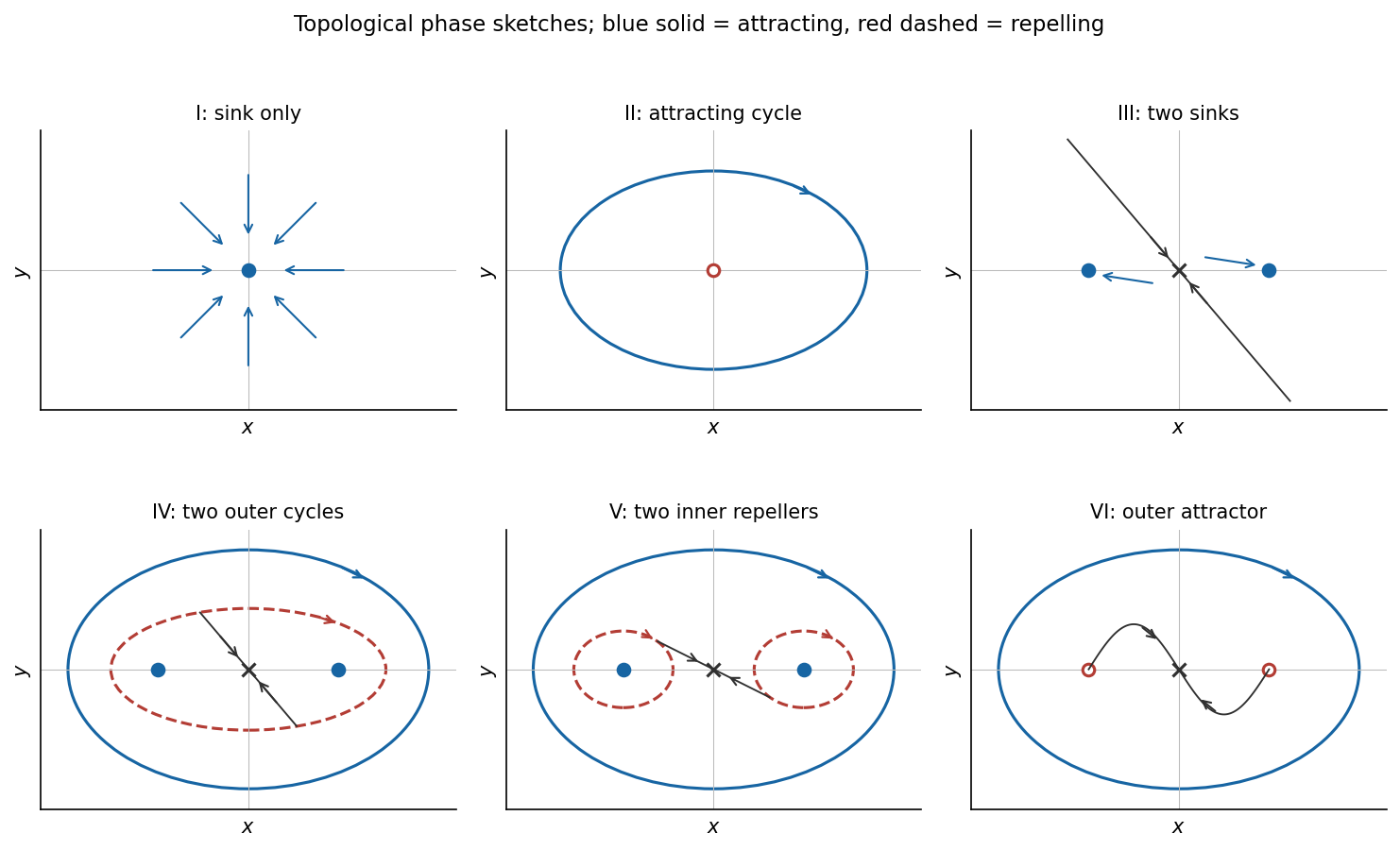
Figure 1.
The six local phase-portrait types; solid cycles attract and dashed cycles repel
. Details. 
Articles by others on the same topic
There are currently no matching articles.