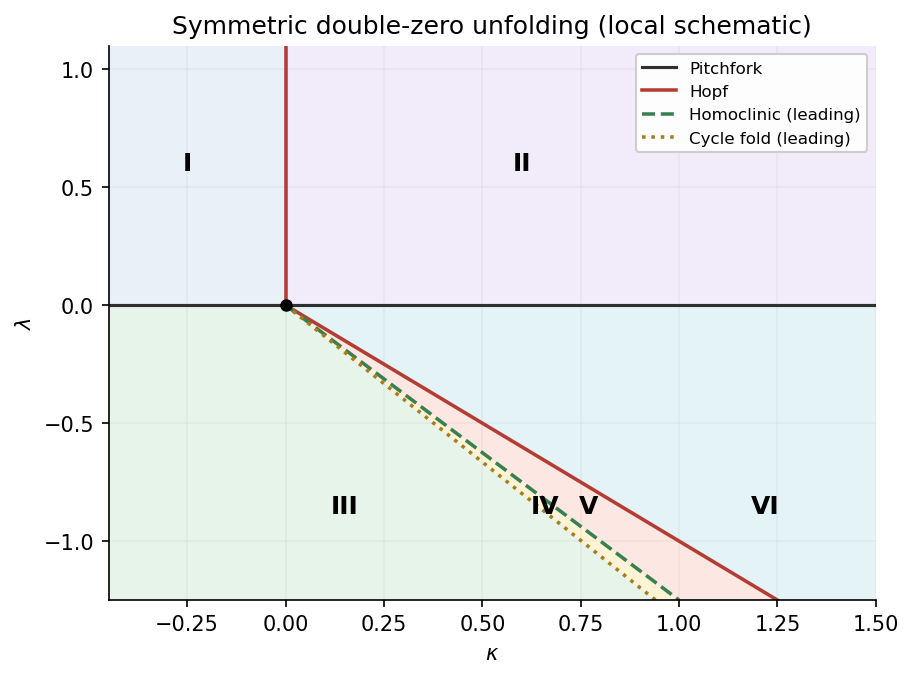
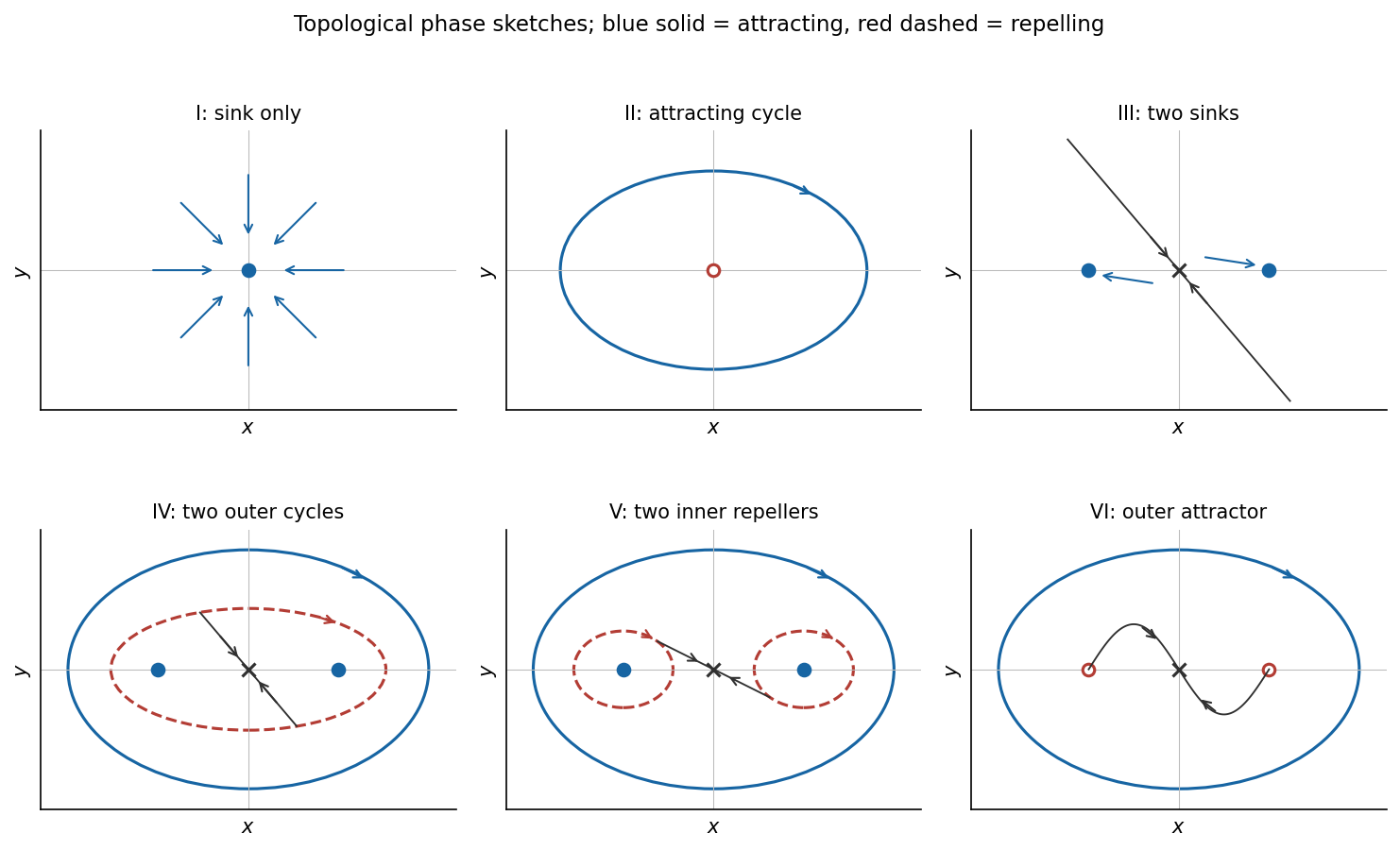
For κ=0 on the pitchfork curve, a leading centre-manifoldequation is x˙=(λx+x3)/κ+⋯. For κ<0, with unfolding parameter −λ, the pitchfork is supercritical and creates two sink equilibria from a sink equilibrium that becomes a saddle equilibrium. For κ>0 it is subcritical in the centre direction; the nonzero branches are unstable, and the transverse eigenvalue is also positive. The origin of parameter space is a reflection-symmetric double-zero degeneration.
To determine Hopf criticality at the origin, use the energyE=y2/2+λx2/2+x4/4, whose derivative is (κ−x2)y2. For a small nearly harmonicoscillation x=Rcos(λt), averaging gives R˙=κR/2−R3/8+⋯. Thus this Hopf bifurcation is supercritical and creates an attracting periodic orbit for κ>0. By the supplied opposite-criticality fact, the simultaneous Hopf bifurcations at the two nonzero equilibria are subcritical. A direct calculation confirms this: writing x=−λ+X, Y=−y/−2λ puts the cubic radial coefficient at 1/4>0, including the contribution from the quadratic terms.
The figure includes these local curves and the global curves derived below. All lines emerging from the double-zero point are local asymptotic sketches.
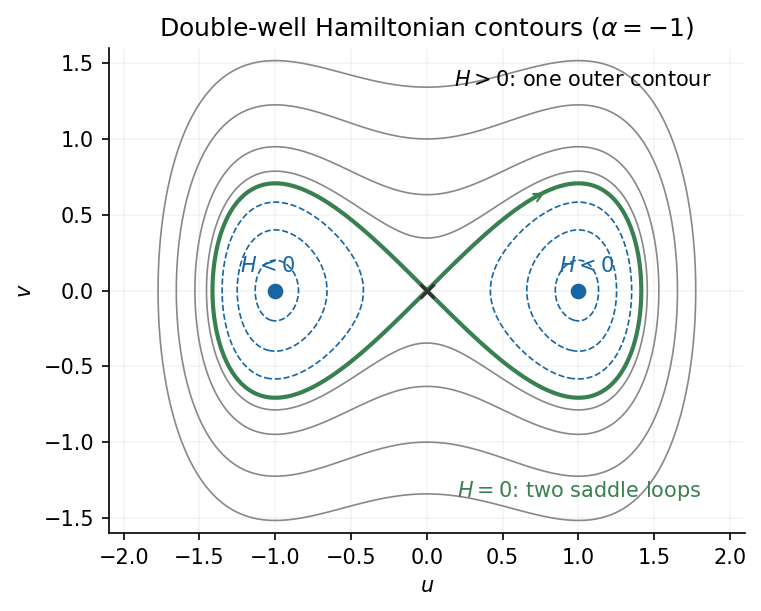
For α=−a02<0, the potential is a double well. Its minima are at u=±a0, where H=−a04/4; these are centre equilibria. The origin is a saddle equilibrium and has H=0. Energies −a04/4<H<0 give two separate closed contours, one in each well. Energies H>0 give a single closed contour surrounding both wells. The intervening figure-eight consists of two homoclinic loops:
At H=0, B=4/5. The derivative of the denominator diverges positively there, while that of the numerator stays finite, so B initially decreases. Rescaling at large H gives B(H)∝H, so it eventually increases. At its minimum the stable and unstable selected periodic orbits meet. Thus the outer-cycle fold in a weakly perturbed double-well oscillator has κfold=cf(−λ)+o(∣λ∣) with 0<cf<4/5; quadrature gives cf≃0.75226. The decreasing portion of B(H) selects the unstable periodic orbit, and the increasing portion selects the stable one, since the energy drift has sign β−B(H).