Put , so and . The second equilibrium equation factors as . The resulting equilibria areThe mixed pair exists strictly when ; equality describes its merger with an axial equilibrium. At the eigenvalues of the Jacobian matrix are , and at they are . At a nonzero mixed equilibrium,Thus both mixed equilibria are saddle equilibria. The axial equilibria are nodes when their two real eigenvalues have the same sign and saddles when the signs differ. In particular,There are exactly three local bifurcation lines away from their common codimension-two intersection. On , and meet in a transcritical bifurcation, visible in on the invariant axis . On , the mixed pair meets in a pitchfork bifurcation. Eliminating near , for fixed nonzero , gives : this pitchfork is supercritical for and subcritical for . On , the mixed pair meets . Writing and , elimination gives . This pitchfork is subcritical for and supercritical for . A supercritical pitchfork here need not produce a stable mixed state: its other eigenvalue can already be positive. The negative mixed Jacobian determinant settles the full stability question. There is no Hopf bifurcation in this quadratic truncation.
Along , the axial curves are and . The mixed pair has the same plotted amplitude for its two signs of :Consequently the mixed curves exist outside the interval whose endpoints are and . The stable portions of the axial curves areFor , stability passes directly from to at the transcritical bifurcation ; the two pitchfork bifurcations lie at and . For , loses stability at and becomes stable only at . Between these points none of the equilibria is stable. This local statement does not prescribe a bounded attractor of the quadratic truncation. All mixed portions are unstable.
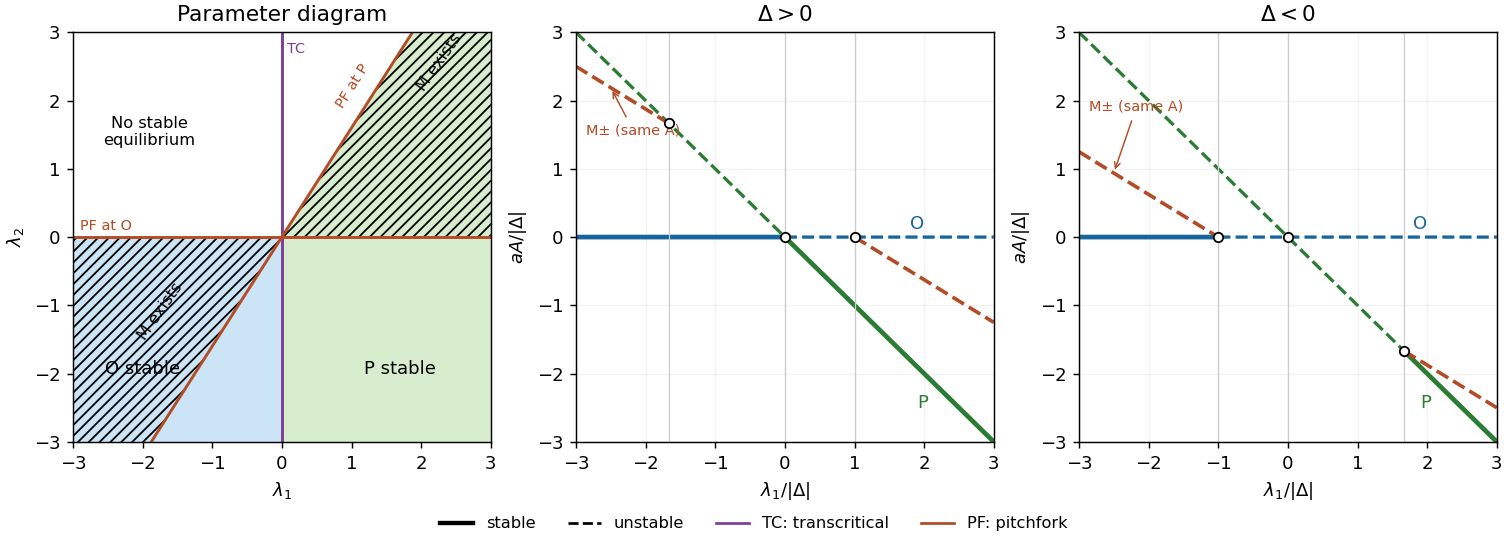
Even-odd mode bifurcations and amplitude branches; solid branches are stable, dashed branches unstable
. Details. 
Articles by others on the same topic
There are currently no matching articles.