The linearization at the zero solution is the self-adjoint differential operator , with domain satisfying both endpoint conditions. The Dirichlet boundary condition for on gives the orthogonal eigenfunctions and . Their second derivatives are multiples of themselves, so the additional condition is automatic. Completeness of the Dirichlet eigenfunctions also shows that these exhaust the spectrum of the polynomial operator . Set ; each eigenfunction has growth rate . Hence the stationary bifurcation thresholds areEquality of the first two thresholds requires to be the midpoint of and , since these numbers are distinct. ThereforeAt this point the even and odd lowest eigenfunctions become neutral simultaneously.
At the double threshold, . For , , so and every remaining eigenvalue is strictly negative. There is a spectral gap separating this two-dimensional kernel from the stable modes. The centre manifold theorem therefore gives a two-dimensional state centre manifold, withIf the two detuning parameters are adjoined as variables with zero time derivatives, the extended centre manifold has total dimension four; its state fibers still have dimension two.
The only nontrivial spatial symmetry of the bounded interval is the reflection . Since is even and odd, its group action on the amplitudes is . Thus equivariance requires to be even and odd in . There is no sign symmetry , because the quadratic nonlinearity breaks it. The general smooth form is , , with the zero solution preserved. The quadratic even-odd mode interaction follows on truncation:Writing and , the exact linear growth rates are and . To first order in detuning,The orthogonal projection of the quadratic term onto the neutral eigenfunctions determines the leading coefficients. Both eigenfunctions have squared norm one, and parity kills the unwanted products. The quadratic correction contributes no term through , since is self-adjoint and the projected modes lie in its kernel. ConsequentlyThese projections are also a concrete way of computing the normal form. In this normalization they give , and , consistent with the stated coefficient ratios.
Put , so and . The second equilibrium equation factors as . The resulting equilibria areThe mixed pair exists strictly when ; equality describes its merger with an axial equilibrium. At the eigenvalues of the Jacobian matrix are , and at they are . At a nonzero mixed equilibrium,Thus both mixed equilibria are saddle equilibria. The axial equilibria are nodes when their two real eigenvalues have the same sign and saddles when the signs differ. In particular,There are exactly three local bifurcation lines away from their common codimension-two intersection. On , and meet in a transcritical bifurcation, visible in on the invariant axis . On , the mixed pair meets in a pitchfork bifurcation. Eliminating near , for fixed nonzero , gives : this pitchfork is supercritical for and subcritical for . On , the mixed pair meets . Writing and , elimination gives . This pitchfork is subcritical for and supercritical for . A supercritical pitchfork here need not produce a stable mixed state: its other eigenvalue can already be positive. The negative mixed Jacobian determinant settles the full stability question. There is no Hopf bifurcation in this quadratic truncation.
Along , the axial curves are and . The mixed pair has the same plotted amplitude for its two signs of :Consequently the mixed curves exist outside the interval whose endpoints are and . The stable portions of the axial curves areFor , stability passes directly from to at the transcritical bifurcation ; the two pitchfork bifurcations lie at and . For , loses stability at and becomes stable only at . Between these points none of the equilibria is stable. This local statement does not prescribe a bounded attractor of the quadratic truncation. All mixed portions are unstable.
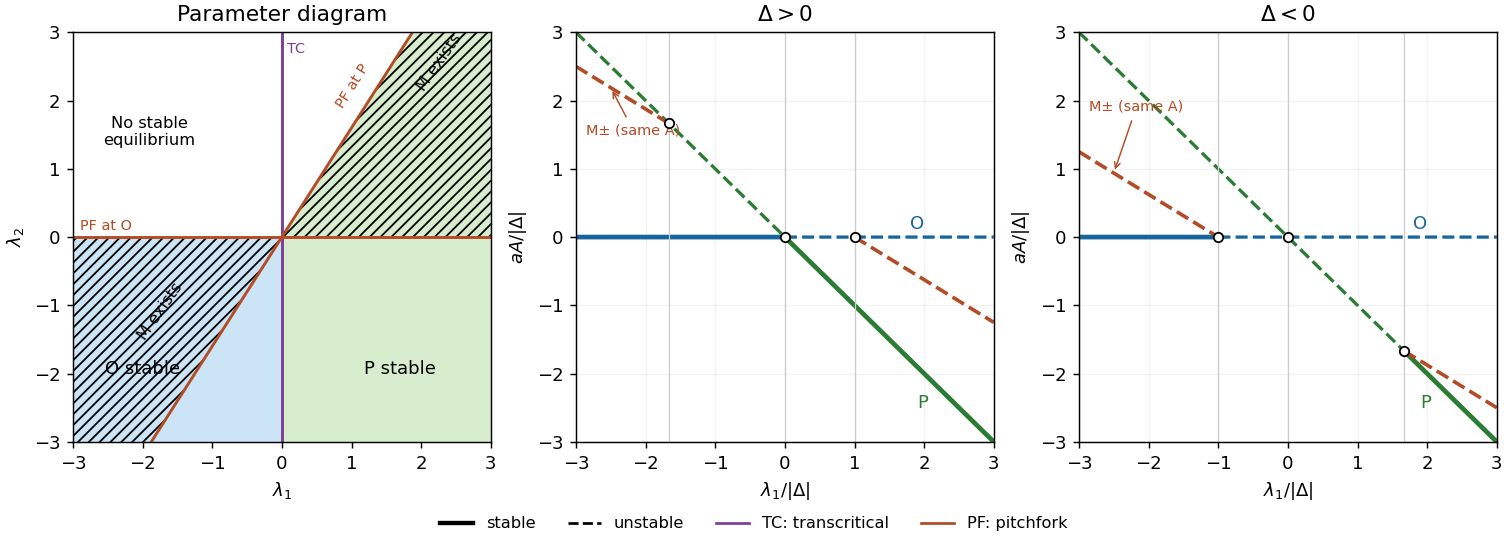
Even-odd mode bifurcations and amplitude branches; solid branches are stable, dashed branches unstable
. Details. 
Articles by others on the same topic
There are currently no matching articles.